

KF-21 rollout and Korea’s bid to become a strategic state
Published: 31 Mar. 2026, 00:03
Audio report: written by reporters, read by AI
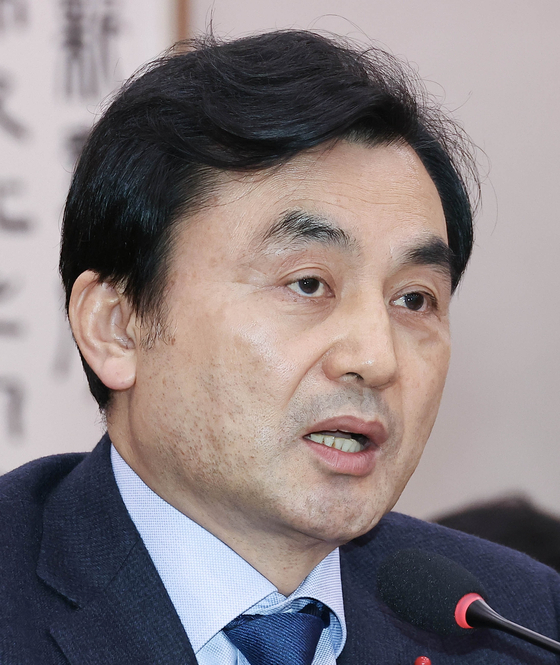
The author is the Minister of National Defense.
The rollout of the first mass-produced KF-21 fighter jet, Boramae, on Wednesday at Korea Aerospace Industries in Sacheon, South Gyeongsang, marked a milestone in Korea’s pursuit of self-reliant defense. The unveiling of the aircraft, developed through years of sustained national effort, generated both pride and reflection. While the achievement is significant, it also underscores that Korea has yet to complete its transition toward full strategic autonomy.
![The KF-21 fighter jet at the launching ceremony on March 25 at the Korea Aerospace Industries headquarters in Sacheon, South Gyeongsang. [NEWS1]](https://koreaseafood.online/data/photo/2026/03/31/caafba18-8339-4a80-b5cf-1d47130dad26.jpg)
The KF-21 fighter jet at the launching ceremony on March 25 at the Korea Aerospace Industries headquarters in Sacheon, South Gyeongsang. [NEWS1]
The KF-21 program traces back to March 2001, when then-President Kim Dae-jung first presented its blueprint. Since 2015, approximately 64,500 personnel, including researchers, engineers and industry workers, have participated in the development process. Before the rollout of the first production model, six prototypes conducted 955 ground tests and 1,601 flight tests. The aircraft is scheduled to undergo further performance verification before being deployed to the Air Force in September.
For decades, Korea has functioned within what may be described as a “tactical state,” operating largely within a given international order rather than shaping it. Although the country has risen in global standing, ranking fifth in conventional military power and entering what is often referred to as the Kospi 6000 era, its level of strategic autonomy has not fully matched its economic and military status.
The long service of the F-4 Phantom and F-5 fighter jets illustrates this limitation. These aircraft protected Korea’s airspace for more than half a century, supported by the dedication of domestic maintenance crews. However, as systems dependent on foreign design and supply, they faced inherent constraints in adapting to rapidly changing operational environments.
Recent conflicts, including those in the Middle East and the war between Russia and Ukraine, demonstrate that modern warfare has evolved into a complex, multi-domain battlespace integrating cyber and electromagnetic operations. In this context, the notion that those who design weapons ultimately shape the battlefield has become increasingly evident. Control over weapons development is closely linked to control over strategic planning.
The KF-21 stands at a turning point in this transformation. It is not merely a high-performance multirole fighter but also an advanced platform equipped with technologies such as an active electronically scanned array radar. More importantly, it provides Korea with the capability to design and manage key aspects of the aerial battlespace, marking a shift toward greater strategic initiative.
Historical experience shows that technological leadership plays a decisive role in determining national power. Countries that led the Industrial Revolution continue to occupy dominant positions in the global system. In the security domain, leading nations maintain strict controls on critical technologies through frameworks such as the International Traffic in Arms Regulations and the Missile Technology Control Regime, limiting access for others.
Among these technologies, advanced aircraft engines remain one of the most challenging barriers. Often referred to as the crown jewel of aerospace engineering, they are independently produced by only a few countries, including the United States, Britain, France, Russia and China. The KF-21 still relies on foreign-made engines, highlighting a significant vulnerability. Achieving domestic capability in this area is essential for Korea’s transition to a fully fledged strategic state.
The path forward is not easy. While Korea is beginning to cultivate its own capabilities, advanced countries have already established mature technological ecosystems. Nevertheless, the success of the KF-21 program has helped dispel much of the earlier skepticism. The project demonstrated that sustained investment and coordination can overcome initial doubts and deliver tangible results.
Confidence is now growing across the defense sector. The firm commitment of the military, the accumulated expertise within the defense industry and the expanding ecosystem of materials, parts and equipment suppliers are increasingly aligning. The foundation for technological self-reliance is becoming more robust than at any point in the past.
![The Korean fighter jet KF-21 “Boramae” is seen during a test flight on Nov. 29, 2024. [NEWS1]](https://koreaseafood.online/data/photo/2026/03/31/39e930c5-54e7-48fb-8a0c-bd0b44160732.jpg)
The Korean fighter jet KF-21 “Boramae” is seen during a test flight on Nov. 29, 2024. [NEWS1]
The development of indigenous advanced aircraft engines would have far-reaching implications. Militarily, it would support the advancement of manned-unmanned teaming systems and high-performance unmanned aerial vehicles, significantly enhancing air power. Industrially, it could drive growth in related sectors, including advanced ship engines, industrial gas turbines and new materials. The broader economic impact is projected to exceed 18 trillion won ($11.8 billion), reinforcing Korea’s ambition to become a leading technological nation.
The Korean concept of jagang bulsik, or unceasing self-strengthening, captures the spirit behind these efforts. The mass production of the KF-21 represents a meaningful outcome of that principle, but it should be regarded as a starting point rather than a conclusion. Continued progress will require sustained commitment and coordination across government and industry.
The Ministry of National Defense will work closely with relevant agencies, including the Ministry of Trade, Industry and Energy, the Ministry of Science and ICT and the Defense Acquisition Program Administration, to ensure that critical gaps are addressed and that support is extended to vulnerable sectors. Through such efforts, Korea aims to advance toward a more independent and capable defense posture.
Public trust and support will remain essential as Korea continues its journey toward becoming a strategic state capable of shaping its own security environment and contributing more actively to regional and global stability.
This article was originally written in Korean and translated by a bilingual reporter with the help of generative AI tools. It was then edited by a native English-speaking editor. All AI-assisted translations are reviewed and refined by our newsroom.


with the Korea JoongAng Daily
To write comments, please log in to one of the accounts.
Standards Board Policy (0/250자)