

Tigers and Magpies [Photo Essay Contest - Gold Prize Winner]
Published: 13 Mar. 2026, 17:34
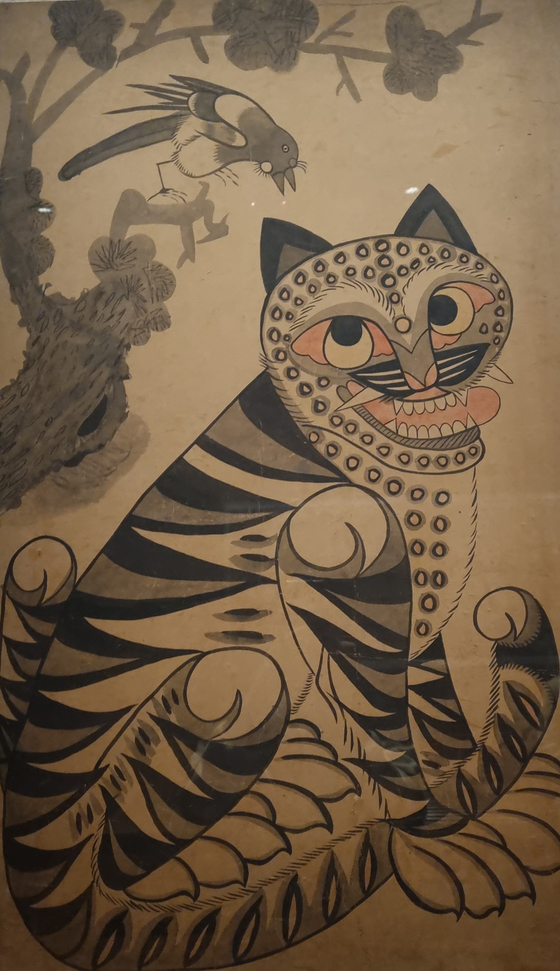
by Andrew Park, Yeoul Elementary School
Countries have their own representative animals. For example, the U.S. has the bald eagle, China has the giant panda, and Australia has the kangaroo and the koala. In the same, South Korea has its own symbolic animals: the tiger and the magpie. Thus, I want to explain about their meanings and how they described by Koreans.
First, I will explain the meaning of the magpie and the tiger. In contrast to crows, magpies have always been a symbol of fortune. Korean ancestors believed this because magpies have keen senses. So, when the stranger appeared, they would chirp to alert the villagers. In the past, the arrival of a visitor was a big event, and magpies were thought to be harbingers of good news. This led to the saying “When a magpie cries, a welcome guest is coming.” Furthermore, farmers have a positive view to magpies because they ate pests that damage crops. Next, Korean ancestors believed that the guardian of the mountains lived inside a deep forest. Additionally, it has a holy power and could control a spiritual order. Thus, the Korean ancestors believed that a tiger-the top predator in Korea-is maintaining a peace of mountains as an order of the guardian spirit.
Second, from an artistic perspective, magpies represent the commoners while tigers often symbolize corrupt officials. Unlike the image of a holy guardian spirit, in ‘Hojakdo’- a popular Korean art-tigers are usually depicted as foolish. This reflects commoners’ desire to expose a falsity of corrupt officials’ power. Also, by drawing scary person to a funny person, they could relieve a psychological oppression. For example, Shin Jae-hyun’s Hojakdo created in 1874 depicts a tiger with crossed eye and a foolish smile instead of scary, sharp teeth. Interestingly, the magpie sits on the pine tree and looks down at the tiger confidently. This simple composition sends a powerful message that tiger cannot defeat the magpie. This cannot happen in real life. However, through these paintings, commoners could express their hope to live free from any corrupt officials. Furthermore, it allowed them to feel a victory.
In conclusion, magpie and tiger have its meaning, commoners and corrupt officials. They often drawn by Hojakdo that depict tiger silly and foolish. This composition gives a catharsis to the commoners. Furthermore, drawing Hojakdo is the only way that ordinary people can relieve stress of corrupt officials. If I was a common people, I will draw a lot of it to relieve a stress. I was very interested at it because it is very similar to the poem. This is because poem often uses metaphor to satire. Like these reasons, tigers and magpies have their meanings and the ‘Hojakdo’ reflects the stress of the ordinary people because of corrupt officials. I hope you to appreciate Hojakdo sometime-it is better than just reading my essay!


with the Korea JoongAng Daily
To write comments, please log in to one of the accounts.
Standards Board Policy (0/250자)