

Won hits 17-year low as fears of prolonged war and energy disruption grow
Published: 09 Mar. 2026, 18:13
-

- JIN MIN-JI
- [email protected]
![Electronic display boards at Hana Bank's dealing room shows Korea's ifnancial markets on March 9. [JOONGANG ILBO]](https://koreaseafood.online/data/photo/2026/03/09/96511002-ab31-4274-b33d-43252e9cc11f.jpg)
Electronic display boards at Hana Bank's dealing room shows Korea's ifnancial markets on March 9. [JOONGANG ILBO]
The Korean won fell to its weakest level in 17 years on Monday, nearing 1,500 per dollar, as the U.S.-Israeli war with Iran escalated after Tehran named Mojtaba Khamenei successor to his father, Ali Khamenei, fueling fears of prolonged disruption to energy supplies.
The won traded at 1,495.5 per dollar at 3:30 p.m., falling 19.1 won from the previous session, to hit its weakest level since March 12, 2009, when the won stood at 1,496.5 per dollar during the global financial crisis.
Stock markets also tumbled, with the Kospi plunging 5.96 percent to 5,251.87 points. Individual investors sustained the market as they bought a net 4.62 trillion won ($3.01 billion), while foreign and institutional investors off-loaded a net 3.18 billion won and 1.53 trillion won, respectively. The tech-heavy Kosdaq sank 4.54 percent to 1,102.28 points. The Japanese market also suffered, with the Nikkei 225 losing more than 7 percent during trading in its steepest decline since April of last year.
Shortly after the opening bell, the Korea Exchange (KRX) activated a sell-side sidecar after Kospi 200 futures index moved by 5 percent or more for at least one minute. The measure was also activated just three trading days earlier. The KRX also activated a circuit breaker on the Kospi, after the benchmark index stayed 8 percent below the previous sessions’ level for one minute. The sell-side sidecar was also activated on Kosdaq.
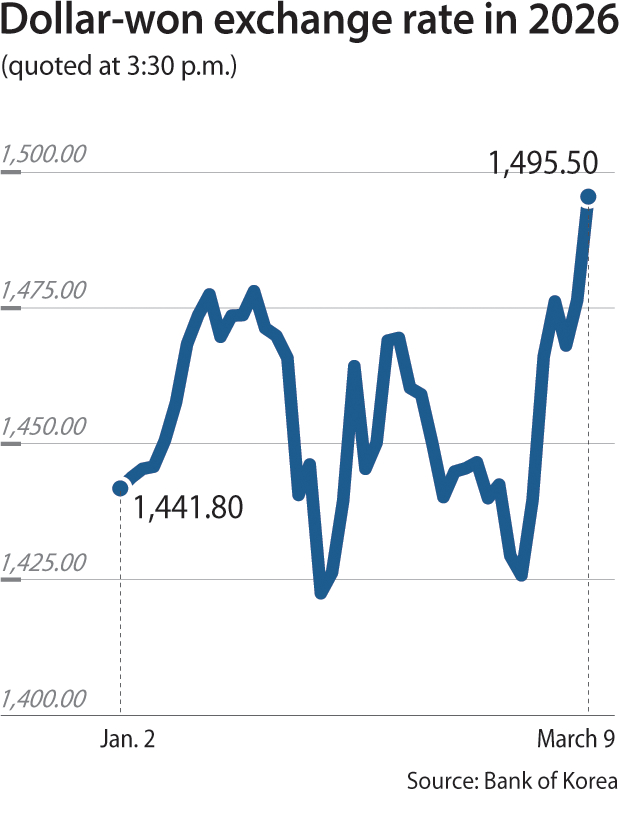
Financial markets plunged as geopolitical tensions escalated over the weekend, after the United States and Israel launched fresh waves of airstrikes across Iran that hit multiple targets such as oil depots. The disruption to energy supplies sent the U.S. benchmark West Texas Intermediate futures up more than 20 percent to their highest level since mid 2022, above $110 per barrel, heightening fears of rising inflation and an economic slowdown.
Goldman Sachs has warned that global oil prices could reach $150 per barrel by the end of the month as it had anticipated that flow of crude through the Strait of Hormuz, a critical maritime chokepoint for global oil and liquefied natural gas shipments over which Iran exercises significant influence, would decline to 15 percent of normal levels. That could take a major toll on Korea, which relies heavily on energy imports.
![People wait in line at the currency exchange booth in Myeongdong, central Seoul, on March 9. [YONHAP]](https://koreaseafood.online/data/photo/2026/03/09/67d98c6a-572e-48be-8b38-b2e6f146a4af.jpg)
People wait in line at the currency exchange booth in Myeongdong, central Seoul, on March 9. [YONHAP]
“The current exchange rate is considered an overshoot relative to fundamentals,” said Oh Jae-young, a foreign exchange analyst at KB Securities, noting the country’s current account, which logged 13.3 billion dollars in surplus in January —- the fifth largest on record. “However, since the current account could decline if oil prices change, the movement of oil prices is seen as having the greatest impact on the current exchange rate,” she added, noting potential government intervention to prevent the further weakening of the won.
As the situation escalated, President Lee Jae Myung chaired an emergency meeting with ministries to assess economic conditions —- including oil prices and the exchange rate —- and to discuss interministerial response measures. The Bank of Korea said on the same day that it would take “appropriate market stabilization measures, if necessary,” noting that risk-off sentiment in global financial markets had risen sharply as oil prices surged on concerns of prolonged tensions, compounded by weak U.S. employment data.
The stock market decline was largely driven by the chip industry, with market bellwether Samsung Electronics falling 7.81 percent to 173,500 won, and its rival SK hynix dropping 9.52 percent to 836,000 won.
LG Energy Solution fell 4.77 percent to 359,500 won, and Samsung SDI plunged 5.24 percent to 389,000 won, while financial firms KB Financial dipped 3.26 percent to 142,600 won and Shinhan Financial Group decreased 3.59 percent to 88,500 won. SK Gas, a liquefied petroleum gas supplier, gained 5.4 percent to 244,000 won, while trading company Posco International rose 4.5 percent to 76,600 won as investors grew optimistic about the firm’s energy business portfolio.
“Higher oil prices could take a negative toll on the trade balance and compress margins in energy-intensive sectors such as semiconductors, automobiles and chemicals,” said Kim Seok-hwan, an analyst at Mirae Asset Securities, in a Monday report. “In a global risk-off phase, emerging markets like Korea are typically the first to be liquidated.” Nevertheless, if U.S. President Donald Trump’s target of ending operations within a month is achieved and shipping through the Strait of Hormuz resumes, the geopolitical risk premium built into the market is likely to evaporate rapidly, Kim added.
BY JIN MIN-JI [[email protected]]


with the Korea JoongAng Daily
To write comments, please log in to one of the accounts.
Standards Board Policy (0/250자)