

SK hynix shares have jumped over 99% this year. Why haven't Samsung's?
Published: 03 May. 2026, 07:00
-

- KIM JI-YE
- [email protected]
![The entrance to Samsung Electronics' office in Seocho District, southern Seoul, on March 18 [NEWS1]](https://koreaseafood.online/data/photo/2026/05/03/ae061296-ca2b-4d14-9583-4f0c42633804.jpg)
The entrance to Samsung Electronics' office in Seocho District, southern Seoul, on March 18 [NEWS1]
A widening gap in stock prices between Samsung Electronics and SK hynix shares is raising concerns among investors as the two memory giants diverge sharply in performance.
SK hynix shares have surged more than 20 percent since Feb. 27 — before the conflict in the Middle East began — when it stood at 1.06 million won ($714), but Samsung Electronics shares have only edged slightly above their prewar level.
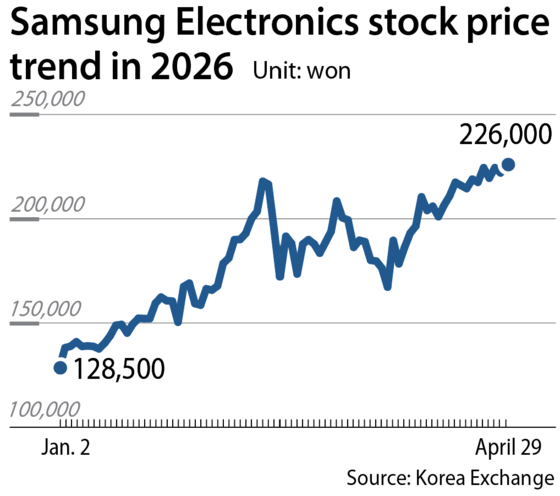
Samsung Electronics shares closed at 226,000 won on Friday, up 1.8 percent from the previous day.
“If SK hynix shares are at 1.3 million won, shouldn’t Samsung Electronics shares be above 260,000 won by now?” a Samsung Electronics shareholder surnamed Kim said. “I’ve even heard that SK hynix shares could go up to 1.9 million won, so I’m wondering if I should switch.”
As the gap in gains between the two stocks continues to widen despite shared optimism over the so-called memory supercycle, some investors have even described SK hynix as “a two-times leveraged version of Samsung Electronics.”
![An electronic screen in Hana Bank's trading room in central Seoul shows the Kospi closing at 6,690.90 on April 29. [NEWS1]](https://koreaseafood.online/data/photo/2026/05/03/c19e0c6c-d819-4ec1-94e3-8085bff87cd0.jpg)
An electronic screen in Hana Bank's trading room in central Seoul shows the Kospi closing at 6,690.90 on April 29. [NEWS1]
The Kospi closed at 6,690.90 on Friday, up 0.75 percent from the previous day, marking a third consecutive record high, according to the Korea Exchange. SK hynix shares fell 0.54 percent to close at 1.29 million won, giving up the “1.3 million hynix” milestone reached a day earlier, though expectations for further gains remain strong.
So far this year, SK hynix shares have risen 99 percent, compared to an 88 percent increase for Samsung Electronics.
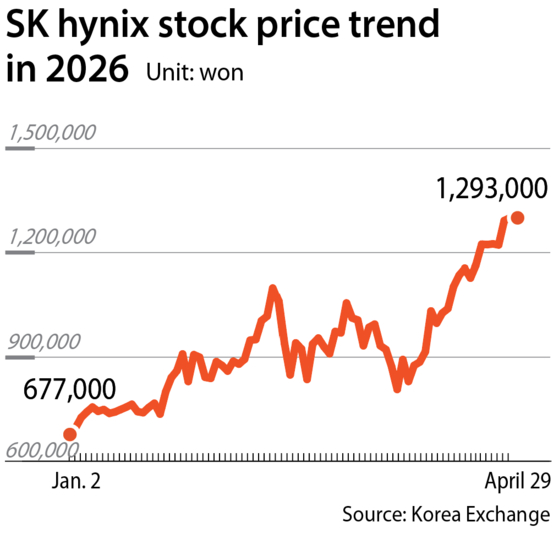
Since the cease-fire between the United States and Iran, the gap has widened further.
From April 8 to Friday, Samsung Electronics rose 15 percent, while SK hynix jumped 41 percent. On days when SK hynix gained 3 to 4 percent, Samsung Electronics often either fell or rose by just 1 to 2 percent.
The differing momentum largely stems from differences in their business structures.
As a semiconductor-focused company centered on high bandwidth memory, or HBM, SK hynix tends to see its stock price move directly in line with semiconductor performance. Samsung Electronics, by contrast, is a diversified electronics company, with businesses spanning memory chips, foundry, system semiconductors, smartphones and home appliances. As a result, weakness in any of these divisions can weigh on its overall valuation.
![Members of Samsung Electronics' labor union hold a large-scale rally near the company’s Pyeongtaek campus in Gyeonggi on the afternoon of April 23. [JOONGANG ILBO]](https://koreaseafood.online/data/photo/2026/05/03/c758ae7b-a6ed-422d-9f02-4038bee0d27e.jpg)
Members of Samsung Electronics' labor union hold a large-scale rally near the company’s Pyeongtaek campus in Gyeonggi on the afternoon of April 23. [JOONGANG ILBO]
Recent concerns over a potential general strike by a union group comprising multiple Samsung Electronics labor unions have further unsettled investors and become another factor weighing on Samsung Electronics shares.
Since March, the company’s unions, demanding higher performance-based pay, have threatened to go on a general strike starting May 21.
“There are no major external headwinds, so the only explanation for the lack of momentum is the union group,” said another Samsung Electronics shareholder. “I hope that an agreement [between the company and unions] is reached as soon as possible.”
In an open chat room of the company’s investors, people were much angrier.
“We, too, should go on strike,” an investor in the chat room wrote on Monday. Another posted, “I’ll only use Apple products from now on.”
One investor wrote, “I won’t even buy a house in Samseong-dong.” The Samseong in Samseong-dong in Gangnam District, southern Seoul, is pronounced the same as Samsung in Samsung Electronics.
Market watchers warn that if a strike actually goes into action, it could lead to production disruptions and earnings uncertainty.
“During the strike in July 2024, only about 15 percent of union members participated,” said Kim Dong-won, the head of research at KB Securities. “But if this strike goes ahead, 30,000 to 40,000 workers, or 30 to 40 percent of the union, could participate, making production disruptions inevitable compared to [the situation] two years ago.”
This article was originally written in Korean and translated by a bilingual reporter with the help of generative AI tools. It was then edited by a native English-speaking editor. All AI-assisted translations are reviewed and refined by our newsroom.
BY JANG SEO-YUN [[email protected]]


with the Korea JoongAng Daily
To write comments, please log in to one of the accounts.
Standards Board Policy (0/250자)