

Samsung Electronics moves to outsource dishwashers, microwaves amid restructuring
Published: 28 Apr. 2026, 19:09
![Samsung Electronics exhibition hall at KBIS 2026 [SAMSUNG ELECTRONICS]](https://koreaseafood.online/data/photo/2026/04/28/f85e3a78-0f8f-4a47-a313-2f924ff68033.jpg)
Samsung Electronics exhibition hall at KBIS 2026 [SAMSUNG ELECTRONICS]
Samsung Electronics has begun restructuring its business, focusing on outsourcing the production of certain home appliances, including dishwashers and microwave ovens.
While the company posted record first-quarter earnings driven by a semiconductor boom, the move is seen as an effort to shift toward a profitability-focused structure as its consumer appliance business continues to struggle.
Samsung Electronics’ Digital Appliance (DA) Business division recently held a management briefing for employees to share the direction of its restructuring and mid- to long-term business strategy, according to industry sources on Tuesday.
The plan includes shutting down some product lines and converting them to outsourced production. The company is also reportedly reviewing the possibility of closing down the Malaysia plant, which has served as an overseas production base since 1989.
The restructuring aims to fundamentally improve the structure of the company's home appliance business.
Profitability has deteriorated rapidly due to rising component prices and logistics costs, compounded by aggressive low-price competition from Chinese manufacturers. The business environment has also become more uncertain amid slowing global consumption, worsened currency volatility and geopolitical risks. The global appliance market, entering a low-growth phase, is also cited as a factor increasing pressure for restructuring.
Samsung Electronics' main goal is to reduce low-profit product lines and reorganize its business around high-value products.
"The move comes as part of our efforts to adapt to the changing business environment and global demand, with the aim of maximizing efficiency in production and enhancing our competitive edge," a Samsung Electronics official said. "We are planning on taking a flexible approach depending on the specific market conditions."
The company will focus its capabilities on premium product line Bespoke, such as the line’s washing machines, refrigerators and air conditioners.
![Samsung Electronics showcases its Bespoke AI Refrigerator One Door at a showroom in Milan on April 21. [SAMSUNG ELECTRONICS]](https://koreaseafood.online/data/photo/2026/04/28/6d33bd37-a11a-42f5-8043-2849928559dc.jpg)
Samsung Electronics showcases its Bespoke AI Refrigerator One Door at a showroom in Milan on April 21. [SAMSUNG ELECTRONICS]
The so-called new businesses will also be a focus, including heating, ventilation, and air conditioning (HVAC) systems, business-to-business operations and subscription services for home appliances. In particular, it plans to broaden HVAC business opportunities across Europe, North America and Asia in response to growing demand from global data centers and commercial buildings, while accelerating the development of next-generation technologies, such as liquid cooling solutions for data centers.
Samsung Electronics is strengthening its premium strategy by launching a series of new products utilizing AI in the first half of this year, including refrigerators, washing machines, air conditioners, robot vacuum cleaners and clothing care devices. It is also pushing to expand its business-to-business market and to fortify dedicated departments by leveraging AI-powered home solutions centered on SmartThings. Subscription-based services are also being considered for expansion beyond the domestic market into overseas markets.
“This year is the last golden time to innovate the structure of the appliance business,” said Kim Cheol-gi, head of Samsung Electronics’ DA Business division. “We must transition to a profitability-based business through selection and concentration.”
This trend is also linked to the restructuring of its overseas appliance and TV businesses.
Samsung Electronics has been reducing shipments and distribution networks for some products in the Chinese market and is also reorganizing its production bases in Europe. The industry views this not as a simple product adjustment but as an endeavor toward structural efficiency.
![Visitors at the CES 2026 experience the Bespoke AI Family Hub on Jan. 7. [SAMSUNG ELECTRONICS]](https://koreaseafood.online/data/photo/2026/04/28/f359be8f-427e-4993-ab89-26f0639fd364.jpg)
Visitors at the CES 2026 experience the Bespoke AI Family Hub on Jan. 7. [SAMSUNG ELECTRONICS]
Behind this is the aggressive push by Chinese companies. Chinese manufacturers TCL and Hisense are rapidly expanding their market share with price competitiveness and Mini LED technology. Amid market stagnation, the added pressure from low-cost competition is further squeezing profitability.
The impact is also being felt in Europe. Samsung Electronics decided last month to close its TV plant in Galanta, Slovakia, as part of a reorganization of its production structure. The move is driven by the declining profitability of local production, due to slowing growth in the global TV market and rising costs.
The strains are also reflected in earnings. Samsung Electronics’ appliance and TV divisions reported 14.8 trillion won ($10 billion) in revenue in the fourth quarter of last year but posted an operating loss of 600 billion won during the same period.
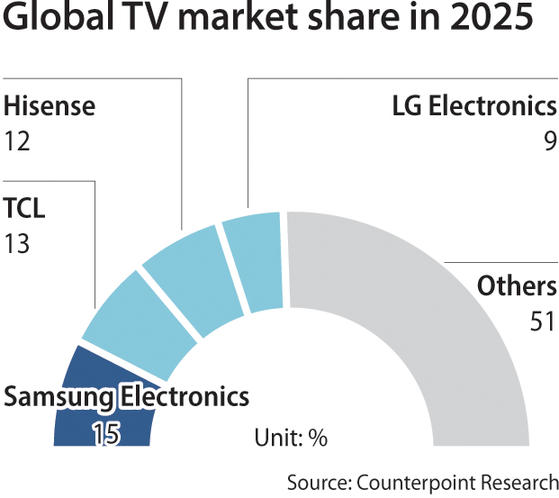
Though the company maintained its No. 1 position in the global TV market with a 15 percent share, competition has intensified with TCL at 13 percent and Hisense at 12 percent, according to Counterpoint Research.
On the other hand, the semiconductor business continues to thrive amid growing demand for AI, widening the performance gap between divisions.
“As both price and technology competition have intensified in the Chinese market, the position of foreign companies has shrunk rapidly,” Shin Joong-ho, head of the research center at LS Securities. “For Samsung Electronics, restructuring the business around profitability is an inevitable choice.”
This article was originally written in Korean and translated by a bilingual reporter with the help of generative AI tools. It was then edited by a native English-speaking editor. All AI-assisted translations are reviewed and refined by our newsroom.
BY PARK YOUNG-WOO [[email protected]]


with the Korea JoongAng Daily
To write comments, please log in to one of the accounts.
Standards Board Policy (0/250자)