

Kospi drops to weakest since Iran war outbreak, won plunges past 1,530
Published: 31 Mar. 2026, 18:20
Updated: 31 Mar. 2026, 19:20
-

- JIN MIN-JI
- [email protected]
![Electronic display boards show Korea's financial market at Hana Bank's trading room in central Seoul on March 31. The Kospi retreated 4.26 percent to 5,052.46 while tech-heavy Kosdaq slipped 4.94 percent to 1,052.39. [NEWS1]](https://koreaseafood.online/data/photo/2026/03/31/e47437c6-9c4d-4051-aa44-5b5087987b5e.jpg)
Electronic display boards show Korea's financial market at Hana Bank's trading room in central Seoul on March 31. The Kospi retreated 4.26 percent to 5,052.46 while tech-heavy Kosdaq slipped 4.94 percent to 1,052.39. [NEWS1]
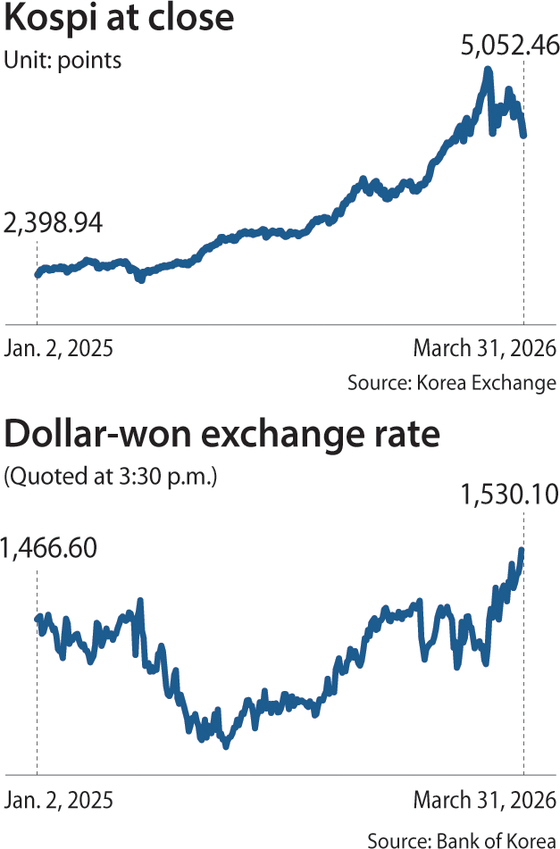
The Kospi tumbled below 5,100 on Tuesday, hitting its weakest level since the outbreak of the Iran war, while the won plunged past 1,530 to the dollar — prompting the central bank to signal possible action — even as the United States indicated a potential end to the conflict.
Extending a four-day losing streak, the main bourse's decline underscores the Korean market’s heightened vulnerability after gaining more than twofold since last year, highlighting its sensitivity to global uncertainty and sharply diverging from the 7,500-8,000 target range projected by foreign investment firms.
The benchmark index fell 4.26 percent to 5,052.46, as foreign investors offloaded a net 3.84 trillion won ($2.5 billion). Institutional and retail investors were net buyers, purchasing 1.03 trillion won and 2.43 trillion won, respectively. The tech-heavy Kosdaq slipped 4.94 percent to 1,052.39.
The Korean market plunged even after U.S. President Donald Trump said on Monday that he is willing to end the war even if the Strait of Hormuz — a key passageway for oil shipments — remains largely closed, according to a report from the Wall Street Journal. That marked a shift from his earlier threat to “obliterate” Iran’s energy grid and oil wells if Tehran did not agree to peace terms and reopen the waterway.
Following the changed stance, U.S. stock futures edged up on Tuesday, with futures tied to the S&P 500 and Nasdaq 100 rising 0.87 percent and 0.86 percent, respectively — in contrast to the local market.
The latest plunge “shows that our country remains particularly vulnerable to external factors,” said Kang Jin-hyuk, a market analyst at Shinhan Securities.
“Korea’s industrial structure — with high dependence on external demand, significant overseas exposure, and an export-oriented economy — makes it deeply sensitive to global developments. Inflation concern is further prompting a reduction in exposure to sectors sensitive to economic cycles, such as semiconductors,” Kang added.
Additional threats to the chip-heavy Kospi include Google’s TurboQuant, which is expected to reduce the demand for memory chips, as well as forecasts from Gartner and TrendForce projecting sharp declines in PC and smartphone shipments in 2026 amid persistent high inflation, according to Lee Jae-won, a market analyst at Yuanta Securities.
gra
As the economy faces mounting pressure, President Lee Jae Myung hinted at the possible issuance of a constitutional emergency economic decree if necessary — a presidential power that can be invoked in times of severe financial crisis, natural disaster or internal unrest without prior approval from the National Assembly.
The recent sell-off was largely driven by foreign investors, who recorded net sales for almost two consecutive weeks since March 19.
On Tuesday, chip giant Samsung Electronics retreated 5.16 percent to 167,200 won, while its rival SK hynix decelerated 7.56 percent to 807,000 won. Automaker Hyundai Motor fell 5.11 percent to 445,500 won, while its sister affiliate Kia declined 4.16 percent to 145,200 won.
Defense giant Hanwha Aerospace fell 4.51 percent to 1,249,000 won, while Samsung Biologics inched down 1.7 percent to 1,504,000 won. Leading shipbuilder HD Hyundai Heavy Industries lost 3.12 percent to 465,000 won.
The won traded at 1,530.1 against the greenback at 3:30 p.m., falling 14.4 won from the previous session and marking its lowest level since March 2009.
As the currency sharply depreciated, the Bank of Korea (BOK) said it is closely monitoring foreign investor outflows from the stock market, adding that it would take action if the won’s deviation from other currencies widens further. The remark came on the same day Shin Hyun-song, the nominee for BOK governor, told reporters that there are no major concerns over the current level of the local currency, citing ample dollar liquidity.
The BOK reported that the foreign exchange authorities sold a net $22.5 billion in the fourth quarter of last year to stabilize the forex market, marking the largest quarterly net sale on record.
BY JIN MIN-JI [[email protected]]


with the Korea JoongAng Daily
To write comments, please log in to one of the accounts.
Standards Board Policy (0/250자)