

Surging import costs put businesses, consumers in almost unprecedented inflation squeeze
Published: 15 Apr. 2026, 19:07
Updated: 15 Apr. 2026, 19:13
-

- MICHAEL LEE
- [email protected]
![A man loads up his vehicle with fuel at a gas station in Seoul on April 15. [YONHAP]](https://koreaseafood.online/data/photo/2026/04/15/a5a7aa9b-9d03-4554-8097-c642d96abf31.jpg)
A man loads up his vehicle with fuel at a gas station in Seoul on April 15. [YONHAP]
The cost of imports is surging on the back of an oil shock and a weakening won, raising concerns about a broadening inflation squeeze on businesses and households — even if the conflict in the Middle East eases.
For small manufacturers, the pressure is already acute. One business owner surnamed Park told the JoongAng Ilbo that his suppliers have demanded price increases of 15 to 30 percent since last month for key components of the self-order kiosks his company produces.
“In more than a decade of running this business, I’ve never seen input costs rise this quickly,” he said. “If costs go up but we can’t fully pass that on to product prices, we’re effectively operating at a loss.”
Park said he may have to scale back factory operations if the trend continues. “I worry about how I can keep paying my employees,” he added.
His concerns reflect a broader surge in import prices, driven by the Iran war and currency weakness. According to the Bank of Korea, the import price index jumped 16.1 percent in March from a month earlier — the steepest monthly increase since January 1998, when the country was in the depths of the Asian financial crisis that began the previous year.
At the center of the spike is oil. Import prices for crude surged 88.5 percent on a month-on-month basis in won terms, the largest increase since records began in 1995. Even if the change in the exchange rate is discounted, the rise was the sharpest since the first oil crisis in 1973.
Global prices have moved in tandem. Dubai crude nearly doubled over the same period, climbing from $68.40 to $128.52 per barrel.
As oil is a key input in many industries, the shock is quickly cascading through the economy. Prices for intermediate goods such as naphtha — a key feedstock for plastics and synthetic materials — rose 46.1 percent, while aviation fuel jumped 67.1 percent. Coal and petroleum products, along with chemical goods, have also posted steep increases, pushing up costs for everything from manufacturing inputs to packaging materials.
The weaker currency has compounded the impact. The won weakened to an average of 1,486.64 per dollar in March from 1,449.32 a month earlier, adding to import cost pressures.
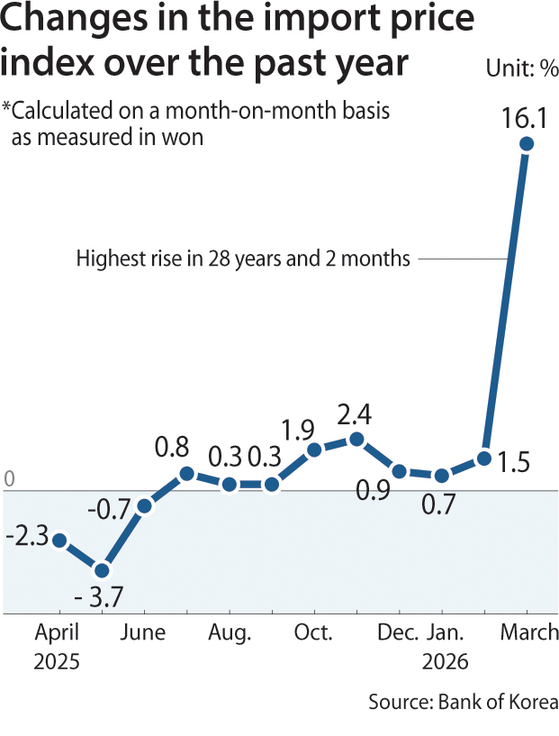
.
The pass-through to consumers is already evident. Gasoline prices are approaching 2,000 won per liter nationwide, while higher feed costs are driving up meat prices in what economists describe as “meatflation.”
According to the Korea Rural Economic Institute, wholesale prices for broiler chickens rose 30.6 percent in March from a year earlier, while duck prices climbed 36 percent. Egg prices also increased by more than 11 percent over the same period.
Rising input costs are expected to spill over further into restaurant prices, raising the prospect of a broader cost-of-living squeeze. Industry observers say the price of a single fried chicken, including delivery, could soon approach 30,000 won.
Even an early cease-fire may offer only limited relief.
“Judging from past crises in the Middle East, shipping costs and insurance premiums tied to risks in the Strait of Hormuz can take weeks to normalize,” said Cho Young-moo, director of NH Financial Research Institute, who added that “disruptions to oil supplies linked to the war could persist and continue to weigh on costs and consumer demand, dampening economic growth.”
The International Monetary Fund on Monday raised its inflation forecast for Korea this year to 2.5 percent, warning that the global economy is once again being tested by geopolitical shocks.
“If the war drags on, there is a risk of stagflation, where rising prices and an economic slowdown occur simultaneously,” said Kang Sung-jin, a professor of economics at Korea University.
He further called on the government to undertake “pre-emptive action and comprehensive measures” in order to minimize the impact on livelihoods and businesses.
This article was originally written in Korean and translated by a bilingual reporter with the help of generative AI tools. It was then edited by a native English-speaking editor. All AI-assisted translations are reviewed and refined by our newsroom.
BY YEOM JI-HYEON, MICHAEL LEE [[email protected]]


with the Korea JoongAng Daily
To write comments, please log in to one of the accounts.
Standards Board Policy (0/250자)