

Surge in renovation and housing costs dissuades people from moving
Published: 16 Apr. 2026, 15:05
Audio report: written by reporters, read by AI
![People look out at apartments from a hill in Seoul on March 10. [NEWS1]](https://koreaseafood.online/data/photo/2026/04/16/11e4320a-adcf-4408-a653-a76f95375cf6.jpg)
People look out at apartments from a hill in Seoul on March 10. [NEWS1]
When Yoon, an office worker in Dobong District, northern Seoul, began planning a move closer to his in-laws in Namyangju, Gyeonggi, he decided to try to find a larger home to accommodate not only him and his wife but also the child that they were planning to have.
Then came the cost estimates.
The quotes he received for even a minimal renovation of a standard 84-square-meter (904-square-feet) apartment — limited to just remodeling the kitchen and bathrooms and replacing the wallpaper and flooring — had risen by about 70 million won ($47,500) compared to three years ago.
Even the price of hiring a moving company had climbed from 1.6 million won to 2 million.
With housing prices up by roughly 200 million won and interest rates pushing his monthly loan payments up by an additional 500,000 won, Yoon said he was reconsidering the move.
“I’m wondering if it might be better to stay where we are and hire a part-time babysitter instead,” he said.
His hesitation reflects a broader change in Korea’s housing market, in which surging costs associated with moving — which includes renovation, logistics and securing a lease — are discouraging mobility even during the traditional spring moving season.
The effect is already showing up in relocation statistics.
About 615,000 people moved residences nationwide in February, down 11.5 percent compared to a year earlier and below the four-year average for the month, according to government data. The annual figure has also declined, with 6.12 million people changing residences last year — a 2.6 percent drop and the lowest figure in more than five decades.
![Yoo Soo-deok, an official at Statistics Korea, announces annual relocation data at the government complex in Sejong on Sept. 29, 2025. [NEWS1]](https://koreaseafood.online/data/photo/2026/04/16/638acf5d-f6ff-42e5-8cb3-4f054699abdb.jpg)
Yoo Soo-deok, an official at Statistics Korea, announces annual relocation data at the government complex in Sejong on Sept. 29, 2025. [NEWS1]
While long-term demographic shifts such as aging and a declining birthrate are factors, economists say the immediate pressure of rising costs is playing a more tangible role.
“For households, the increase in housing prices and moving-related expenses is likely to be felt more directly than structural factors,” said Yang Jun-sok, an economics professor at the Catholic University of Korea.
At the core of the trend is a sharp rise in the prices of key construction materials over the past five years.
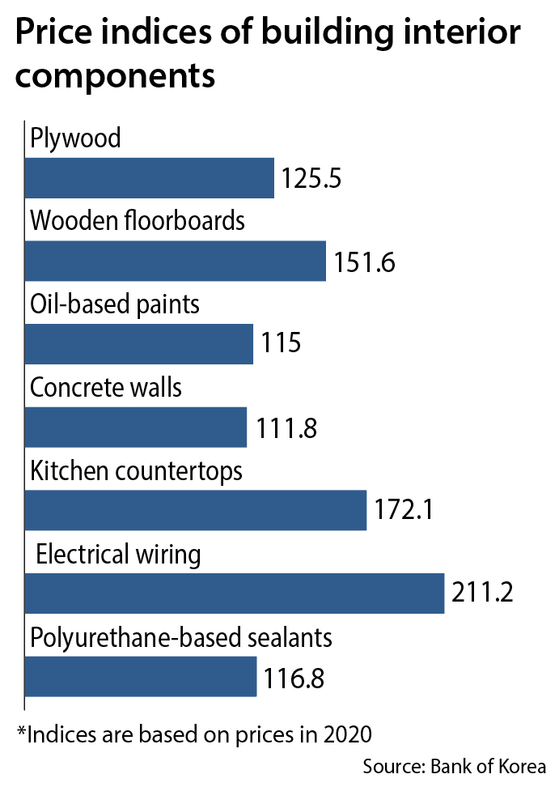
.
Prices of other components commonly needed in home renovations, such as metal window frames, kitchen countertops and electrical wiring, have surged by 50 to 110 percent, adding to the overall burden.
Labor costs have followed a similar trajectory. As skilled workers in trades such as tiling and carpentry age out of the work force, fewer younger workers are replacing them, pushing wages higher, according to industry sources.
Consumers are feeling the impact beyond home renovations.
Moving service fees rose about 30 percent nationwide from 2020 to 2025, and the price of furniture and household goods increased by roughly 31 percent, according to consumer price data.
There are also concerns that costs could climb further. Rising oil prices and instability in the Middle East have already prompted some paint manufacturers to raise prices. The cost of materials derived from polyvinyl chloride — widely used in windows, flooring and insulation — is expected to follow.
“Construction materials depend heavily on imports, so they are highly sensitive to global supply chains and exchange rates,” said Kim Sang-bong, an economics professor at Hansung University.
Housing market dynamics are further compounding the effect.
In the Seoul metropolitan area, rising home prices and a shortage of long-term jeonse (lump-sum deposit) leases have pushed up rental costs, making it harder for households to move up the property ladder.
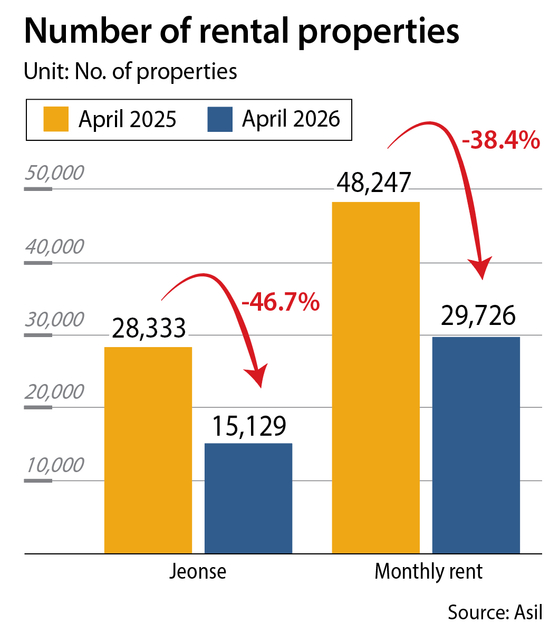
.
Jeonse prices have also been on a steady upward trend, rising for 62 consecutive weeks as of early April.
Higher interest rates are increasing the cost of borrowing at the same time. A borrower with a 500 million won loan over 30 years could see monthly payments rise by about 750,000 won at current rates.
The result is a growing number of households choosing to stay put — or shifting to monthly rentals — rather than pay the increasingly unaffordable cost of moving.
“Stricter lending rules and a weaker jeonse market are likely to reduce the demand for moving further,” said Seo Jeong-ryeol, a professor of real estate studies at Youngsan University.
This article was originally written in Korean and translated by a bilingual reporter with the help of generative AI tools. It was then edited by a native English-speaking editor. All AI-assisted translations are reviewed and refined by our newsroom.
BY KIM SEON-MI [[email protected]]


with the Korea JoongAng Daily
To write comments, please log in to one of the accounts.
Standards Board Policy (0/250자)