

Airfares set to skyrocket with record fuel surcharges as Iran war wreaks havoc on oil supply
Published: 16 Apr. 2026, 17:42
Updated: 16 Apr. 2026, 18:26
-

- SARAH CHEA
- [email protected]
Audio report: written by reporters, read by AI
![Korean Air planes are seen at Incheon International Airport on April 16. [YONHAP]](https://koreaseafood.online/data/photo/2026/04/16/9ddd595a-cf3d-411b-ade9-38ca5f28e22c.jpg)
Korean Air planes are seen at Incheon International Airport on April 16. [YONHAP]
Airfares are poised to skyrocket further next month as Korean carriers have raised fuel surcharges for May to record levels, driven by a surge in oil prices in the wake of the lingering Iran war.
With the set price, fuel surcharges alone will amount to 1.13 million won ($770) for a round trip on the Incheon-New York route, even before the base fare is considered, a 470 percent surge from prewar levels in March.
Korean Air said on Thursday that its fuel surcharge for May tickets would range from 75,000 won on short-haul routes such as Fukuoka to as much as 564,000 won on long-haul routes, including New York and Washington, on a one-way basis. Before the Iran war, the surcharge ranged from 13,500 won to 99,000 won in March.
The surcharge, levied separately from base fares, fluctuates with international oil prices, typically benchmarked against Singapore jet fuel.
Korean Air sets the surcharge on the 16th of each month for tickets issued the following month. For the May benchmark period — from March 16 to April 15 — the average price of Singapore jet fuel stood at 511.21 cents per gallon, or $214.71 per barrel.
That figure places the surcharge at Level 33, the highest tier in the system under Korea’s distance-based framework. The top tier applies when the average price of Singapore jet fuel exceeds 470 cents per gallon.
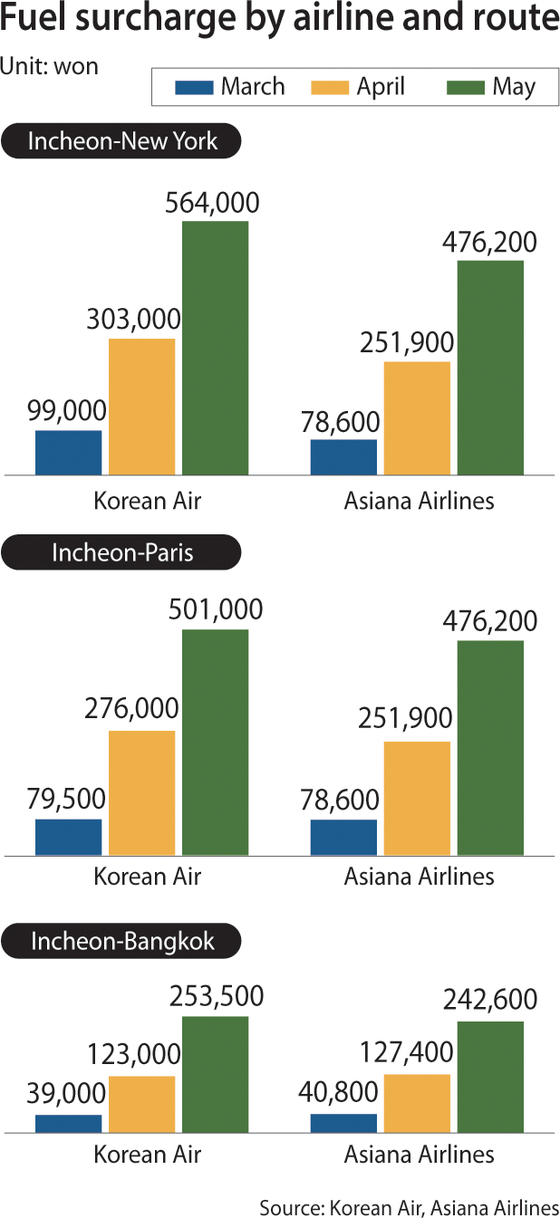
The surcharge stood at Level 6 just in March before logging a 27-tier jump in two months, the sharpest climb since the system’s introduction in 2016, and the first time the highest tier has been applied.
Once a ticket is issued, subsequent changes in fuel costs do not result in additional charges or refunds, though surcharges are reimbursed separately in the event of cancellation.
Asiana Airlines also said its May surcharge would rise to between 85,400 won and 476,200 won one-way, compared to April’s range of 43,900 won to 251,900 won.
Strains in crude supply are increasingly constraining jet fuel production, as refiners, already stretched to meet demand for gasoline and diesel, scale back aviation fuel production.
Korea, the world’s largest exporter of jet fuel, has been forced to nearly halt exports as it had to redirect the supply to domestic use, as reported exclusively by the Korea JoongAng Daily earlier this month.
“Even if the war ends, prices are unlikely to fall quickly, given the damage to infrastructure,” said Lee Hwi-young, a professor of airline service management at Inha Technical College, adding that demand for air travel will inevitably weaken further.
“In times of uncertainty, demand for long-haul routes reduces sharply as people shift toward short-haul routes,” Lee said. “But that doesn’t mean a boost for short-haul routes, as some consumers end up canceling their plans amid rising travel costs.”
Low-cost carriers such as Jin Air, Jeju Air and Eastar Jet are expected to announce their updated surcharges soon.
Air Premia said on April 15 that it would cancel 12 flights scheduled between June 20 and June 28. Eastar said it would suspend about 50 flights on the Incheon–Phu Quoc route from May 5 through the end of the month.
BY SARAH CHEA [[email protected]]


with the Korea JoongAng Daily
To write comments, please log in to one of the accounts.
Standards Board Policy (0/250자)