

Why can't Korea kick its Middle Eastern oil habit and buy American instead?
Published: 13 Apr. 2026, 05:00
-

- SARAH CHEA
- [email protected]
Audio report: written by reporters, read by AI
![From left, U.S. President Donald Trump speaks about the conflict in Iran at the White House on April 6 in Washington; A man fills a car with fuel at a gas station in Gwangju on April 9. [AFP/YONHAP]](https://koreaseafood.online/data/photo/2026/04/13/d8f422c3-fbc0-4ddb-9b8b-c24bcb01a237.jpg)
From left, U.S. President Donald Trump speaks about the conflict in Iran at the White House on April 6 in Washington; A man fills a car with fuel at a gas station in Gwangju on April 9. [AFP/YONHAP]
[EXPLAINER]
While U.S. President Donald Trump touts American crude as an alternative for allies facing Iran-linked supply disruptions, the idea can sound fanciful — nowhere more so than in Korea.
On paper, U.S. crude is competitive and lower in sulfur, making it easier to refine. Still, industry insiders agree that U.S. supply cannot fully replace Middle Eastern imports, which account for 70 percent of Korea’s total.
The constraint is not about volume; rather, it lies in the structure of Korea’s refining system, which is optimized for heavy, viscous crude.
Though a non-oil-producing nation, Korea ranks among the world’s top refiners, with total capacity placing it roughly fifth globally. Three of Korea's four refiners — SK Energy, GS Caltex, and S-Oil — operate three of the five largest single-site refineries on Earth.
Why, then, does a country so technologically adept at refining remain unable to make U.S. crude its mainstream feedstock, even amid ample supply?
Q. Why can’t U.S. crude become mainstream in Korea?
Several factors are at play, but the decisive constraint lies in Korea’s industrial architecture and the hardware that underpins it. Feed U.S. barrels into the system, and then refining efficiency drops sharply.
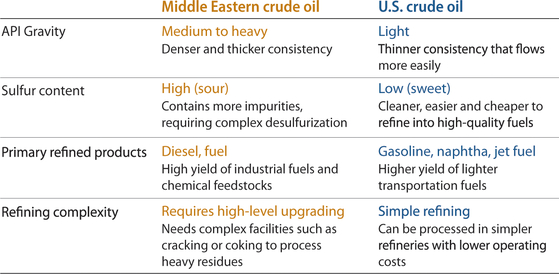
Korean refiners are designed for heavy, viscous, high-sulfur crude from the Middle East, and firms have poured fortunes into upgrading units to crack such grades into higher-value products like gasoline and diesel. The feedstock is foul-smelling and residue-laden, but once processed, it yields diesel, jet fuel and naphtha, which are the petrochemical backbone.
At major Korean refiners, about 30 percent of refining capacity is dedicated to upgrading processes, roughly twice the global average of 10 to 15 percent. In the case of HD Hyundai Oilbank, that share exceeds 40 percent.
By contrast, U.S. oil is light and sweet, which underperforms in Korea’s configuration. Processing isn’t impossible, but it reshapes the product slate, such as reducing jet fuel output, and erodes profitability within a system optimized for heavier grades.
“From the 1970s, when refining infrastructure was first built, Middle Eastern crude dominated. The system was engineered accordingly,” said researcher Chang Tae-hun of the Korea Energy Economics Institute.
“Also, asphalt, a by-product of heavy crude processing, coincided with Korea’s construction boom at the time.”
As an export-driven manufacturing economy, Korea consumes far more diesel than gasoline, fueling trucks, ships and heavy machinery that serve as the backbone of livelihood-driven enterprise.
U.S. crude tends to skew toward gasoline yields, while Middle Eastern grades produce relatively more diesel and kerosene.
Q. What about the economics, more broadly?
Distance — and the costs it compounds — remains a decisive handicap.
When using Middle Eastern crude, refining costs are low compared to U.S. oil, pricing can be stabilized through long-term contracts, and transit to Korea takes only some 20 to 23 days.
But the United States sits far outside Korea’s natural supply basin; Very large crude carriers often cannot pass narrow canals and must round Africa’s Cape of Good Hope, stretching voyages to more than 50 days, over twice as long as Middle Eastern routes.
Freight costs rise, and once marine insurance is factored in, the gap in total landed costs widens further.
“Refining units are highly sensitive, so running the wrong light crude through them means risking corroding costly equipment,” said a source at a major refiner in Korea. “While U.S. light crude already carries a freight and logistics disadvantage, if Middle Eastern supply is readily available, it is hard to see any refiner diversifying with ease.”
![A bird flies near a vessel transferring LPG in Mumbai, India, on April 1 after transiting the Strait of Hormuz, through which Korea obtains most of its oil imports. [REUTERS/YONHAP]](https://koreaseafood.online/data/photo/2026/04/13/ac6529c3-011f-4323-8ce7-b11cfbe31f5a.jpg)
A bird flies near a vessel transferring LPG in Mumbai, India, on April 1 after transiting the Strait of Hormuz, through which Korea obtains most of its oil imports. [REUTERS/YONHAP]
Q. How severe is Korea’s dependence on Middle Eastern crude?
Currently, roughly 70 percent of Korea’s crude imports come from the Middle East, and of that, 99 percent passes through the Strait of Hormuz.
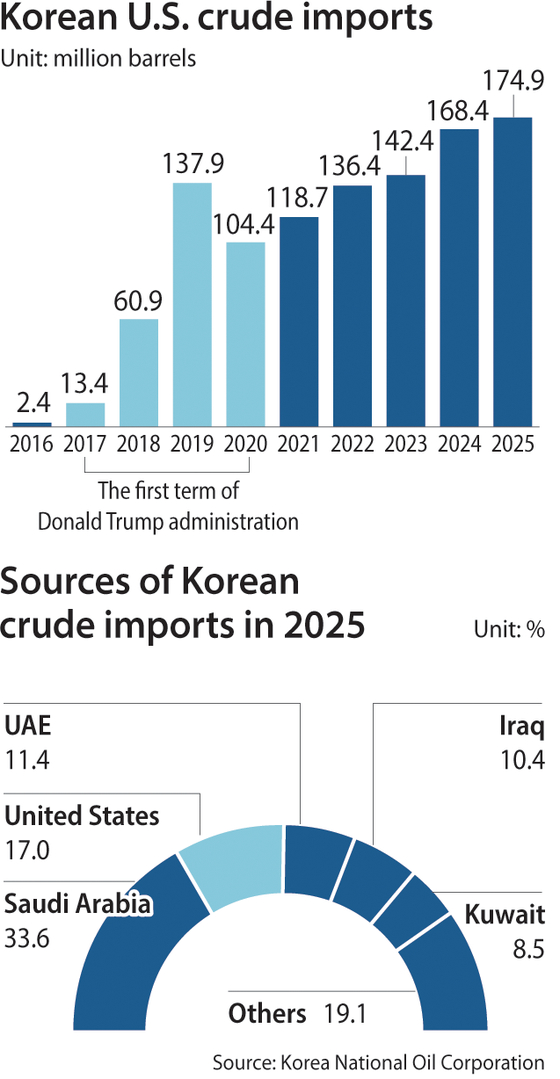
Previous efforts to diversify have been real and significant. Korea's Middle Eastern dependence, which once peaked at around 85 percent, fell to about 59 percent by 2021, thanks to increased purchases of Russian and U.S. crude.
In fact, American crude accounted for a meager 0.21 percent of imports in 2016, but rose to 5.3 percent in 2018, 12.4 percent in 2019, and 13.5 percent in 2023. It climbed further to 15.7 percent in 2024 and 16.3 percent last year.
That momentum, however, has since been disrupted due to Russia’s invasion of Ukraine, as U.S. sanctions sharply curtailed Russian crude flows. At the same time, China and India absorbed larger volumes of discounted Russian barrels, tightening global competition for alternative supply and indirectly reinforcing reliance on Middle Eastern crude.
As a result, dependence has again risen to 70 percent.
Another layer of rigidity comes from capital-locked supply chains, and S-Oil is a case in point. Originally established as a joint venture involving Iranian interests, S-Oil underwent a structural shift in the wake of the Asian financial crisis. In 1999, Saudi Aramco became its largest shareholder with a 63.4 percent share.
Since then, S-Oil has relied on long-term crude supply agreements anchored to Aramco, effectively tying equity ownership to guaranteed feedstock flows. S-Oil relies on the Middle East for more than 90 percent of its annual imports.
Q. Can the structure be changed?
In principle, yes — but only at a steep cost. And the unanswered question is who, in the end, pays for it.
Reconfiguring refinery systems would require investments of hundreds of billions of won, potentially reaching the trillions.
Profitability comes first for refiners, leaving little appetite for multibillion-won extra investments. For decades, they have relied on cost-efficient Middle Eastern crude, with little commitment to shift away, unless the government steps in with incentives or other forms of support to enable the transition.
No company has, so far, announced a full-scale conversion of its refining system to fundamentally shift away from Middle Eastern crude.
“Firms invest when the outlook is promising, but amid persistent uncertainty, such as EV adoption and carbon reduction policies, it is difficult to commit to large-scale capital expenditure,” Chang said.
The government, aware of these constraints, said it is exploring various measures.
“While immediate action is difficult, we are considering support measures to help build naphtha-cracking and other upgrading facilities capable of processing lighter crude in the future," Industry Minister Kim Jung-kwan said at the National Assembly on April 6.
“As refiners largely rely on heavy crude, much of it sourced from the Middle East, the current structure is highly vulnerable to geopolitical shocks in the region."
BY SARAH CHEA [[email protected]]


with the Korea JoongAng Daily
To write comments, please log in to one of the accounts.
Standards Board Policy (0/250자)