

For Samsung and SK hynix, long-term deals with Big Tech offer stability in churning chip cycles
Published: 14 Apr. 2026, 05:00
-
- LEE JAE-LIM
- [email protected]
Audio report: written by reporters, read by AI
![Logo of Samsung Electronics, left, and SK hynix [YONHAP]](https://koreaseafood.online/data/photo/2026/04/14/c40025f3-0090-4b2a-a8dd-2a691af3890e.jpg)
Logo of Samsung Electronics, left, and SK hynix [YONHAP]
[NEWS ANALYSIS]
A shift toward longer-term semiconductor supply agreements is unprecedented. Until now, no contracts have extended beyond a year, but prospective memory deals with Microsoft and Google may usher in a transition that commits Samsung Electronics and SK hynix to long-term supply contracts of up to five years, bringing much-needed stability to the highly cyclical chip industry.
Both companies confirmed the shift toward longer-term contracts at their respective annual general meetings last month.
“In light of supply-demand uncertainties driven by expanding AI investments, we are pursuing multiyear contracts spanning three to five years with our customers, moving away from traditional short-term agreements,” Samsung Electronics Vice Chairman and co-CEO Jun Young-hyun said. SK hynix CEO Kwak Noh-jung similarly commented that requests for long-term agreements (LTAs) from their clients are increasing.
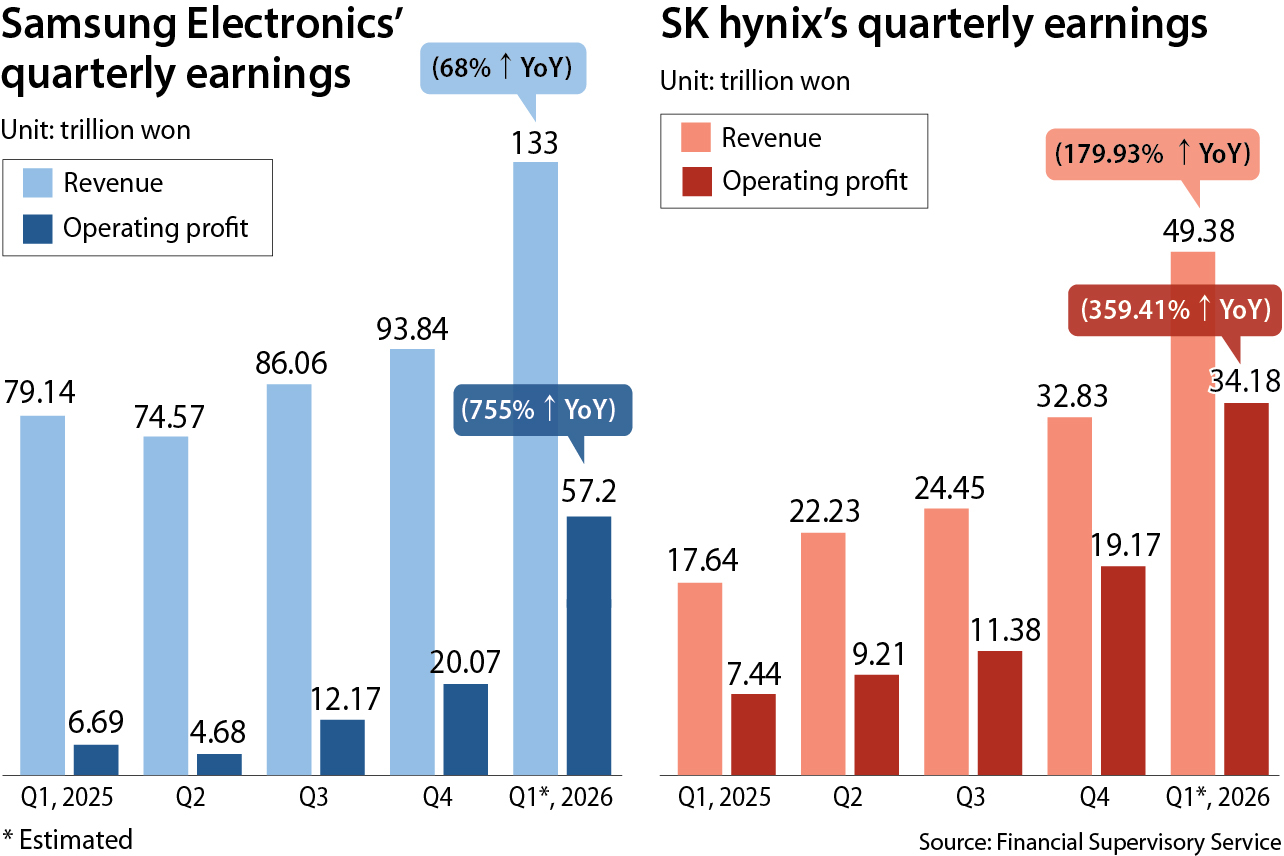
Multiple media outlets indicate that Google and Microsoft are each seeking such deals with Korean chipmakers. The range of memory products under discussion spans from high bandwidth memory (HBM) used in AI applications to conventional dynamic random-access memory (DRAM) chips that are particularly price volatile, according to an exclusive report by the Korea Economic Daily.
The deals are said to include an upfront payment of around 10 to 30 percent of the total contract value, which chipmakers can use to fund capital expenditure.
The trend extends beyond Korea. Micron Technology confirmed in a March earnings call that it signed its first five-year agreement to supply chips for a major customer.
The shift marks a radical departure from the industry’s traditional practice of quarterly, or at most, annual supply contracts.
“Even during the previous chip upcycle led by cloud service providers, the longest contracts typically lasted only up to a year,” said an industry source who requested anonymity. “Moving toward long-term supply agreements benefits both sides: Customers can secure a stable supply during shortages, while suppliers are less exposed to sharp cyclical swings.”
However, market views remain divided. Supporters highlight improved stability, while skeptics warn that suppliers could be locked into lower-than-expected prices during upcycles.
Supply constraints are already evident.
![Samsung Electronics' Seocho office in southern Seoul [NEWS1]](https://koreaseafood.online/data/photo/2026/04/14/403831cc-ddaf-4361-b07f-01f19ddc5b48.jpg)
Samsung Electronics' Seocho office in southern Seoul [NEWS1]
“We are currently using low-power double data rate [DDR] memory for our chips, but we may consider adopting HBM for our next product, as conventional DRAM prices are now costlier than HBM,” said a source at an AI chip startup.
For example, the contract price of DDR4 surged from $1.35 per unit in March of last year to $13 by the end of March this year, according to DRAMeXchange.
“For DRAM, average selling prices [ASP] in 2025 were largely driven by HBM,” said Ryu Hyung-keun, an analyst at Daishin Securities. “In 2026, however, the DRAM ASP is rising sharply, led by conventional DRAM.”
Ryu added that HBM is expected to regain a dominant share of ASP growth in 2027, driven by HBM4 and HBM4E products.
“It’s also important to note that the transition to LTAs does not necessarily cap the DRAM ASP upside,” he said. “While the domestic industry may not achieve the same linear growth track as TSMC, its three-year average profitability could evolve toward a similarly stable structure.”
![SK hynix's headquarters in Icheon, Gyeonggi [YONHAP]](https://koreaseafood.online/data/photo/2026/04/14/bc4f474e-7d33-40da-8bb1-5d4cf3d05c4f.jpg)
SK hynix's headquarters in Icheon, Gyeonggi [YONHAP]
Han Dong-hee, an analyst at SK Securities, said that such deals could become the industry's breakaway from its historical boom-and-bust cycles.
“Price discovery will remain centered in the spot market, and those prices will effectively set the upper and lower bounds for long-term contract pricing,” Han said. “The degree of cycle exposure [how much a memory company is influenced by cyclical swings] will vary depending on contract structures, but suppliers are in a strong position to design these agreements.”
Han said memory supply remains a critical bottleneck in AI infrastructure, describing the current phase as “one of the strongest and longest cycles in history.” He added that long-term supply agreements are expected to reinforce this trend by providing Big Tech with greater confidence in future performance.
“While operating leverage driven by elevated profitability may gradually ease, the downside impact from deleveraging is likely to be less pronounced than in previous cycles, barring sharp market disruptions.”
BY LEE JAE-LIM [[email protected]]


with the Korea JoongAng Daily
To write comments, please log in to one of the accounts.
Standards Board Policy (0/250자)