

Korea weighs upping crude imports from U.S. and Australia as Iran blocks Strait of Hormuz
Published: 03 Mar. 2026, 18:52
Updated: 03 Mar. 2026, 20:07
-

- SARAH CHEA
- [email protected]
Audio report: written by reporters, read by AI
![Boats maneuver around a tanker vessel during a military exercise by Iran in the Strait of Hormuz. [AFP/YONHAP]](https://koreaseafood.online/data/photo/2026/03/03/ca99d6fb-c9cd-4a4f-9698-f23ae279107e.jpg)
Boats maneuver around a tanker vessel during a military exercise by Iran in the Strait of Hormuz. [AFP/YONHAP]
With the closure of the Strait of Hormuz choking off Korea’s primary artery for Middle Eastern crude, Seoul is weighing an expansion of oil imports from the United States and Australia to blunt the impact from the escalating U.S.-Iran war.
Korea depends heavily on the Middle East for roughly 70 percent of its crude oil imports, and nearly 99 percent of the region’s shipments bound for Korea pass through the narrow waterway. Korea currently holds oil reserves equivalent to about seven months of supply.
“On the supply side, we are carefully managing existing stockpiles and reviewing hiking imports from the United States and Australia, alternative countries to the Middle East,” an official overseeing crude imports at the Ministry of Trade, Industry and Resources told the Korea JoongAng Daily on Tuesday. “If the situation deteriorates further, we are also considering demand-side measures, including adjustments to petroleum exports.”
Iran’s Islamic Revolutionary Guard Corps (IRGC) on Monday warned that “if anyone tries to pass, the heroes of the IRGC and the regular navy will set those ships ablaze.”
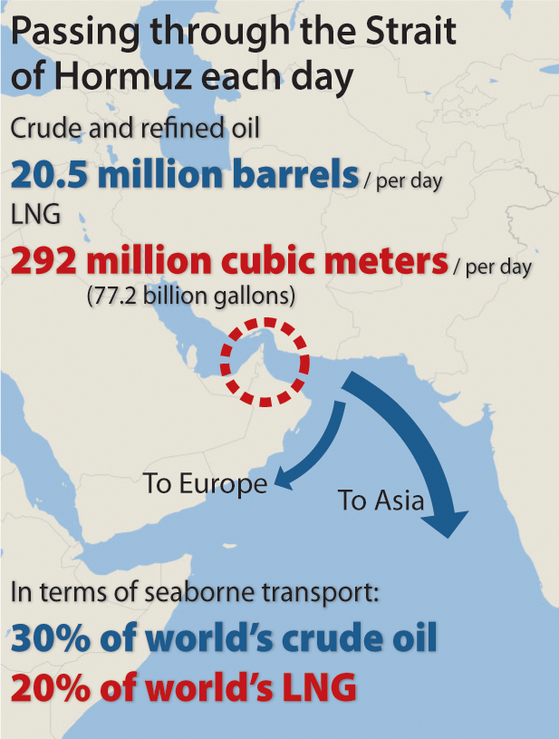
Despite being only about 90 miles long and 21 miles wide at its narrowest point, the Strait of Hormuz possesses critical geopolitical importance as the exclusive maritime corridor linking the Persian Gulf to the Indian Ocean. Roughly 26 percent of global crude and 23 percent of liquefied natural gas shipments flow through the strait every year.
It has never experienced a complete blockade, but it has faced multiple disruptions over the decades, including the Iran-Iraq War in the 1980s, tensions between Iranian and U.S. naval forces in 2007 and Iran’s seizure of the Advantage Sweet, a crude tanker chartered by Chevron in 2023.
![A customer fills up at a gas station in central Seoul on March 3. [YONHAP]](https://koreaseafood.online/data/photo/2026/03/03/4a9678f6-a742-4101-8ffb-23113806daa9.jpg)
A customer fills up at a gas station in central Seoul on March 3. [YONHAP]
The Korean government is also mulling the option of redirecting volumes that are produced overseas back to Korea.
“Crude refined in our foreign factories, such as Vietnam, is generally sold locally, but we are considering bringing those home,” a representative of the Korea National Oil Corporation told the Korea JoongAng Daily.
Korea’s reserves include the government’s stockpiles equivalent to 117.1 days of consumption and private-sector stockpiles covering an additional 104.1 days, together amounting to about seven months.
“The government does not foresee an immediate emergency given that reserves amount to roughly 200 days of crude and gas, but the authorities are working to secure alternative supply routes,” said Rep. Han Jeoung-ae, chair of the Democratic Party’s policy committee, on Tuesday.
Korea’s heavy reliance on the Middle East leaves it acutely vulnerable to surging oil prices. As of last year, 71 percent of crude oil, 34 percent of natural gas and 66 percent of petroleum products were imported from the region.
Brent crude futures for May delivery on the Intercontinental Exchange settled at $77.74 a barrel on Monday, up 6.7 percent from the prior session. Prices briefly surged as high as $82.37 intraday before paring gains toward the close. West Texas Intermediate futures for April delivery settled at $71.23 a barrel, up 6.3 percent from the previous session.
The Hyundai Research Institute estimated that under a prolonged-war scenario in which crude averages around $100 a barrel, “Korea’s economic growth rate would fall by at least 0.3 percentage point,” while consumer “inflation would rise by 1.1 percentage points.”
![Oil tankers in Seongnam, Gyeonggi, on March 3 [YONHAP]](https://koreaseafood.online/data/photo/2026/03/03/9802842e-0bfa-42a9-8f2c-5439caecc46d.jpg)
Oil tankers in Seongnam, Gyeonggi, on March 3 [YONHAP]
BY SARAH CHEA [[email protected]]


with the Korea JoongAng Daily
To write comments, please log in to one of the accounts.
Standards Board Policy (0/250자)