

Why Nvidia's primary memory supplier is aiming for a U.S. listing
Published: 30 Mar. 2026, 14:05
Updated: 30 Mar. 2026, 16:22
-
- LEE JAE-LIM
- [email protected]
Audio report: written by reporters, read by AI
![SK hynix CEO Kwak Noh-jung speaks at the 78th annual general shareholder meeting at Icheon, Gyeonggi, on March 25. [SK HYNIX]](https://koreaseafood.online/data/photo/2026/03/30/dbc1c1ed-2124-487e-8d3f-c32062a0378a.jpg)
SK hynix CEO Kwak Noh-jung speaks at the 78th annual general shareholder meeting at Icheon, Gyeonggi, on March 25. [SK HYNIX]
[NEWS ANALYSIS]
SK hynix, which is still believed to be undervalued despite being the world’s leading memory maker and a key supplier to Nvidia, is preparing to boost its valuation by pursuing a U.S. listing in the second half of 2026 through American depositary receipts (ADRs).
At the same time, the company is investing a significant amount to expand its supply chain footprint across Korea and the United States.
However, the ADR listing plan has sparked debate among shareholders and analysts. Supporters argue that a U.S. listing could help narrow the “Korea discount” — in which local shares trade below their value — that has long weighed on domestic equities. Critics, on the other hand, warn that issuing new shares could dilute existing shareholders’ stakes.
The uncertainty persists because the listing process is at the initial stage, with no detailed plans regarding the ADR structure and issuance.
TSMC is being cited as a relevant successful precedent. The Taiwanese chipmaker listed its ADRs on the New York Stock Exchange in 1997, just three years after its domestic initial public offering, or IPO, in September 1994. Since then, TSMC’s market capitalization has increased more than 220-fold to $1.7 trillion.
![A prototype of SK hynix’s Vera Rubin product signed by Nvidia CEO Jensen Huang during his visit to the company’s booth at the annual developer conference GTC 2026, held between March 16 and 19 at the San Jose Convention Center in California. [YONHAP]](https://koreaseafood.online/data/photo/2026/03/30/111cc3aa-f066-41b4-a891-87e70c92e41b.jpg)
A prototype of SK hynix’s Vera Rubin product signed by Nvidia CEO Jensen Huang during his visit to the company’s booth at the annual developer conference GTC 2026, held between March 16 and 19 at the San Jose Convention Center in California. [YONHAP]
So what is the dispute?
Domestic shareholders are concerned that issuing new shares could dilute existing ones. At the general meeting, a retail investor questioned whether the company would issue new shares to support ADRs, noting that it had already canceled its treasury shares.
SK hynix did not answer the question directly and instead commented that details on size and structure have not yet been finalized.
Market participants estimate that new shares worth 10 to 15 trillion won ($6.6 billion to $9.9 billion) could be issued.
Despite this, global market sentiment regarding SK hynix stock remains optimistic. Nomura Securities recently revised its target price for SK hynix upward to 1.93 million won, citing the Korean company’s U.S. listing effort — which would reduce the valuation gap with Micron — as a key rationale. Goldman Sachs and Mirae Asset Securities estimated SK hynix’s target price at 1.35 million and 1.54 million won. Goldman Sachs described the current period as the “strongest upcycle in memory history,” forecasting SK hynix’s 2026 operating profit to reach 202 trillion won. Korean analysts have also been overly positive about the company’s U.S. listing effort due to the fact that memory shortages will likely persist throughout 2028; chip prices, in turn, will remain elevated from the supply bottleneck.
“If a valuation gap emerges between ADRs and domestic common shares, [that gap] could lift the valuation of the underlying shares,” said Mirae Asset Research analyst Kim Young-gun.
A valuation gap between ADRs and domestic shares refers to the same company trading at different prices or valuation multiples across markets.
While ADRs and Korean-listed shares should theoretically be priced equally after accounting for exchange rates and conversion ratios, ADRs can sometimes trade at a premium due to stronger demand from global investors, with better market access and a reduced Korea discount. If ADRs trade higher, arbitrage activity, in which investors buy cheaper Korean shares and convert them into ADRs, may drive up the domestic share price, ultimately lifting the underlying valuation.
This is important when assessing the potential dilution from a new share issuance. While issuing new shares increases the total number of outstanding shares, thereby diluting existing ownership, the impact may be limited if the issuance is small. In such cases, any valuation rerating driven by an ADR listing could outweigh the dilution effect, especially if the listing helps narrow the company’s discount relative to global peers. This is the reason that SK Square, SK hynix’s largest shareholder, is expected to maintain its 20.5 percent stake.
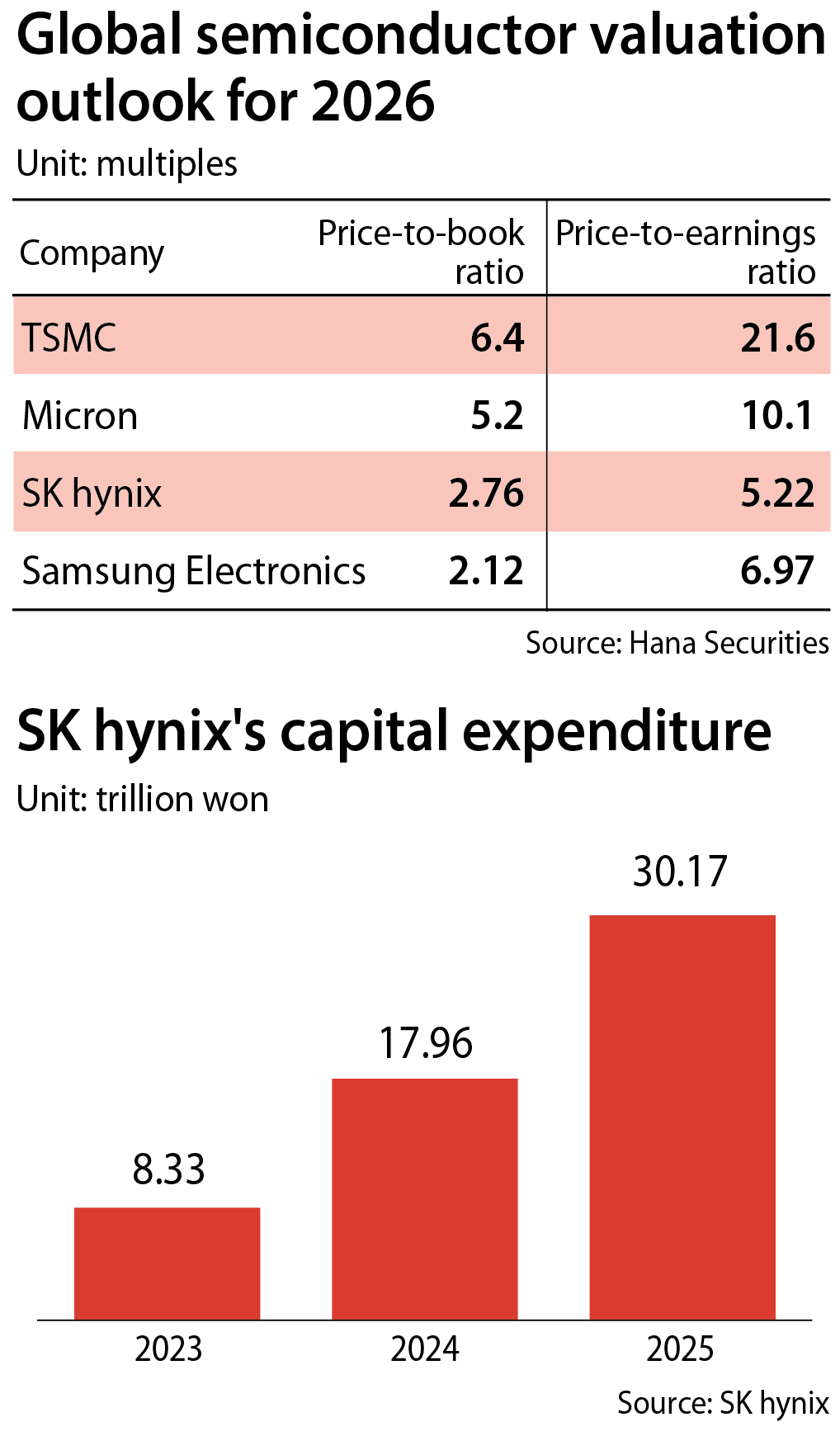
Kim Rok-ho, an analyst at Hana Securities, said that if Micron’s higher valuation multiples are partly attributable to its U.S. listing, SK hynix could narrow the valuation gap or even command a higher valuation once it lists in the United States.
“Following an ADR listing, SK hynix is likely to trade at a premium multiple,” he said.
U.S.-listed memory peers trade at higher valuations. Based on 2026 forecast estimates from Mirae Asset Securities, Micron is valued at 7.8 times its expected forward earnings and 4.2 times its net book value, while SanDisk trades at 17.6 times and 7.8 times, respectively — compared to just 5.9 times earnings and 3.5 times, respectively, for SK hynix.
![SK hynix headquarters in Icheon, Gyeonggi [NEWS1]](https://koreaseafood.online/data/photo/2026/03/30/be2a3fe6-c171-48cf-a263-abc57f0037f9.jpg)
SK hynix headquarters in Icheon, Gyeonggi [NEWS1]
Why go through with it now?
SK hynix has confidentially submitted a registration statement for a public offering to the U.S. Securities and Exchange Commission, CEO Kwak Noh-jung said at the company’s annual general shareholder meeting last Wednesday.
The company is reportedly in the process of selecting underwriters. Though earlier expectations suggested that treasury shares would back ADRs, the offering is now likely to be supported by newly issued shares, reflecting the increased complexity surrounding treasury share transactions following recent amendments to Korea’s Commercial Act.
The regulatory changes have tightened oversight on the use of treasury shares to prevent practices that may unfairly benefit major shareholders. Under the revised rules, companies are required to cancel a significant portion of treasury shares within a specified period to boost overall shareholder value.
SK hynix canceled treasury shares worth 12 trillion won, equivalent to 2.1 percent of total outstanding shares, in February, and it no longer holds a meaningful treasury share balance.
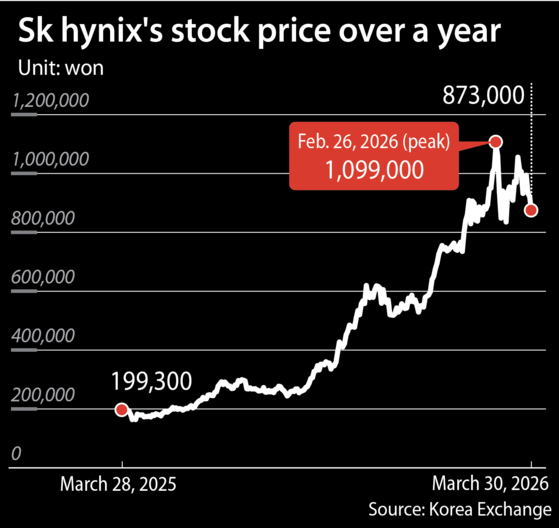
The listing effort comes as the company ramps up its capital expenditure to capitalize on the AI-driven semiconductor upcycle, for which clients are now actively requesting long-term agreements for supply stability.
“Financial strength is crucial to sustain investment and growth in the AI era,” Kwak said. “We aim to secure more than 100 trillion won in net cash to ensure stable investment.”
graph
“Until last year, we focused on debt repayment,” the CEO continued. “We are now beginning to generate net cash. Considering our required investment levels, this financial position will allow us to continue investing and growing even during downturns while supporting higher share prices, increased dividends and expanded share buybacks and cancellations.”
As of last year, SK hynix held approximately 12.6 trillion won in net cash, implying a plan to secure an additional 87 trillion won.
The company plans to invest around 600 trillion won by 2050 to develop a semiconductor cluster in Yongin, Gyeonggi, which will house four advanced memory chip fabrication plants. Additionally, SK hynix is set to invest 39 trillion won in Cheongju, North Chungcheong, and 5 trillion won in Indiana to build new manufacturing facilities.
BY LEE JAE-LIM [[email protected]]


with the Korea JoongAng Daily
To write comments, please log in to one of the accounts.
Standards Board Policy (0/250자)