

Kospi’s double-digit plunge, rebound mark Korea as one of most volatile markets amid Iran war
Published: 05 Mar. 2026, 18:37
Updated: 05 Mar. 2026, 21:37
-

- JIN MIN-JI
- [email protected]
![Electronic display boards at Hana Bank's dealing room in central Seoul show Korea's financial markets on March 5. [NEWS1]](https://koreaseafood.online/data/photo/2026/03/05/36f1e8a9-8a26-4d6c-bcf8-65a2d85a7c21.jpg)
Electronic display boards at Hana Bank's dealing room in central Seoul show Korea's financial markets on March 5. [NEWS1]
Korea proved one of the most volatile markets amid the U.S.-Iran conflict, as the Kospi swung heavily for three consecutive days — surging nearly 10 percent on Thursday, just a day after plunging 12 percent.
The Kospi closed at 5,583.9 on Thursday, up 9.63 percent, to snap a three-session losing streak. The surge came amid signs of easing oil price increase sparked by the U.S.-Iran conflict and the resilient U.S. stock market. The rally came after the benchmark index suffered its worst one-day decline by 12.06 percent the previous day. The tech-heavy Kosdaq closed up 14.1 percent to 1,116. 41.
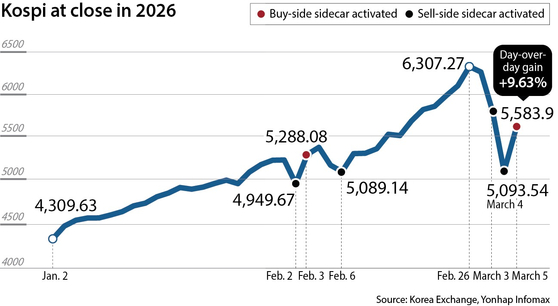
The steep recovery was fueled by reports of Iran’s outreach to the U.S Central Intelligence Agency to discuss the end of the conflict, despite the continued strikes. The sentiment was further bolstered as global oil prices and the U.S. stock market stabilized, with the Nasdaq climbing 1.29 percent overnight. West Texas Intermediate (WTI) futures inched up 0.13 percent to $74.66 per barrel on Wednesday, slowing from a 6.3 percent surge two days earlier.
Additional support came from the government’s pledge to stabilize markets. President Lee Jae Myung on Thursday ordered the swift execution of a 100 trillion won ($68 billion) market stabilization program designed to contain volatility in capital markets.
Lee said the government would “respond proactively to the widening volatility in financial markets, including stocks and the exchange rate,” noting that the country could face significant difficulties in energy supply as well as across the broader economic and industrial sectors.
The sidecar trading curb on both the Kospi and Kosdaq indexes was activated by the main bourse operator Korea Exchange just minutes into trading, halting program trading for five minutes after stocks surged.
Trade volume totaled 44.8 trillion won, led by retail investors who net purchased 1.79 trillion won. Foreign and institutional investors net sold 144.6 billion won and 1.7 trillion won, respectively.
Chip giant Samsung Electronics surged 11.27 percent to 191,600 won, while SK hynix jumped 10.84 percent to 941,000 won. Automaker Hyundai Motor accelerated 9.38 percent to 548,000 won, while pharmaceutical giant Samsung Biologics gained 8.64 percent to 1.65 million won.
![Plumes of smoke rise as strikes hit the city during the U.S.?Israeli military campaign in Tehran, Iran, on March 5. [AP/ YONHAP]](https://koreaseafood.online/data/photo/2026/03/05/a3cad983-d014-42bd-a0bb-b872b97dd94b.jpg)
Plumes of smoke rise as strikes hit the city during the U.S.?Israeli military campaign in Tehran, Iran, on March 5. [AP/ YONHAP]
The market rebound set the stage for economists’ expectations that, while fluctuations may continue, the range of the index’s ups and downs is likely to narrow as the conflict eases and investor sentiment recovers.
“Recent volatility appears to have been driven more by investor sentiment than by the fact that Korea depends heavily on Middle Eastern oil,” said Heo In, economics professor at Catholic University of Korea. Much of the country’s oil is shipped through the Strait of Hormuz, the world’s most critical oil export route, which Iran’s Revolutionary Guard Corps has effectively declared closed to ships from the United States, Israel, Europe and their supporters.
“Other countries with similar exposure, such as Japan, did not experience this level of market fluctuation. The Kospi’s fluctuation was bigger as it had not yet settled at a stable, agreed-upon level following its dramatic surge since last year, so when the U.S.-Iran event occurred, investors reacted with heavy trading,” Hur added.
Japan’s Nikkei 225 shed a cumulative 7.8 percent this week through Wednesday before it bounced back 1.9 percent on Thursday.
The Kospi surged 76 percent last year and gained an additional 45 percent through Feb. 27, the last trading day before the United States struck Iran.
Economists view 5,000 points as the bottom threshold for the Kospi.
“Based on Wednesday’s closing price, the Kospi’s 12-month forward price-to-earnings ratio fell to about 8.1 times, and I view eight times as the threshold for bottom-fishing,” said Park Seok-hyun, an economist at Woori Bank. “For the Kospi, that corresponds to roughly 5,000 points at the current level,” Park added, noting that the level was the point at which foreign investors started scooping back up local stocks.
Based on history, the stock market has tended to find its bottom around the eightfold level, as there have been very few instances in Kospi history when the ratio fell below the level, including the European debt crisis, the pandemic and the announcement of reciprocal tariffs.
“If oil prices keep soaring throughout the end of the year, it could damage market fundamentals. But such a view seems too pessimistic to assume at this point,” Park added, while noting the continued massive investment by U.S. Big Tech firms and the government’s market-friendly policy.
The won traded at 1,468.1 per U.S. dollar at 3:30 p.m., rising 8.1 won from the previous session’s close.
BY JIN MIN-JI [[email protected]]


with the Korea JoongAng Daily
To write comments, please log in to one of the accounts.
Standards Board Policy (0/250자)