

Local Korean eateries disappearing as ingredient prices climb and culinary culture shifts
Published: 26 Jul. 2025, 07:00
Updated: 28 Jul. 2025, 15:57
Audio report: written by reporters, read by AI
![A spread for a kimchi jjigae (kimchi stew) baekban is laid out at a restaurant in Seoul on March 16. [YONHAP]](https://koreaseafood.online/data/photo/2025/07/28/3561f169-8e0d-42f4-8b37-4f8b46579175.jpg)
A spread for a kimchi jjigae (kimchi stew) baekban is laid out at a restaurant in Seoul on March 16. [YONHAP]
While global demand for Korean food rises, the neighborhood kitchens that defined it are closing one by one.
After 17 years serving hearty food to loyal locals in Anyang, longtime owner Park closed her doors in April, citing soaring ingredient costs, her own dwindling energy and no successor in sight — a quiet but telling sign of the vanishing home-style Korean eateries that once anchored their communities.
“My stews and rolled omelets were always popular in the neighborhood,” Park said. “But as ingredient costs kept rising, I couldn’t keep raising the price of a meal. Most of my customers were regulars, and I felt bad.”
Park added that the business was never highly profitable, and as she got older, her motivation dwindled. Although she considered passing on the restaurant to her daughter, the younger woman had no interest in continuing the family trade.
The decline of traditional Korean eateries, especially baekban restaurants — serving affordable home-style meals with multiple side dishes — has accelerated in recent years.
The industry has suffered especially from rising food costs, as Korean cuisine relies on a wide array of ingredients, each of which is vulnerable to price volatility. Add to that a sluggish economy and a broader shift in dining culture, including the rise of food delivery that favors simpler, more portable dishes.
Shrinking share
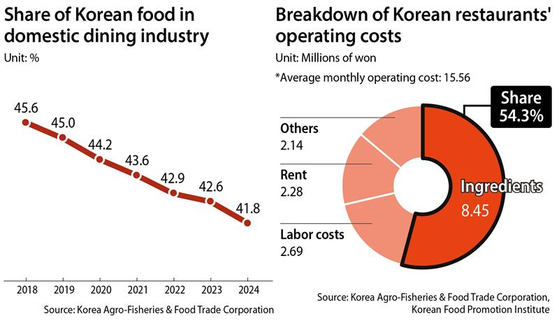
Korean restaurants made up 41.8 percent of the country’s dining establishments in 2024, down from 45.6 percent in 2018, according to the Ministry of Agriculture, Food and Rural Affairs. This decline was based on a survey of 3,196 restaurants across all 17 metropolitan and provincial areas between August and November last year.
Overall, the number of restaurants in Korea peaked at over 804,000 in 2020 but had fallen to 795,024 by 2022, according to Statistics Korea. Korean restaurants appear to be declining at a faster rate than the rest of the sector.
![A menu for a Chinese restaurant advertises jajangmyeon (black bean noodles) in Myeong-dong, central Seoul, on Jan. 30. [YONHAP]](https://koreaseafood.online/data/photo/2025/07/28/b1b8cc93-11c0-407f-a543-e211c6dd00be.jpg)
A menu for a Chinese restaurant advertises jajangmyeon (black bean noodles) in Myeong-dong, central Seoul, on Jan. 30. [YONHAP]
In the space left by these closures, other cuisines and dining categories are expanding.
Chinese restaurants increased their market share from 3.5 to 3.9 percent between 2018 and 2024. Japanese and Western cuisine also grew from 1.5 to 2.6 percent and 1.7 to 2.4 percent, respectively. Chicken establishments rose to 5.2 percent, up from 4.9, while pizza, burger and sandwich shops climbed from 2.4 to 3.5 percent. Bakeries followed a similar trend, reaching 3.4 percent last year from 2.7 percent in 2018.
The drop in Korean eateries also reflects broader demographic and cultural shifts. As of May this year, there were 410,429 Korean restaurant owners, a decrease of 2,233 compared to May 2024, according to the National Tax Service.
The average age of a Korean restaurant owner in 2024 was 56.2, significantly higher than the industry average of 52.9. Chinese restaurant owners averaged 53.9 years, while Japanese, Western, and other foreign cuisine restaurant operators were generally younger, at 49.9, 46.7 and 46.3 years, respectively.
“Younger generations tend to avoid traditional Korean food businesses, which require long hours and physically demanding cooking,” said one industry insider.
![Vegetables are stocked at a supermarket in Seoul on July 22. [NEWS1]](https://koreaseafood.online/data/photo/2025/07/28/4501d956-8fe1-4af0-a1d5-9d90991eb7d9.jpg)
Vegetables are stocked at a supermarket in Seoul on July 22. [NEWS1]
Soaring ingredient prices
Rising ingredient prices have particularly affected Korean diners, given the variety of dishes they serve. According to the Korea Agro-Fisheries & Food Trade Corporation (aT), as of July 21, the average price for 20 kilograms (44 pounds) of rice was 59,641 won ($43), a 13.4 percent increase from a year earlier. Leafy vegetables have surged as well — cabbage now costs 5,240 won per head, up 44.71 percent from the previous month. Perilla leaves are up nearly 11 percent, and spinach has more than doubled in price to 1,969 won per 100 grams.
Government surveys indicate that ingredients and labor account for 71.1 percent of total revenue at Korean restaurants, which is higher than the overall average of 69.8 percent. A separate report on the Korean food industry, published this year by the Ministry of Agriculture and the Korean Food Promotion Institute, revealed that ingredients alone account for more than half of monthly operating expenses. Out of 1.56 million won in monthly costs, 845,200 won — 54.2 percent — went to food supplies.
Delivery not a boon
Although food delivery surged after the pandemic, traditional Korean dishes — particularly stews and mixed platters — have struggled to adapt. Only 21.6 percent of Korean restaurants reported using delivery apps, far below the average of 25.6 percent. Chinese restaurants had the highest adoption rate at 47.7 percent, followed by Japanese restaurants at 40.4 percent and Western restaurants at 38 percent. In contrast, 85.1 percent of pizza, burger and sandwich shops used delivery apps.
Delivery participation remains low even when factoring in third-party services. A striking 74.7 percent of Korean eateries reported zero daily deliveries, the highest among all restaurant types.
Franchise model gains ground
As independent diners disappear, franchises are stepping in. The Agriculture Ministry found that Korean franchise restaurants accounted for 26.2 percent of the segment in 2024, up from 22.7 percent in 2018. According to Fair Trade Commission data released in April, the total number of franchise brands across all dining categories slightly declined from 9,934 in 2023 to 9,873 in 2024. However, Korean food franchises increased by 4.1 percent, rising from 3,556 to 3,701.
Some experts argue that the sector is undergoing a necessary correction.
“Without proper culinary training or business knowledge, opening a diner may seem easy, but it’s just as easy to fail,” said Moon Jung-hoon, professor of food business at Seoul National University and director of the Food Business Lab. “Compared to franchise restaurants that can source ingredients at relatively lower costs, independent diners often fall behind in both price and quality.”
Choi Min-ji, a director at the Agriculture Ministry's food service policy division, noted that simply increasing the number of baekban restaurants would not automatically strengthen Korean cuisine’s competitiveness.
“We need to support Korean food businesses and franchises as they expand overseas, while also creating dedicated programs to help small-scale operators stay afloat,” she said.
Translated from the JoongAng Ilbo using generative AI and edited by Korea JoongAng Daily staff.
BY KIM KYUNG-HEE, JANG WON-SEOK [[email protected]]


with the Korea JoongAng Daily
To write comments, please log in to one of the accounts.
Standards Board Policy (0/250자)