

Key inflation indicator is down — but not at Korean dinner tables
Published: 08 Jul. 2025, 07:00
-

- JIN MIN-JI
- [email protected]
Audio report: written by reporters, read by AI
![A customer shops for instant noodles in a supermarket in Seoul on June 15. [NEWS1]](https://koreaseafood.online/data/photo/2025/07/08/52e2b681-6957-4514-a504-d5459469c773.jpg)
A customer shops for instant noodles in a supermarket in Seoul on June 15. [NEWS1]
[BEHIND THE NUMBERS]
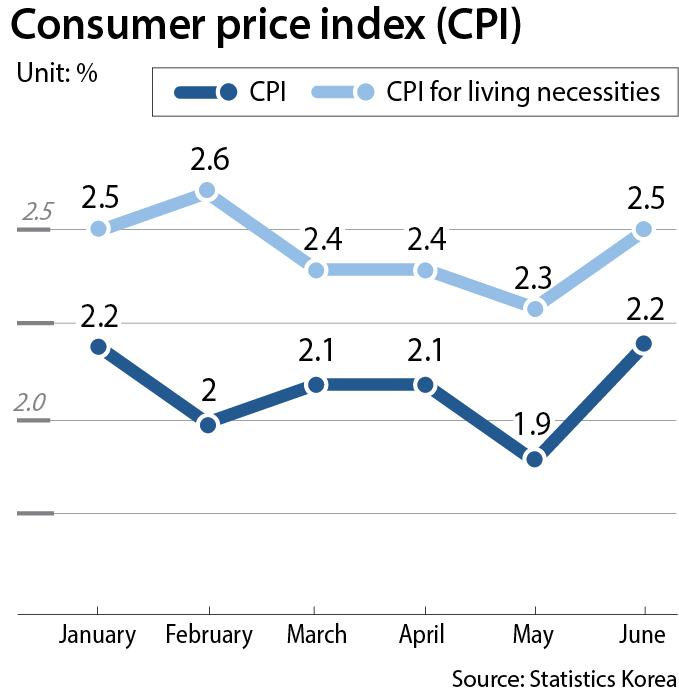
The Consumer Price Index (CPI), a key measure of inflation, has stabilized to around 2 percent since August of last year, signaling the end of pandemic-driven high inflation. However, few consumers relate to the headline figure, as the prices of essential food items like instant noodles and instant coffee have surged, masked by the broader inflation indicator that tracks a wider basket of goods.
To offset rising food prices, some shoppers have turned to lower-priced imported alternatives.
“I don’t feel that inflation is cooling at all, but is holding steady at best,” said 33-year-old office worker Cho Su-rim. “Due to the rising prices, I switched from drinking pasteurized domestic milk to imported sterilized milk, a much cheaper alternative, which I buy in bulk to stay within budget.”
Others choose to switch to more affordable cuts of meat.
“I set my weekly budget at 30,000 won [$22],” said Kim Jin-young, a stay-at-home partner living in Seoul. “To stay within that budget, I’ve switched from buying tenderloin to more affordable cuts like shank. Sometimes I even buy meatloaf from Costco because it’s more budget-friendly.”
Falling CPI — on paper
Korea’s CPI has neared the Bank of Korea's (BOK) 2 percent target rate.
The index slightly climbed back to 2.2 percent in June from a year earlier, up from 1.9 percent logged the previous month, driven by a rise in oil and processed food prices.
The price growth of processed food and livestock products outpaced the overall index last month, rising 4.6 percent and 4.3 percent, respectively.
Instant noodle prices rose 6.9 percent, while eggs jumped 6 percent.
“Although the inflation rate is generally showing signs of stabilization, the burden of living expenses felt by the public remains high,” said BOK Gov. Rhee Chang-yong in a press conference in June. “The steeper rise of essential goods such as processed food and dining out has kept perceived inflation high.”
The rapid price growth of processed foods was noted by President Lee Jae Myung in June, who expressed alarm over instant noodle prices, which cost roughly 2,000 won per unit.
Many food companies — including Orion, Nongshim and Binggrae — raised their product prices over the past year, citing the increased cost of raw materials and labor as well as the weak won.
Of the 34 types of food consumers frequently buy, the prices for 24 of them jumped by an average of 7.1 percent in April on year, according to Korea Consumer Agency data.
Instant coffee, soft drinks and gochujang were among those included in the list.
“High perceived inflation is driven by certain products, including those that solely rely on domestic production, like apples, due to nontariff barriers, which ultimately affects the price of processed food,” said Kang Hyun-ju, senior research fellow at the local think tank Korea Capital Market Institute.
Apples, pears, peaches and watermelons are among the fruits that the government has not yet approved for import, citing sanitary and phytosanitary measures that are designed to protect humans, animals or plants from pests and diseases.
“The elevation of the overall price level is also keeping the perceived inflation high. The general price level has gotten high as price increases have accumulated, including the Covid-19 period when the mass unleashing of liquidity sent consumer prices surging.”
The cumulative increase in living necessities soared by a whopping 19.1 percent from 2021 through May this year, far outpacing the overall consumer price increase of 15.9 percent, according to the BOK data.
![People shop for affordable products that cost below a dollar in a market in Dongdaemun District in eastern Seoul on July 6. [YONHAP]](https://koreaseafood.online/data/photo/2025/07/08/3aa6dfda-50f3-4968-8147-7f2e65a375fe.jpg)
People shop for affordable products that cost below a dollar in a market in Dongdaemun District in eastern Seoul on July 6. [YONHAP]
Inflationary triggers
The growing financial burden is reflected in consumer spending patterns.
The average propensity to consume, which measures how much a person’s income is spent on consumption rather than saved, fell three straight quarters through March of this year, adjusted for inflation.
The propensity fell 2.9 percent on year in the first quarter, which means that households spent a smaller share of their disposable income on consumption.
Some worry that perceived inflation may bounce higher amid the government’s second extra budget plan, which has been approved by the National Assembly on Friday.
“The supplementary budget itself is an inflationary factor, as was seen by the Covid-19 relief funds that significantly pushed up livestock prices," said Kang from the Korea Capital Market Institute. “Households will likely spend the stimulus payments — ranging between 150,000 and 550,000 won — on dining out, potentially fueling a further rise in restaurant prices.”
The prices of livestock products jumped in May 2020 after the government distributed relief funds nationwide to revive the economy hit by the pandemic. Prices of pork soared 12.2 percent on year, while that of beef jumped 6.6 percent.
But the inflationary trigger may be temporary.
"Inflation is projected to eventually fall due to the weak domestic economy," said Ma Chang-seok, Associate Fellow at the state-run think tank Korea Development Institute. "The central bank's monetary easing, in coordination with the financial authorities, will be necessary to raise domestic demand."
The BOK is scheduled to hold a monetary policy board meeting on Thursday to decide on the base interest rate, which currently sits at 2.5 percent.
BY JIN MIN-JI [[email protected]]


with the Korea JoongAng Daily
To write comments, please log in to one of the accounts.
Standards Board Policy (0/250자)