

Hyundai’s factory humanoid will differ from the Atlas that you know
![The research version of Atlas, left, and its mass-production variant at CES 2026 [HYUNDAI MOTOR GROUP, NEWS1]](https://koreaseafood.online/data/photo/2026/04/10/dbfea6b9-2f72-49fa-b018-0de08022be22.jpg)
The research version of Atlas, left, and its mass-production variant at CES 2026 [HYUNDAI MOTOR GROUP, NEWS1]
A tumbling-enabled Atlas, showcased during Hyundai Motor Group’s booth at CES 2026, is widely believed to be the model slated for real-world manufacturing deployment starting in 2028.
“But you know what? That’s not the robot that will actually go into factories,” a humanoid robotics researcher with knowledge of the matter said.
The silver Atlas — developed by Boston Dynamics, Hyundai Motor’s U.S. subsidiary — is not intended for actual manufacturing use, as it is just a prototype built for technological validation.
![Atlas performs a series of aerial flips, including cartwheels and back tumbling, in footage released by Boston Dynamics on April 7 via its YouTube channel. [YONHAP]](https://koreaseafood.online/data/photo/2026/04/10/a8e39987-bfac-483b-86c6-8e5f8028c3b1.jpg)
Atlas performs a series of aerial flips, including cartwheels and back tumbling, in footage released by Boston Dynamics on April 7 via its YouTube channel. [YONHAP]
The model that Hyundai plans to deploy in factories starting in 2028 is the mass-produced version: the blue mock-up also displayed at CES 2026. The two differ fundamentally, beginning with their leg structures.
Hyundai did distinguish between the research prototype and the production model in its presentation. But more attention was drawn to the tumbling Atlas while the production version remained largely overlooked.
Built on a different structure
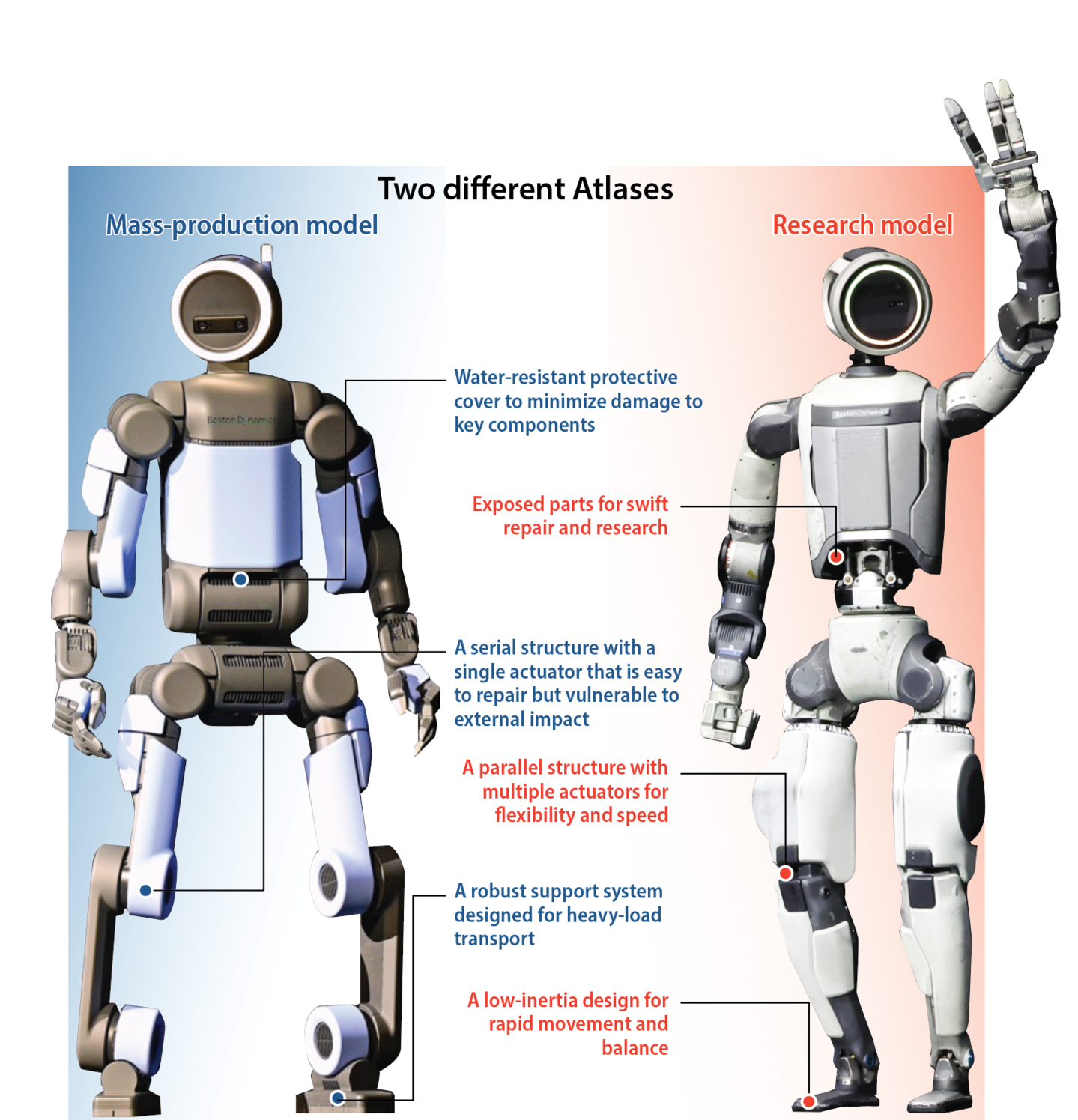
A closer look reveals why. Based on remarks from multiple researchers, the research prototype possesses a parallel structure with multiple actuators — integrated systems that combine motors, gear reducers and controllers — around the knees and ankles.
This allows it to generate a high amount of force and absorb shocks effectively. Its ability to regain its balance immediately after a tumble stems from this design. Even visually, its leg movements resemble those of a human, bending naturally back and forth.
The production model, however, adopts a different structure, resembling a robotic arm used in factories. While sufficient for basic bending and extending motions, it appears less capable of handling movements at multiple angles or absorbing impact compared to the research prototype.
“Based on the images released, if the production model were deployed in factories today, it could lose its balance and fall if its center of gravity shifts abruptly, such as when it pulls a parts tray from a shelf,” the researcher said.
![Tesla's humanoid robot 'Optimus' distributes popcorn at a Christmas market stall during its presentation at a mall in Berlin, Germany on Dec. 20, 2025. [AP]](https://koreaseafood.online/data/photo/2026/04/10/f22223a7-aca2-4ad6-a7cc-52651dab6149.jpg)
Tesla's humanoid robot 'Optimus' distributes popcorn at a Christmas market stall during its presentation at a mall in Berlin, Germany on Dec. 20, 2025. [AP]
Such differences are not unusual. Most humanoid developers, including Tesla, follow a similar approach, first building high-performance prototypes then refining them into mass-producible models after tests and demonstrations.
The production version has its own advantages. Protective covers over its joints and body shield core components and help them be resistant to water and dust. Its simpler joint structure lowers manufacturing costs and makes repairs easier. For industrial use, the ability to tumble is unnecessary, so designing for it would amount to overengineering.
Functionally, it remains competitive. The production version of Atlas features 56 degrees of freedom, meaning most joints can rotate 360 degrees. It is equipped with a 360-degree vision system for full environmental awareness. The robot can lift up to 50 kilograms (110 pounds), reach heights of 2.3 meters (7 feet) and operate in temperatures ranging from minus 20 degrees Celsius to 40 degrees Celsius (minus 4 degrees Fahrenheit to 104 degrees Fahrenheit). In terms of degrees of freedom, it exceeds Tesla’s Optimus’ 50 degrees of freedom and China’s Unitree G1’s 23 degrees of freedom.
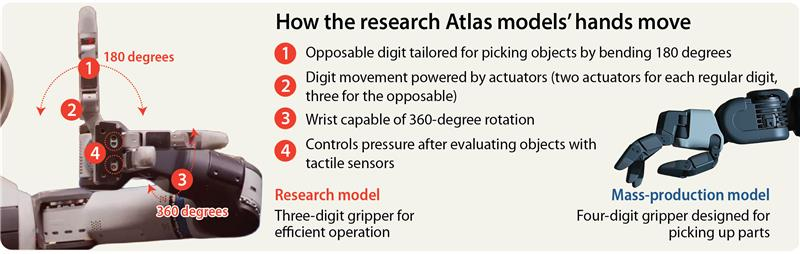
However, no real-world footage of the production model in operation has been released. At CES 2026 and other exhibitions, it has appeared only as a mock-up. A factory deployment video released by Boston Dynamics on YouTube is a 3-D rendering rather than footage of an actual robot.
The first challenge for Hyundai in mass-producing humanoids, therefore, is finding a balance between target performance and affordability.
“The key is how reliably the performance of a full-spec research model can be implemented in a mass-produced version,” Lee Dong-jun, a professor of mechanical engineering at Seoul National University, said. “Securing price competitiveness through mass production is also essential.”
Atlas effect
The impact of Atlas has been significant. For many in Korea’s industrial sector, humanoid robots had been seen as a distant prospect. That perception is shifting as companies begin to assess the potential gains from machines capable of performing tasks similarly to human workers — though concerns about job displacement continue to grow.
JPMorgan estimated that the mass-produced Atlas could be priced at a minimum of $130,000 by 2030. Given that the prototype’s cost is estimated at around $300,000, this suggests the production model aims for a cost reduction of about 56 percent through simplification of core components.
![A model interacts with China's Unitree G1 humanoid robot at an expo held at COEX in Seoul on April 4. [YONHAP]](https://koreaseafood.online/data/photo/2026/04/10/18e1a870-a94d-4218-8398-eeb17c41b57e.jpg)
A model interacts with China's Unitree G1 humanoid robot at an expo held at COEX in Seoul on April 4. [YONHAP]
Even so, the price remains a burden for companies. Competing models such as Unitree’s G1 and Tesla’s Optimus are expected to cost between $20,000 and $30,000, placing Atlas at a disadvantage in terms of price competitiveness.
Hyundai plans to address this through “robot as a service.” Under this model, companies subscribe to robots and their operating software rather than purchasing them outright. This shifts costs from capital expenditures to operating expenses, reducing upfront financial burdens, and allows manufacturers to handle maintenance and technical support.
Hyundai is also considering leasing options similar to auto financing. “Just as leasing supported early growth in the automotive market, it could play a similar role in expanding the humanoid robot market,” an industry source said.
If a single Atlas unit were deployed at Hyundai’s Ulsan plant in 2030 under a subscription model, the cost could be relatively competitive. The estimated monthly fee is about 5 million won ($3,400), based on a typical 36-month industrial equipment contract, which is lower than the roughly 9 million won monthly salary of a skilled worker earning 150 million won annually.
A February report by the Export-Import Bank of Korea projected that Atlas could deliver up to three times the productivity of a human worker, allowing companies to recover their investment within two years.
![Figure 02, a humanoid robot developed by U.S. robotics firm Figure, is seen working at a BMW factory. Using five-fingered hands, it picks up components and places them into position for assembly. [SCREEN CAPTURE]](https://koreaseafood.online/data/photo/2026/04/10/2e146738-bf48-4b3e-932b-97b59787ccc0.jpg)
Figure 02, a humanoid robot developed by U.S. robotics firm Figure, is seen working at a BMW factory. Using five-fingered hands, it picks up components and places them into position for assembly. [SCREEN CAPTURE]
Hyundai plans to produce 30,000 units annually by 2030, initially deploying them across its affiliates to gather operational data and improve performance.
This approach could also enable a new business model: robot foundries. Similar to Taiwan’s semiconductor foundry model, Hyundai could manufacture humanoid robots for companies that have design capabilities but lack production capacity.
To support this, Hyundai is investing 400 billion won in a robotics manufacturing and foundry complex in Saemangeum, scheduled for completion in 2029. By vertically integrating key components such as motors and sensors, the company aims to reduce costs.
“Hyundai has an advantage in that it can both produce robots and deploy them in its own automotive and parts factories for real-world validation,” Kwon Yong-joo, a professor of automotive and transport design at Kookmin University, said. “This makes it well-positioned for its transition into a smart mobility solutions provider.”
Hyundai Motor Group Executive Chair Euisun Chung highlighted this direction in 2021, when the group acquired an 80 percent stake in Boston Dynamics for $880 million.
“By combining Boston Dynamics’ robotics technology with Hyundai’s capabilities as a smart mobility solutions provider, we will lead innovation in future mobility,” Chung said.
This article was originally written in Korean and translated by a bilingual reporter with the help of generative AI tools. It was then edited by a native English-speaking editor. All AI-assisted translations are reviewed and refined by our newsroom.
BY KIM HYO-SEONG, JANG JOO-YOUNG [[email protected]]


with the Korea JoongAng Daily
To write comments, please log in to one of the accounts.
Standards Board Policy (0/250자)