

Regulation must not hold back autonomous AI
Published: 06 Apr. 2026, 00:04
Audio report: written by reporters, read by AI

Lim Jong-in
The author is an honorary professor at the Graduate School of Information Security at Korea University and a member of the Reset Korea AI Innovation Division.
The center of gravity in the artificial intelligence industry is shifting rapidly. Trends confirmed at CES 2026 in Las Vegas and Nvidia’s GTC 2026 conference point in a clear direction: Beyond text-based generative AI, “physical AI,” which interacts with the real world, and “autonomous AI,” or agentic AI, which is capable of making decisions and acting independently, are emerging as new paradigms.
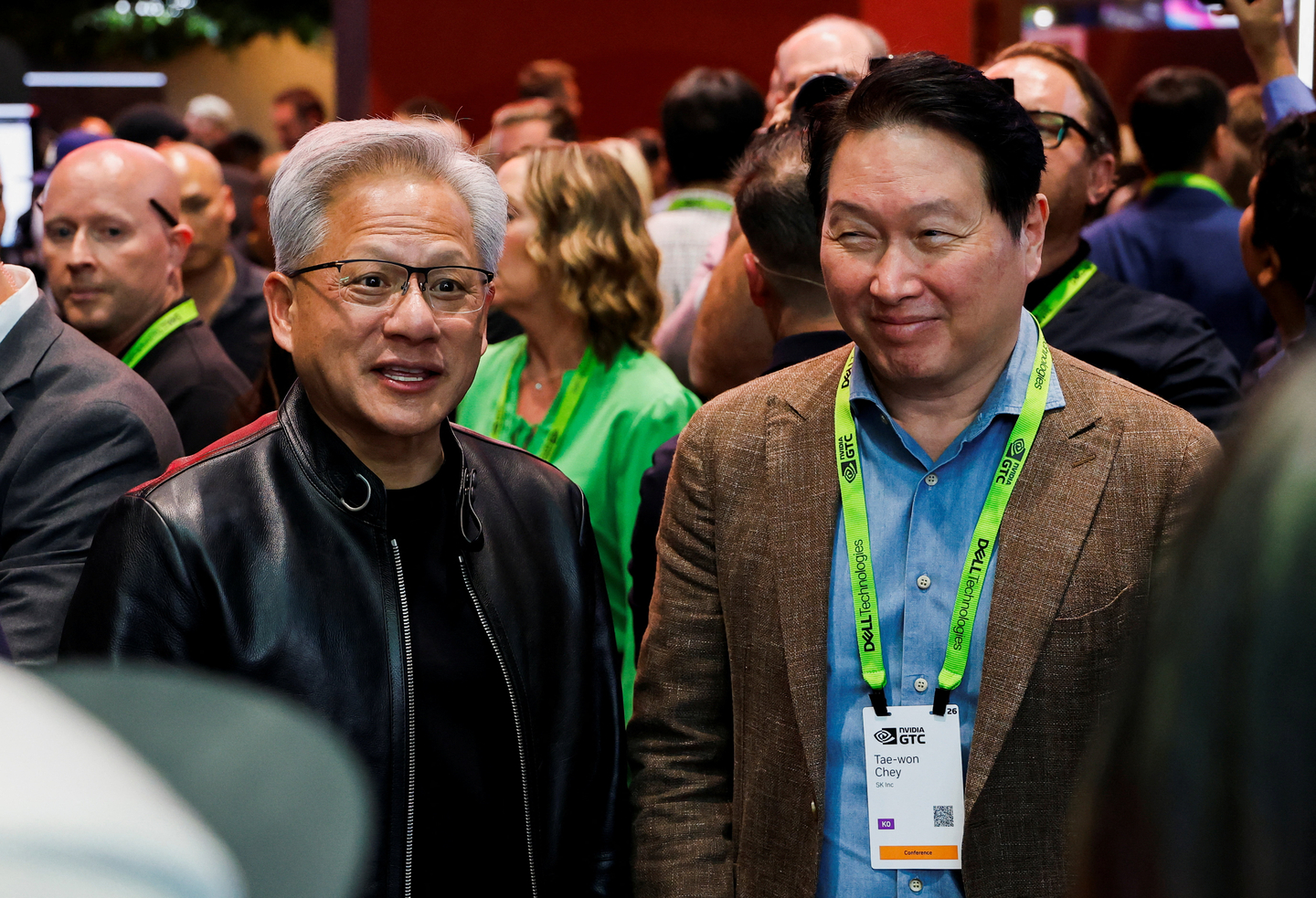
Nvidia CEO Jensen Huang, left, and SK Group Chairman Chey Tae-won attend the Nvidia GTC global AI conference in San Jose, California, on March 16. [REUTERS/YONHAP[
In particular, Nvidia CEO Jensen Huang’s emphasis on an “agentic AI economy” signals the arrival of an era in which AI functions not merely as a tool but as an economic actor. This marks more than a technological advancement; it represents the beginning of a transformation that will reshape the structures of labor, production and consumption, with implications extending across entire economies.
That kind of technological evolution demands fundamental changes to policy frameworks. In the past, AI policy focused on safety and accountability. Now, speed and competitiveness are becoming central. The United States is prioritizing technological leadership through deregulation, and Europe is maintaining its regulatory stance while exploring more flexible applications to prevent a loss of industrial competitiveness.
AI is no longer a single industry. It has become a strategic asset that determines national competitiveness. It is also expanding into a complex domain that integrates diplomacy, security and industrial policy, reflecting its growing importance in global competition.
Korea, meanwhile, implemented the AI Basic Act — the first of its kind in the world — in January. But as the pace of technological change accelerates to unprecedented levels, experts remain worried that rigid ex ante regulations may fail to keep up with innovation. A one-year grace period for some provisions has provided temporary relief, but underlying concerns about regulatory burdens remain unresolved in the field.
As a result, calls are growing for more fundamental regulatory reform rather than temporary adjustments. The AI industry today is not competing within fixed rules. Instead, rules themselves are still being shaped through ongoing experimentation and competition among countries and firms.
Excessive pre-emptive regulation at this stage risks discouraging experimentation and challenge, ultimately weakening industrial competitiveness. In manufacturing, in which Korea has established strengths, the adoption of physical AI presents an opportunity to significantly improve productivity and efficiency, with data accumulated in semiconductors, automobiles, shipbuilding and display industries constituting a critical asset in global competition.
However, the regulatory environment surrounding data use remains restrictive. Uncertainty over text and data mining, as well as limits on the use of video and biometric information, make AI training and real-world testing more difficult. These constraints slow technological progress and erode industrial competitiveness over time. A more refined balance between data utilization and protection is therefore essential.
Concerns about misuse, including deepfakes, cannot be ignored. Still, approaches that treat technology itself as an inherent risk and impose broad liability require caution. Excessive regulation can hinder corporate innovation and act as a digital barrier in global markets, potentially placing domestic firms at a disadvantage.
![A screen reads "AI in the physical world" as attendees gather during Rivian's first Autonomy and AI Day, showcasing developments in self-driving technology in Palo Alto, California, on Dec. 11, 2025. [REUTERS/YONHAP]](https://koreaseafood.online/data/photo/2026/04/06/8582f1b1-4219-46ec-88e7-04f2d9d09039.jpg)
A screen reads "AI in the physical world" as attendees gather during Rivian's first Autonomy and AI Day, showcasing developments in self-driving technology in Palo Alto, California, on Dec. 11, 2025. [REUTERS/YONHAP]
What is required now is a shift in regulatory approach. It may be more practical to allow technological experimentation within defined boundaries and strengthen accountability when problems arise rather than attempt to block all risks in advance.
Introducing a “safe harbor” framework could also help companies innovate in a more predictable environment. The AI Basic Act itself should not remain a fixed framework but should be continuously refined in line with technological advances and changes in global competition. Regulation should serve not as a tool of restriction but as a catalyst for growth.
As AI enters the physical world, global competition is being driven by the speed of innovation — not by regulation. If Korea remains bound by rigid rules, it risks limiting its opportunities and slowing its response to global change.
This is not the time to fall behind under regulatory constraints. It is a critical moment to accelerate innovation in step with change and to design a policy environment in which innovation can breathe, develop and contribute meaningfully to future growth.
This article was originally written in Korean and translated by a bilingual reporter with the help of generative AI tools. It was then edited by a native English-speaking editor. All AI-assisted translations are reviewed and refined by our newsroom.


with the Korea JoongAng Daily
To write comments, please log in to one of the accounts.
Standards Board Policy (0/250자)