

Korea to implement vehicle rotation system, but how much energy will it really save?
Published: 24 Mar. 2026, 18:15
Updated: 24 Mar. 2026, 20:04
-

- SARAH CHEA
- [email protected]
Audio report: written by reporters, read by AI
![A notice for the public sector five-day vehicle rotation system is posted in front of the Government Seoul Complex in Jongno District, central Seoul, on March 24. The system takes effect at midnight on March 25. [NEWS1]](https://koreaseafood.online/data/photo/2026/03/24/046fb52a-f6a1-4c9e-9b37-b456f8b09a0d.jpg)
A notice for the public sector five-day vehicle rotation system is posted in front of the Government Seoul Complex in Jongno District, central Seoul, on March 24. The system takes effect at midnight on March 25. [NEWS1]
Korea is set to implement a five-day vehicle rotation system — restricting cars from operating on one weekday each week — across the public sector starting at 12 a.m. on Wednesday as part of an energy-saving campaign to address energy supply disruptions caused by the prolonged war in the Middle East.
But the immediate impact is expected to be modest, as participation in the private sector remains voluntary and the affected vehicles account for less than 7 percent of the total fleet.
Still, the mandatory system marks the first such measure in 15 years, since oil prices surged past $100 a barrel in 2011, following political turmoil in the Middle East and North Africa. Should the policy be expanded to private vehicles, it would be the first time in 35 years since the 1991 Gulf War.
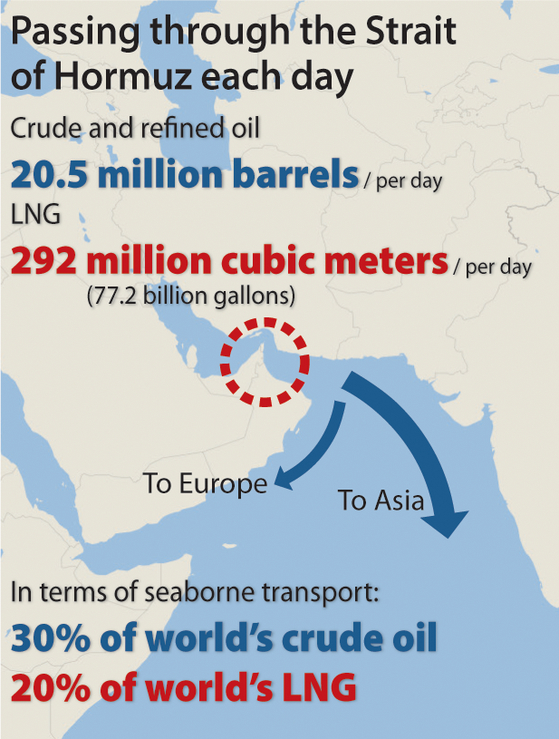
The measures were announced following Korea's upgrade of the oil‑related resource security alert to the second of four levels — “caution” — after Iran's block of the Strait of Hormuz disrupted Korea's crude imports. The Energy Ministry’s series of measures includes ways to minimize liquefied natural gas (LNG) consumption, implement stringent oil-saving and energy conservation policies, and accelerate the deployment of renewable energy and energy storage systems.
How the 5-day car restriction system works
The five-day vehicle rotation system restricts passenger cars from operating on designated weekdays based on the last digit of their license plates. For instance, vehicles with plate numbers ending in 1 or 6 are barred from the roads on Mondays, while those ending in 2 or 7 are restricted on Tuesdays.
However, cars used by people with disabilities, vehicles carrying pregnant women or young children, EVs and hydrogen cars are exempt from the mandatory restriction. Hybrid cars and small-sized cars, which had long been exempt under similar schemes, are included this time.
A voluntary system was already in place among public institutions, with no provisions for monitoring or penalties. The government plans to tighten enforcement by increasing compliance checks and imposing disciplinary measures on repeat violators.
![Minister of Climate, Energy and Environment Kim Sung-whan explains the five-day car restriction system during a press briefing on March 24 in central Seoul. [NEWS1]](https://koreaseafood.online/data/photo/2026/03/24/c72efa4d-9a06-4a7c-9239-8f404a7ce6f9.jpg)
Minister of Climate, Energy and Environment Kim Sung-whan explains the five-day car restriction system during a press briefing on March 24 in central Seoul. [NEWS1]
The measure is expected to cover roughly 20,000 institutions across the country, including public agencies and schools, affecting about 1.5 million vehicles owned by government employees, or roughly 6.8 percent of all cars registered in Korea.
That will potentially save around 3,000 barrels of oil per day — a relatively modest figure compared to Korea’s daily petroleum consumption of around 2.8 million barrels, a quarter of which is consumed by vehicles.
Public institutions that fail to comply with the system will receive warnings, and employees who violate the restrictions four or more times will face disciplinary action.
“If the energy supply crisis materializes, stronger measures will be unavoidable,” Minister of Climate, Energy and Environment Kim Sung‑whan said during a press briefing on Tuesday. “We will actively consider additional demand-reduction measures, such as remote work.”
No mandatory measures are being pushed for the private sector as of now, but Kim said he is considering doing so if the nation's oil‑related resource security alert worsens in the future.
The government also plans to temporarily encourage staggered commuting hours in public institutions and major corporations to help spread transportation demand.
The top 50 energy-consuming companies will be asked to develop energy-saving plans, with incentives such as priority access to financing for energy-efficiency facilities offered to those that meet their energy reduction targets.
![A cargo ship carrying vehicles sails through the Persian Gulf toward the Strait of Hormuz on March 22. [AP/YONHAP]](https://koreaseafood.online/data/photo/2026/03/24/9168cbbc-29ea-4cdc-a0b1-21dc14d8f9a1.jpg)
A cargo ship carrying vehicles sails through the Persian Gulf toward the Strait of Hormuz on March 22. [AP/YONHAP]
Boosting nuclear, coal to cut LNG
Korea will expand operations at nuclear and coal-fired plants in a bid to curb LNG consumption, which has the greatest impact on electricity prices.
Fifteen out of 26 nuclear reactors are operational as of March 16, and of the 11 reactors undergoing maintenance, five are slated for reactivation by May.
Restrictions on coal-fired power plants, currently in place to reduce fine dust, will be temporarily eased to allow for increased electricity generation.
“If necessary, three coal plants slated for decommissioning could be postponed,” Kim said. “Currently, daily LNG consumption for power generation averages 69,000 tons. The government expects that these measures could reduce usage by up to 14,000 tons per day, roughly 20 percent of the current daily total."
The Ministry of Energy also plans to accelerate the deployment of renewable energy, aiming to quickly add more than 7 gigawatts this year, bringing total capacity to 44.5 gigawatts. Around 1.3 gigawatts of energy storage systems will be installed to help reduce demand for LNG and oil.
The Korean government also unveiled 12 energy-saving guidelines for citizens, including using public transportation, charging EVs and mobile phones during daylight hours, shortening shower times and running washing machines and vacuum cleaners on weekends.
![President Lee Jae Myung appeals citizens' participation in the energy-saving campaign during a Cabinet meeting held at the Blue House on March 24. [JOINT PRESS CORPS]](https://koreaseafood.online/data/photo/2026/03/24/d5fec1a0-59a6-47d5-b9de-a2d8572d36ae.jpg)
President Lee Jae Myung appeals citizens' participation in the energy-saving campaign during a Cabinet meeting held at the Blue House on March 24. [JOINT PRESS CORPS]
Korea grapples with energy shortages
Korea is quietly bracing for a so-called energy crisis, which could come as early as the end of April, with the ongoing war expected to hit the country hardest through disruptions to energy supplies.
Korea depends on 70 percent of its crude oil imports from the Middle East, and 99 percent of those imports pass through the Strait of Hormuz. Though the government claims it has enough reserves to last 200 days, domestic refineries say they are expected to run out of crude by the end of April.
Naphtha — a key raw material for petrochemical products — is particularly vulnerable, with typical stockpiles lasting only about two weeks, and the supply crunch has already forced some domestic chemical firms to shut down plants. Naphtha prices have surged to over $1,100 per barrel, nearly doubling from pre-crisis levels of around $600 per barrel.
The government is even considering a ban on naphtha exports to redirect naphtha produced by local refineries to the domestic market and ease supply shortages.
LNG is also under mounting strain after Iran attacked Qatar’s LNG facilities, which could invoke force majeure clauses in long-term supply contracts with Korea, potentially suspending deliveries for up to five years. Qatar accounts for roughly 14 percent of Korea’s LNG imports per year.
President Lee Jae Myung also appealed for public cooperation.
“The second official announcement of the maximum oil price is scheduled for Friday, and while a price increase is unavoidable, we must swiftly implement concrete measures to minimize the impact on citizens’ lives,” President Lee said during a Cabinet meeting on Tuesday.
“Public cooperation is crucial. Just as we overcame the foreign exchange crisis and the Covid-19 pandemic, we can also overcome this crisis if all our citizens unite in purpose and effort,” Lee added. “Public institutions should lead by example through measures such as the five-day vehicle system, and we ask citizens to join the campaign to conserve energy by using public transportation and practicing everyday energy-saving habits.”
BY SARAH CHEA [[email protected]]


with the Korea JoongAng Daily
To write comments, please log in to one of the accounts.
Standards Board Policy (0/250자)