

Youth employment in Korea declines for 19th month as joblessness rises among 30-somethings
Published: 10 Dec. 2025, 17:47
Updated: 15 Dec. 2025, 12:04
![A job seeker fills out an application form at a job center in Mapo District, western Seoul, on Dec. 9. [NEWS1]](https://koreaseafood.online/data/photo/2025/12/15/7347f0a3-d7a2-4b9d-ac24-2ee16b974e3f.jpg)
A job seeker fills out an application form at a job center in Mapo District, western Seoul, on Dec. 9. [NEWS1]
Korea saw youth hiring fall again in November, extending a 19-month decline, while unemployment rose among people in their 30s, government data showed Wednesday. A record number of people in their 30s also said they were “just resting,” reflecting the group’s frequent job moves and widening labor market pressure.
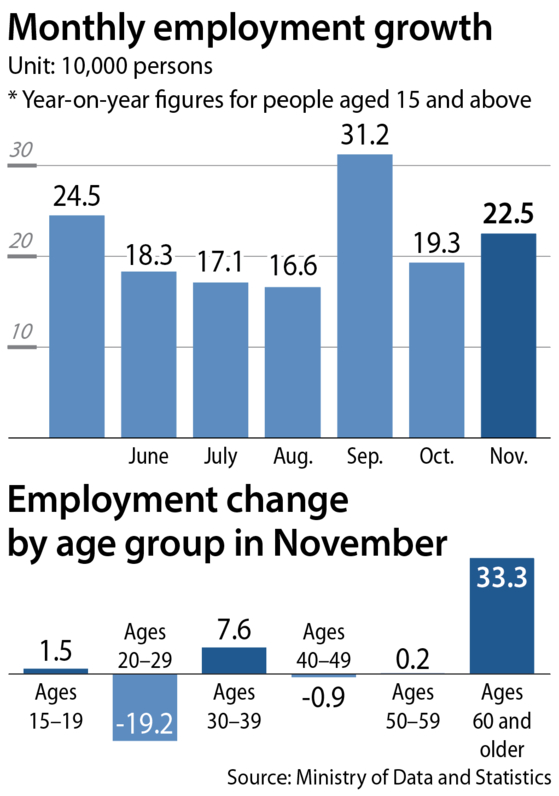
The employment rate still climbed to 63.4 percent in November, up 0.2 percentage points on year and the highest for any November since records began. The number of people aged 15 and over who had jobs rose 225,000, or 0.8 percent, on year to 29.05 million, according to the Ministry of Data and Statistics.
The gains came almost entirely from older workers. The number of people aged 60 and above who held jobs increased by 333,000, outpacing the national rise. Youth employment, which covers people aged 15 to 29, fell by 177,000 on year, while employment among those in their 40s dropped by 9,000. The youth employment rate slipped to 44.3 percent, down 1.2 percentage points, during the same period.
Officials and analysts cite firms’ preference for experienced hires and prolonged slumps in construction and manufacturing as key drags on youth hiring.
Signs of stress also emerged among people in their 30s. Employment in that age group grew by 76,000, but the pace slowed sharply from September to October. The number of unemployed in their 30s jumped to 164,000, up 29.7 percent on year, the largest increase for any November since 2020, when Covid-19 disruptions were still visible.
Government officials said the increase partly reflected a rise in the size of the age group.
"The number of unemployed people in their 30s increased significantly, but both the employment rate and the labour-force participation rate also went up," said Gong Mi-sook, head of the social statistics bureau at the Data Ministry.
The population reporting they were “just resting” — neither working nor looking for work — reached 2.543 million, up 124,000 on year and the highest for any November since the data series began in 2003. The figure for people in their 30s rose by 6,000 to 314,000, also a record for November. Among the youth cohort, the number increased for the first time since May, rising by 7,000 to 416,000.
"People in their 30s belong to a group whose population is growing, and some are counted as ‘resting’ while they prepare for job changes," an official at the Ministry of Economy and Finance said.
"The government will closely analyze trends and causes of youth ‘resting’ status by type and draw up tailored support measures to strengthen job-seeking capabilities and encourage entry into the labor market," the official added.
Weakness persisted across major industries. Construction employment dropped by 131,000, extending its decline to 19 months. Manufacturing jobs fell by 41,000, marking a 17th straight month of contraction, though the pace eased on stronger semiconductor demand.
Employment in accommodation and food services, a sector that hires many young part-timers, fell by 22,000, the first drop in four months after gains driven by the government-issued consumer coupons faded.
"Accommodation and food services improved due to livelihood-recovery consumption coupons, but their effect now seems to be fading," Gong said.
This article was originally written in Korean and translated by a bilingual reporter with the help of generative AI tools. It was then edited by a native English-speaking editor. All AI-assisted translations are reviewed and refined by our newsroom.
BY AHN HYO-SEONG [[email protected]]


with the Korea JoongAng Daily
To write comments, please log in to one of the accounts.
Standards Board Policy (0/250자)