

Won nearly hits 1,400 to the dollar as U.S. trade talks stall
Published: 22 Sep. 2025, 18:44
Updated: 22 Sep. 2025, 19:35
-

- JIN MIN-JI
- [email protected]
![Electronic boards at Hana Bank in central Seoul show the Kospi and the won-dollar exchange rate on Sept. 22. The won almost broke 1,400 against the greenback as the dollar strengthened on a hawkish U.S. Federal Reserve stance, while Britain's budget deficit came in significantly higher than the forecast. [YONHAP]](https://koreaseafood.online/data/photo/2025/09/22/547c4a42-d5da-4c1e-95eb-2fc18a65f8a6.jpg)
Electronic boards at Hana Bank in central Seoul show the Kospi and the won-dollar exchange rate on Sept. 22. The won almost broke 1,400 against the greenback as the dollar strengthened on a hawkish U.S. Federal Reserve stance, while Britain's budget deficit came in significantly higher than the forecast. [YONHAP]
The Korean won nearly broke the 1,400 threshold against the dollar on Monday, weighed down by stalled Korea-U.S. trade negotiations and a stronger dollar driven by Britain's budget deficit, which came in significantly higher than expected.
The won reached 1,399 against the dollar, rising 0.14 percent from the previous trading session and closing just below the psychologically significant 1,400 won threshold, a level closely watched by markets and policymakers. It was quoted at 1,392.6 won at 3:30 p.m.
But experts say that it will be difficult for the won to further weaken against the greenback as the dollar is expected to stay weak.
“The U.S. job market remains weak, and the economy is unlikely to see a meaningful turnaround, making further rate cuts more likely,” said Choi Kwang-hyuk, an analyst at LS Securities. “That will likely push the dollar index lower through the end of the year.”
In August, the unemployment rate in the United States increased to nearly a four-year high of 4.3 percent. Softening labor market conditions contributed to the U.S. Federal Reserve’s first rate cut of the year last week, lowering the benchmark rate by 25 basis points to a range of 4 to 4.25 percent. It was seen as hawkish, as the Fed Chair Jerome Powell said it was a risk management cut.
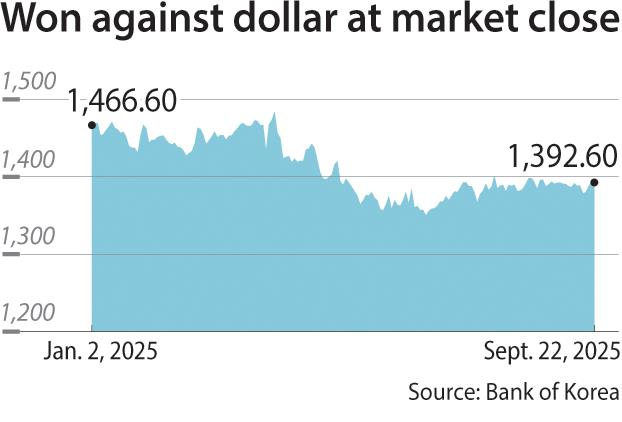
gra
The psychological and economic threshold of 1,400 won will also prevent the further weakening of the won.
“People have come to expect that the government will engage in verbal intervention to stabilize the currency if it breaks the 1,400 won level,” Choi added. “This expectation helps keep the value below that threshold.”
The strength of the won has become a sensitive issue recently, as Korea tries to find ways to source the $350 billion it promised to invest in the United States in return for lower tariff rates.
President Lee Jae Myung warned that complying with the investment plans could put Korea at risk of a financial crisis similar to the one it faced in 1997, Reuters reported on Sunday. Lee said that Korea needs a currency swap agreement with the United States to finance the investment — something many experts believe is unlikely, primarily due to Korea’s nonkey currency status.
Seoul closely monitors exchange rates, having faced near financial collapse during the Asian financial crisis, when a shortage of U.S. dollars left the country vulnerable.
The Bank of Korea’s (BOK) warning that the won could experience greater depreciation than advanced market currencies in response to global shocks has heightened attention on exchange rate monitoring.
The central bank’s Monday report was based on the uncovered interest rate parity (UIP), an economic theory that suggests the difference in interest rates between two countries will equal the expected change in their exchange rates.
The BOK said that Korea’s UIP premium-to-global risk shock rate was 2.11 percentage points — higher than the average of 0.41 percentage points of advanced economies, such as Germany and Japan. A higher reading indicates that its currency is more likely to depreciate when it encounters global risks.
“A coordinated policy mix — involving not only monetary policy but also foreign exchange market intervention and macroprudential measures — can enable authorities to achieve their policy objectives more effectively,” the BOK said.
BY JIN MIN-JI [[email protected]]


with the Korea JoongAng Daily
To write comments, please log in to one of the accounts.
Standards Board Policy (0/250자)