

Should Korea work less? A four-and-a-half-day week sparks a divide.
Published: 19 Sep. 2025, 15:07
Updated: 19 Sep. 2025, 21:27
-

- JIN MIN-JI
- [email protected]
![Office workers walk across a street in central Seoul on May 29, 2024. [YONHAP]](https://koreaseafood.online/data/photo/2025/09/19/b6980b5e-2b74-442e-98ab-a7b9d4ffdb6a.jpg)
Office workers walk across a street in central Seoul on May 29, 2024. [YONHAP]
End-of-day songs and automatic computer shutdowns are common rituals observed toward the end of the workday at Korean companies. Though they may seem quirky, these practices reflect a determined push to enforce standard working hours in a country where the average work time far exceeds that of other developed nations.
The Lee Jae Myung administration is looking to further reduce the regular workweek from the current five to four-and-a-half days with a plan to propose a related bill this year. The move has quickly instigated heated debates with labor unions advocating for it as an improvement to work-life balance, while business associations worry about a potential erosion of labor productivity amid a shrinking population and sluggish growth.
The Moon Jae-in administration in 2018 implemented a labor law that caps the workweek for employees at 52 hours — including 12 hours of overtime — from the previous maximum of 68 hours.
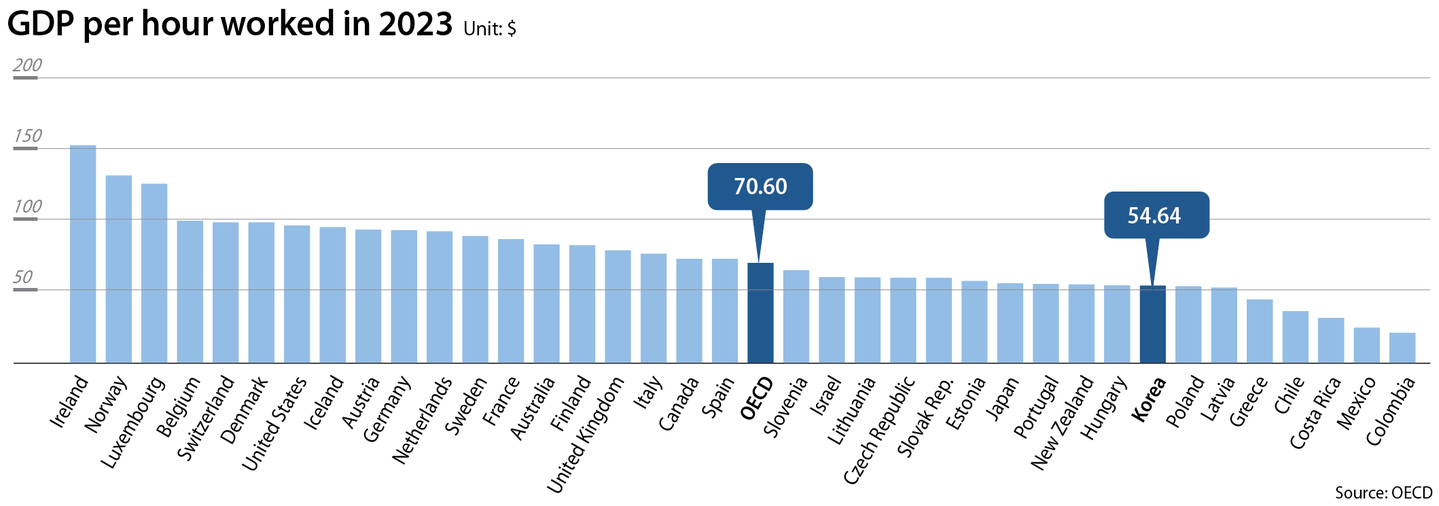
But the reduction in working hours has not been matched by a corresponding rise in productivity. In 2023, Korea’s GDP per hour worked was $54.64 — significantly lower than the Organisation for Economic Cooperation and Development (OECD) average of $70.60.
Some experts warn that adopting a four-and-a-half-day workweek could further hurt productivity, especially in industries like manufacturing, where output is closely tied to crew size and hours.
![A member of the Korean Financial Industry Union speaks on the need to introduce a 4.5-day workweek during a press conference held in Jung District, central Seoul, on Sept. 8. The union said it will go on a strike on xx unless the demand met. [YONHAP]](https://koreaseafood.online/data/photo/2025/09/19/d90af039-66b4-42b6-a2c4-667255294a65.jpg)
A member of the Korean Financial Industry Union speaks on the need to introduce a 4.5-day workweek during a press conference held in Jung District, central Seoul, on Sept. 8. The union said it will go on a strike on xx unless the demand met. [YONHAP]
“Reduced working hours are a long-term trend driven by advances in AI, but companies should be able to design what works best for them — whether that means a four-and-a-half-day week or a 4.8-day week — instead of being uniformly required to adopt a one-size-fits-all model through legislation,” said Prof. Cho Joon-mo, who teaches labor economics at Sungkyunkwan University.
“The scheme also doesn’t match the economic urgency of the current situation, where many small and midsize companies are struggling with labor shortages — as seen in the mass exodus of businesses from industrial hubs in suburbs,” he added.
Last month, the government designated Seosan in South Chungcheong and Pohang in North Gyeongsang “industrial crisis response zones,” as their regional economies struggle under slumps in the petrochemical and steel industries, respectively — sectors for which they’re well-known. Yeosu in South Jeolla was also given the same designation in May due to a downturn in its local petrochemical industry.
Amplifying labor's voice
Labor unions are intensifying calls for reduced working hours, arguing that the current system hurts work-life balance.
The Korean Financial Industry Union, which represents bank labor unions, is pushing for a four-and-a-half-day workweek — or a reduction to a 36-hour workweek from the current 40 — threatening to hold a strike later this month. The Hyundai Motor union entered partial strikes earlier this month demanding reduced work hours, though it recently settled with management on a pay increase.
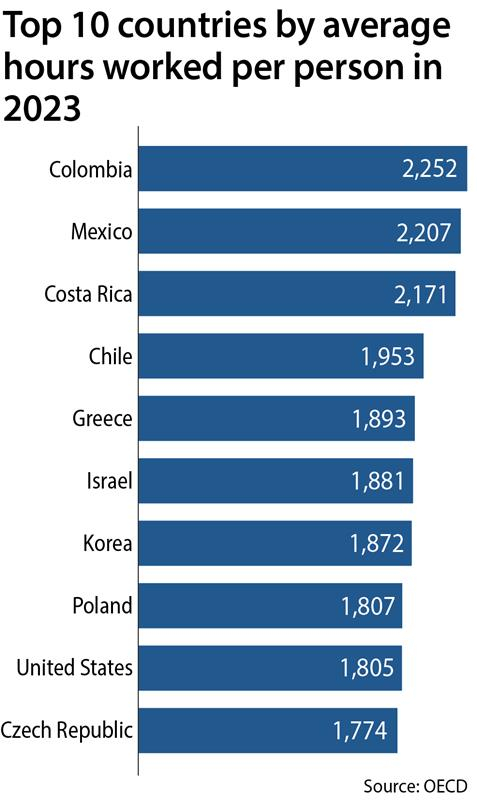
Korea ranks among the countries with the longest working hours in the OECD, averaging 1,872 hours in 2023, including regular working hours for full-time and part-time. That is significantly higher than the group's average of 1,740 hours and the seventh-highest out of the 38 member nations.
A potential compromise between labor and management could be to pilot a shorter work-hour system initially, starting with larger companies, and then gradually expanding it — rather than legislating a shorter workweek from the start.
“The reduced hours should start with conglomerates and then their partner companies, and then gradually expand the initiative to other industries,” said Lee Chan, professor and associate dean for Student Affairs at the School of Transdisciplinary Innovations at Seoul National University.
Major conglomerates like SK and Posco have embraced shorter weeks at some of their affiliates by implementing “Happy Friday” programs, which give employees one or two Fridays off each month. Woowa Brothers, the leading food delivery app operator in Korea, adopted a four-and-a-half-day workweek in 2015.
These companies are largely knowledge-intensive sectors where performance is measured by outcomes, not by physical presence at the workplace.
Overhauling a longstanding system
To maintain productivity under a four-and-a-half-day workweek across a broader range of industries, the wage system should shift from the current seniority-based to a role-based one. Otherwise, companies will face a growing financial burden as their work force ages and commands higher salaries, making it harder to recruit younger talent and potentially forcing firms to relocate production to countries with cheaper labor costs, Lee added.
Companies and labor should also jointly strive to eliminate any work inefficiencies, as shown by overseas precedents.
To maintain productivity while reducing work hours, Iceland — which piloted a 35- to 36-hour workweek, down from 40 hours, without pay cuts between 2015 and 2019 — saw companies cut inefficiencies by shortening meetings and reducing travel time, resulting in higher job satisfaction and fewer sick days.
According to a 2024 publication by the Committee on Labour Market Statistics, labor productivity in Iceland grew by an average of 1.5 percent annually over the five years leading up to the report — the highest among the Nordic countries — marking a potential shift from the past, when Iceland lagged its neighbors.
“When it comes to improving the way we work, it's not just about companies changing systems; workers themselves need to internalize new ways of working and change how they operate, reducing any parts of working hours that are being used inefficiently,” said Oh Kye-taik, senior research fellow at the Korea Labor Institute.
“If we're going to move toward a four-and-a-half-day workweek, labor and management need to make efforts together, and the government needs to step in to support challenges difficult for individual companies to handle, like providing consulting services,” Oh added.
BY JIN MIN-JI [[email protected]]


with the Korea JoongAng Daily
To write comments, please log in to one of the accounts.
Standards Board Policy (0/250자)