

Kospi's all-time high precarious as political, corporate policy threaten confidence
Published: 15 Sep. 2025, 16:58
Updated: 15 Sep. 2025, 19:47
Audio report: written by reporters, read by AI
![The Kospi is seen closing at 3,407.31 points, up 11.77 points, or 0.35 percent, from the previous trading day, at a Hana Bank dealing room in central Seoul on Sept. 15. [YONHAP]](https://koreaseafood.online/data/photo/2025/09/15/bba2efd6-d8a9-4cb8-ae95-477f28cf299d.jpg)
The Kospi is seen closing at 3,407.31 points, up 11.77 points, or 0.35 percent, from the previous trading day, at a Hana Bank dealing room in central Seoul on Sept. 15. [YONHAP]
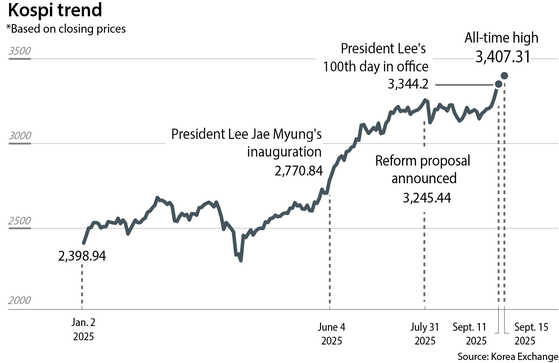
The Kospi has soared 25.8 percent in President Lee Jae Myung’s first 100 days, climbing from 2,698.97 at close on June 2 to 3,407.31 on Monday, setting record highs.
With the “Kospi 5000 era” as a national goal, the administration will push to redirect capital from real estate into equities. Investor attention has surged, but so have concerns about volatility and policy uncertainty.
But heightened expectations are paired with growing unease. The domestic stock market has shown sharp swings in response to government remarks. After breaking 3,200 within a month of Lee’s inauguration in a "honeymoon rally," momentum faltered on July 31 following the announcement of a reform plan to lower the taxable threshold on capital gains.
Stuck in a narrow band for more than a month, the Kospi broke upward again on Thursday after Lee said at his 100-day press conference, “If the expansion of capital gains tax requirements hinders market vitality, there is no need to insist on it,” propelling the index close to 3,400.
“The burden of taxation itself is less the issue than the unease caused by the government’s mixed signals on its pledge to boost the market,” said Cho Hong-jong, a professor of economics at Dankook University. “Policy consistency is more crucial than ever, since the market depends on clear signals.”
A survey of 1,000 retail investors conducted twice by JoongAng Ilbo and research firm Open Survey showed rising anxiety about policy uncertainty after the tax plan was announced. On July 29, just before the announcement of the tax reform plan, 26.9 percent cited policy uncertainty as their reason for not investing in domestic stocks. By Thursday, that figure had risen to 38.6 percent.
During the same period, belief that the government could achieve its Kospi 5000 pledge dropped from 32.3 percent to 28.5 percent, while those shifting or planning to shift investments from real estate to stocks slipped from 34.1 percent to 33.4 percent.
A separate survey of 60 institutional investors revealed similar concerns. The most frequent answers on what the market needed were: “consistent policy execution with a unified sense of purpose,” “trust in sustained government initiatives,” “long-term guidance instead of short-term measures” and “consistent shareholder return policies.”
Corporate sentiment echoed these findings. In a survey of 200 listed firms conducted by the JoongAng Ilbo and the Korea Chamber of Commerce and Industry (KCCI), 77.5 percent said their shares were undervalued relative to corporate fundamentals.
The top reasons cited were a lack of market confidence at 37.4 percent, insufficient shareholder return policies at 23.2 percent and government policy uncertainty at 13.5 percent.
While 67 percent viewed government stock market initiatives positively, 38 percent of companies said revitalization required strong incentives such as tax benefits, 25.5 percent said reasonable mandatory requirements instead of voluntary measures were needed and 14 percent said consistent long-term policy execution was necessary.
Korea has introduced stock market policies with each administration, but a lack of persistence has undermined investor confidence. Taiwan, by contrast, has maintained consistent market-friendly measures for 22 years, while Japan has done so for 12.
![Screens showing the Kospi and Kosdaq are seen at a dealing room of Hana Bank in Seoul on Sept. 15. [AP/YONHAP]](https://koreaseafood.online/data/photo/2025/09/15/ad822780-44ef-454b-bb65-8a06f3d431aa.jpg)
Screens showing the Kospi and Kosdaq are seen at a dealing room of Hana Bank in Seoul on Sept. 15. [AP/YONHAP]
Taiwan focused on improving corporate governance to resolve chronic undervaluation, launching a policy program in 2003 and rolling out five phased road maps since. These included independent directors, stricter disclosure requirements, bans on cross-shareholdings and the encouragement of shareholder activism.
“Global recognition from financial markets and foreign investors is essential for Korea to achieve a virtuous cycle,” said Rhee Nam-uh, the chairman of the Korea Corporate Governance Forum. “Creating a dedicated body to coordinate across ministries and lead governance reform should be considered.”
Of the surveyed companies, 70 percent cited Korea’s speculative investment culture as a major obstacle to raising share values, while 56 percent also cited rigid capital market and commercial law regulations. Needed measures included stronger incentives such as tax breaks at 38 percent and indirect support for attracting friendly investors at 21 percent.
“Firms are willing to enhance corporate value, but stricter commercial law regulations have made innovative investment decisions harder,” said Lee Soo-won, head of corporate policy at the KCCI. “Improvements to breach-of-trust rules and stronger defenses against hostile takeovers are necessary.”
“To build an environment where companies can raise capital and grow more easily, both public funds like pension funds and private capital such as notes, integrated investment accounts and business development companies must be mobilized in parallel,” said Kim Sei-wan, the president of the Korea Capital Market Institute. “Ultimately, more new growth and innovative firms must emerge for the Korean stock market to take the next leap forward.”
This article was originally written in Korean and translated by a bilingual reporter with the help of generative AI tools. It was then edited by a native English-speaking editor. All AI-assisted translations are reviewed and refined by our newsroom.
BY CHOI HYUN-JU, KIM MIN-JOONG, KO SUK-HYUN [[email protected]]


with the Korea JoongAng Daily
To write comments, please log in to one of the accounts.
Standards Board Policy (0/250자)