

Exports to U.S. tumble by double digits as Trump tariffs catch up
Published: 01 Sep. 2025, 17:47
Updated: 01 Sep. 2025, 19:46
![Hyundai Motor cars are waiting for exports at a port in Pyeongtaek, Gyeonggi, on July 31, the day when the United States cut its tariffs against Korea to 15 percent. [YONHAP]](https://koreaseafood.online/data/photo/2025/09/01/030aa0d9-2589-44ae-ae49-312291a71a71.jpg)
Hyundai Motor cars are waiting for exports at a port in Pyeongtaek, Gyeonggi, on July 31, the day when the United States cut its tariffs against Korea to 15 percent. [YONHAP]
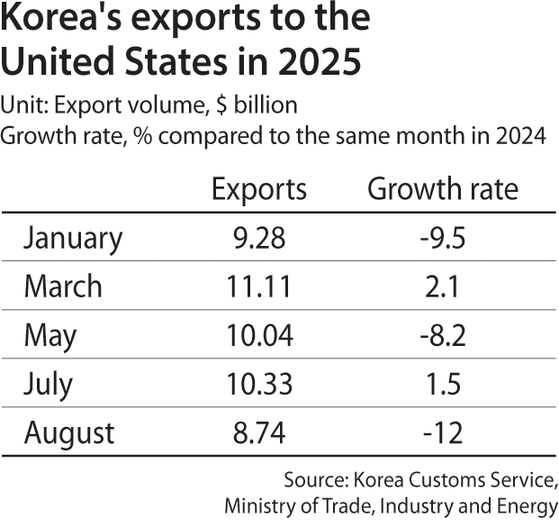
The impact of the Donald Trump administration’s “tariff bomb” is beginning to take hold, with Korea’s exports to the United States falling by double digits in August for the first time in 2025.
Shipments of automobiles, auto parts and steel — all subject to U.S. tariffs — were hit particularly hard. Washington has also delayed its planned cut of auto and parts tariffs from 25 percent to 15 percent, raising fears of prolonged sluggish exports in related industries.
Korea’s shipments to the United States from Aug. 1 to 25 fell 12 percent on year to $8.74 billion, compared to $9.94 billion a year earlier, according to the Ministry of Trade, Industry and Energy on Monday.
The decline was the steepest since May 2020, when exports plunged 29.4 percent amid the Covid-19 pandemic. Monthly exports to the United States also dropped below $9 billion for the first time in two years, since August 2023.
“The tariff impact appears to be surfacing with a delay,” said industry ministry official Seo Ga-ram.
Autos, Korea’s biggest export item to the United States, saw August shipments fall 3.5 percent on year to $1.58 billion. From January to July, auto exports were already down 15.1 percent to $18.2 billion. Auto parts, subject to a 14.4 percent tariff, and steel, down 32.1 percent, also posted steep drops.
The Wall Street Journal recently estimated that Hyundai Motor Group incurred $1.17 billion in tariff-related losses in the second quarter. Hyundai bore $600 million of the cost and Kia $570 million. Although smaller than Japanese rivals — Toyota at $3 billion and Honda at $850 million — the losses are still significant for individual companies.
Tariff negotiations between Seoul and Washington on July 30 produced a deal to reduce U.S. auto and parts tariffs from 25 percent to 15 percent, but implementation has been delayed. Trump officials are reportedly linking the tariff cut to Korea’s pledge of $350 billion in investment, demanding a detailed execution plan before lowering duties.
![Containers carrying items for export are piled up at a port in Pyeongtaek, Gyeonggi, on Aug. 17. [NEWS1]](https://koreaseafood.online/data/photo/2025/09/01/b27a19b5-d3e5-41a7-8acb-2eb0ea466436.jpg)
Containers carrying items for export are piled up at a port in Pyeongtaek, Gyeonggi, on Aug. 17. [NEWS1]
“Korean firms have kept car prices steady to protect market share despite tariff costs, but they cannot continue absorbing the burden,” added Seo. “Future price hikes could dampen demand.”
By contrast, U.S.-bound semiconductor exports, not subject to tariffs, soared. Shipments in August jumped 56.8 percent on year to $810 million. From January to July, exports rose 23.7 percent to $6.49 billion, boosted by demand for AI applications and data centers.
Analysts caution, however, that this may reflect stockpiling ahead of potential U.S. tariffs. Even with most favored nation status, semiconductors could face tariffs of at least 15 percent once Washington finalizes its schedule, raising risks for Korea’s trade environment.
![A large crane is seen at Hanwha Ocean’s Geoje shipyard in Geoje, South Gyeongsang, on July 31, the day Korea and the United States reached a trade deal centered on lowering tariffs on exports to the United States and boosting investment in the shipbuilding industry. [NEWS1]](https://koreaseafood.online/data/photo/2025/09/01/85c21054-17a2-4798-ab10-3e3e0eef7f4b.jpg)
A large crane is seen at Hanwha Ocean’s Geoje shipyard in Geoje, South Gyeongsang, on July 31, the day Korea and the United States reached a trade deal centered on lowering tariffs on exports to the United States and boosting investment in the shipbuilding industry. [NEWS1]
"Semiconductor exports will remain strong for now, but if U.S. tariffs are imposed, growth momentum will inevitably slow,” said Jang Sang-sik, the head of international trade studies at the Korea International Trade Association.
Korea’s exports to China also fell, down 2.9 percent on year in August to $11.01 billion. Declines in wireless communication devices by 10.2 percent and displays by 11.6 percent reflected a saturated smartphone market, while general machinery exports dropped 17 percent due to China’s push for the domestic production of air conditioners.
Despite weak sales in its two biggest markets, Korea’s overall exports rose 1.3 percent on year in August to $58.4 billion — the highest ever for the month — extending a streak of record monthly exports since June. Cumulative exports from January to August reached $453.97 billion, up 0.9 percent on year.
![Hyundai Motor cars are waiting for exports at a port in Pyeongtaek, Gyeonggi, on July 31, the day when the United States cut its tariffs against Korea to 15 percent. [YONHAP]](https://koreaseafood.online/data/photo/2025/09/01/e71cad42-5f15-4972-bad1-6350a5ba2708.jpg)
Hyundai Motor cars are waiting for exports at a port in Pyeongtaek, Gyeonggi, on July 31, the day when the United States cut its tariffs against Korea to 15 percent. [YONHAP]
Semiconductors led the gains, surging 27.1 percent on year to a record $15.1 billion in August, accounting for 25.9 percent of total exports. Higher chip prices boosted performance, with DDR4 memory surpassing $5 for the first time this year and DDR5 remaining above $5 for three consecutive months.
Although auto exports to the United States remained sluggish, overall exports in August hit a record $5.5 billion thanks to growth in environmentally friendly vehicles such as pure EVs and hybrids, as well as increased shipments of used cars. Analysts attributed the record to Korea’s diversification into markets including the European Union, the Commonwealth of Independent States and the Middle East.
Ship exports rose 11.8 percent to $3.14 billion, while exports to the Association of Southeast Asian Nations jumped 11.9 percent to $10.89 billion — both record highs for August.
“Korea’s export diversification is paying off,” Jang said. “As the United States and China remain locked in a tariff war, trade alliances among other economies are deepening, creating both challenges and opportunities for Korean exporters.”
This article was originally written in Korean and translated by a bilingual reporter with the help of generative AI tools. It was then edited by a native English-speaking editor. All AI-assisted translations are reviewed and refined by our newsroom.
BY KIM WON [[email protected]]


with the Korea JoongAng Daily
To write comments, please log in to one of the accounts.
Standards Board Policy (0/250자)