

With only 3 days to go, Korea hopes shipbuilding can put wind in tariff deal sails
-

- SARAH CHEA
- [email protected]
![U.S. President Donald Trump reacts after reaching a trade deal with European Commission President Ursula von der Leyen at the Trump Turnberry golf course in Turnberry, Scotland, on July 27. [AP/YONHAP]](https://koreaseafood.online/data/photo/2025/07/28/a6a6ac71-a98e-42ef-99cf-805f55d384f6.jpg)
U.S. President Donald Trump reacts after reaching a trade deal with European Commission President Ursula von der Leyen at the Trump Turnberry golf course in Turnberry, Scotland, on July 27. [AP/YONHAP]
[NEWS ANALYSIS]
With Japan and the European Union (EU) having wrapped up tariff negotiations with U.S. President Donald Trump, Korea — constrained by limited and modest investment potential — is set to test whether its dominance in global shipbuilding can compensate for its financial shortfalls at the bargaining table.
Korean Finance Minister Koo Yun-cheol will leave for Washington on Tuesday for a face-to-face meeting with U.S. Treasury Secretary Scott Bessent scheduled for Thursday.
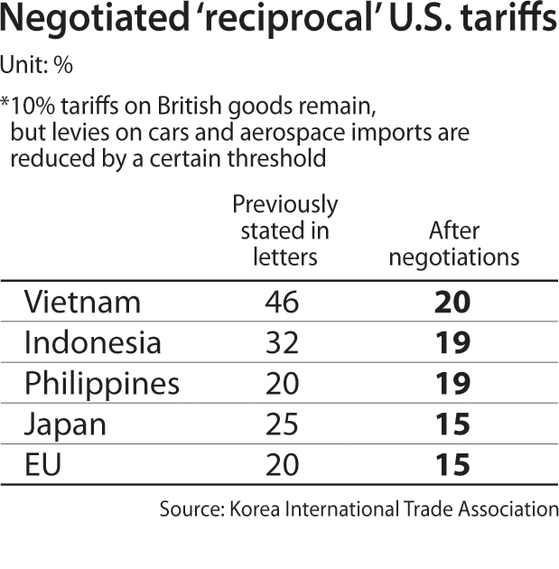
Given the substantial overlap in export categories like automobiles, Seoul’s failure to secure tariff terms comparable to the 15 percent rate granted to Tokyo and the EU would risk eroding its competitive position in the U.S. market, which accounts for nearly 20 percent of Korea’s total exports.
The EU on Monday reached a trade deal framework with the United States and reached a consensus of 15 percent tariffs on all goods to the U.S. market, with a condition of $600 billion in investment and $750 billion in purchases of U.S. energy. That deal followed Japan’s $550 billion investment package pledge.
The EU, whose economy is more than five times the size of Japan’s, appears to have taken an alternative approach, circumventing headline investment figures by incorporating large-scale energy purchases into its package.
Leveraging this approach, Korea is reported to have proposed a massive shipbuilding cooperation project worth billions of dollars of investment to the United States, hoping to capitalize on a strategic asset unmatched by other countries.
How much, and what can Korea offer
Experts assert that Korea needs to propose an investment of at least $200 billion, and potentially up to $300 billion, to elicit favorable consideration from Trump.
However, previous negotiations have hinted that these amounts need not consist solely of pure direct investment — offering the only glimmer of hope for Korea, whose economic scale pales in comparison to the competing U.S. trade partners.
“Trump will undoubtedly want a certain scale — figures of considerable magnitude; Considering Japan’s economy is about twice the size of ours, we expect the baseline to start at around $200 billion, with something extra,” Prof. Min Jeong-hun from the Institute of Foreign Affairs and National Security under the Korea National Diplomatic Academy told the Korea JoongAng Daily.
“The investment figures released so far are inflated and function with some loopholes such as vague timelines and conditions,” Min added. “Korea will need to use those loopholes, by incorporating shipbuilding and energy imports, to help reduce the trade deficit in a way that aligns with what Trump wants.”
Korean Industry Minister Kim Jung-kwan on July 25 proposed the multibillion-dollar “MASGA,” or "Make American Shipbuilding Great Again," project during a meeting with U.S. Commerce Secretary Howard Lutnick on July 25, according to a Yonhap News Agency report.
![Korean Industry Minister Kim Jung-kwan, left, greets U.S. Commerce Secretary Howard Lutnick for a tariff meeting in Washington on July 25. [NEWS1]](https://koreaseafood.online/data/photo/2025/07/28/51868a36-7f19-45c3-8baa-fe9057061bde.jpg)
Korean Industry Minister Kim Jung-kwan, left, greets U.S. Commerce Secretary Howard Lutnick for a tariff meeting in Washington on July 25. [NEWS1]
Modeled after Trump’s “MAGA” slogan, the project adds “Shipbuilding” to the phrase and envisions large-scale investments by Korean shipbuilders, backed by a comprehensive financing package involving loans and guarantees from Korean public financial institutions.
Minister Kim reportedly followed the departing Trump administration delegation to Europe, leaving for Scotland to seize every possible opportunity for negotiation.
Specific details of the project are slated for discussion during Koo's face-to-face meeting with Bessent scheduled for Thursday.
“Hanwha Ocean has already acquired Philly Shipyard in Philadelphia last year, but Trump hasn’t mentioned it at all, simply because the deal wasn’t completed during his administration,” said economics Prof. Yang Jun-sok from the Catholic University of Korea.
“There’s no doubt that Trump values Korea’s shipbuilding technology, but he will expect some fresh, integrated initiative on the table.”
![U.S. President Donald Trump shakes hands with European Commission President Ursula von der Leyen, after an announcement of a trade deal between the two in Turnberry, Scotland, on July 27. [REUTERS/YONHAP]](https://koreaseafood.online/data/photo/2025/07/28/2c284e0c-3a17-4a88-b85b-07bbcfcde9bd.jpg)
U.S. President Donald Trump shakes hands with European Commission President Ursula von der Leyen, after an announcement of a trade deal between the two in Turnberry, Scotland, on July 27. [REUTERS/YONHAP]
The real problem: Auto tariffs
Prospects appear markedly less favorable with the automobile tariffs, where Korea faces a particularly complex challenge, as brands like Toyota Motor and Volkswagen are direct competition for Hyundai Motor and Kia in the U.S. market.
The Korean carmakers now stand as the only major global auto brands subject to a 25 percent tariff, excluding a handful of cars from U.S. manufacturers that produce certain models in Mexico and Canada, which also face a 25 percent duty.
Korea, Japan and the EU rank as the three largest automobile exporters to the United States, with Korea exporting some 1.43 million vehicles to the country as of last year, narrowly ahead of Japan’s 1.37 million. The EU followed at around 758,000 units.
“It’s unlikely that Trump will grant Korea a 15 percent auto tariff,” Prof. Yang said, adding that since lowering tariffs against Japan and the EU, “Trump is already facing harsh pushback from some U.S. carmakers like GM and Ford.”
For instance, the sticker price of the Hyundai Elantra sedan, known as the Avante in Korea, starts at $22,125 in the United States, slightly undercutting its rival, the Toyota Corolla, which is priced from $22,325.
But assuming 100,000 units are exported, Hyundai cars would be subject to some $5.5 million in tariffs, compared to $3.3 million for Toyota.
![Hyundai Motor cars are waiting for exports at a port in Ulsan on July 28. [YONHAP]](https://koreaseafood.online/data/photo/2025/07/28/47e56772-fb94-43f6-a3b6-999a1ec8db5d.jpg)
Hyundai Motor cars are waiting for exports at a port in Ulsan on July 28. [YONHAP]
Genesis, Hyundai’s luxury marque, is also vulnerable, particularly in its competition with premium German brands like BMW and Mercedes-Benz. The Genesis GV70 has a sticker price of $48,000, roughly 10 percent lower than the BMW X3’s $52,075 and Mercedes GLC’s $51,000. But the 10 percentage point tariff gap between Korea and the EU could effectively nullify that pricing advantage.
Hyundai and Kia have already begun to suffer, with operating profits in the second quarter falling by 19.6 percent. Hyundai’s earnings were slashed by 828.2 billion won ($597.7 million), while Kia saw a decline of 786 billion won.
The automotive group predicted that the second half of the year may bring deeper losses, as inventories deplete and U.S. government subsidies set to expire after Sept. 30.
“If the current 25 percent tariff remains in place, Korean automakers will face an estimated burden of $6,000 per vehicle, which expands to 9.1 trillion won when including [Kia] cars produced in Mexico,” said analyst Song Sun-jae from Hana Securities.
“In a worst-case scenario, Hyundai and Kia’s combined annual tariff burden could rise to 10.5 trillion won, which is equivalent to nearly 37 percent of their projected annual operating profit."
![U.S. President Donald Trump holds a paper after reaching a trade deal with European Commission President Ursula von der Leyen at the Trump Turnberry golf course in Turnberry, Scotland, on July 27. [AP/YONHAP]](https://koreaseafood.online/data/photo/2025/07/28/7ea98af8-035b-4f46-82e0-ddc1c50a9cc5.jpg)
U.S. President Donald Trump holds a paper after reaching a trade deal with European Commission President Ursula von der Leyen at the Trump Turnberry golf course in Turnberry, Scotland, on July 27. [AP/YONHAP]
BY SARAH CHEA [[email protected]]


with the Korea JoongAng Daily
To write comments, please log in to one of the accounts.
Standards Board Policy (0/250자)