

For foreign workers, dreams are broken by harsh conditions, remade by kind bosses
![Migrant workers are seen at the multicultural food street in Danwon District, Ansan, Gyeonggi, on July 29. [JOONGANG SUNDAY]](https://koreaseafood.online/data/photo/2025/08/12/d2c5a659-ef08-4534-8b0d-da99584480f6.jpg)
Migrant workers are seen at the multicultural food street in Danwon District, Ansan, Gyeonggi, on July 29. [JOONGANG SUNDAY]
Rou looked stunned. The Indonesian youth had just been dismissed two days earlier. “The boss said to leave,” he said. When asked why, he replied, “He said he cannot pay wages.”
On July 29, the multicultural food street in Danwon District, Ansan, Gyeonggi, felt chilly even amid the rising heat. Rou's bulging suitcase contains all that he owns. He carried it from Yongin to Ansan. Friends from East Java who’ve stood by him since childhood had come to pick him up.
“The boss was a good person, fortunately. Just didn’t have the money,” Rou said. He has not been paid for three months.
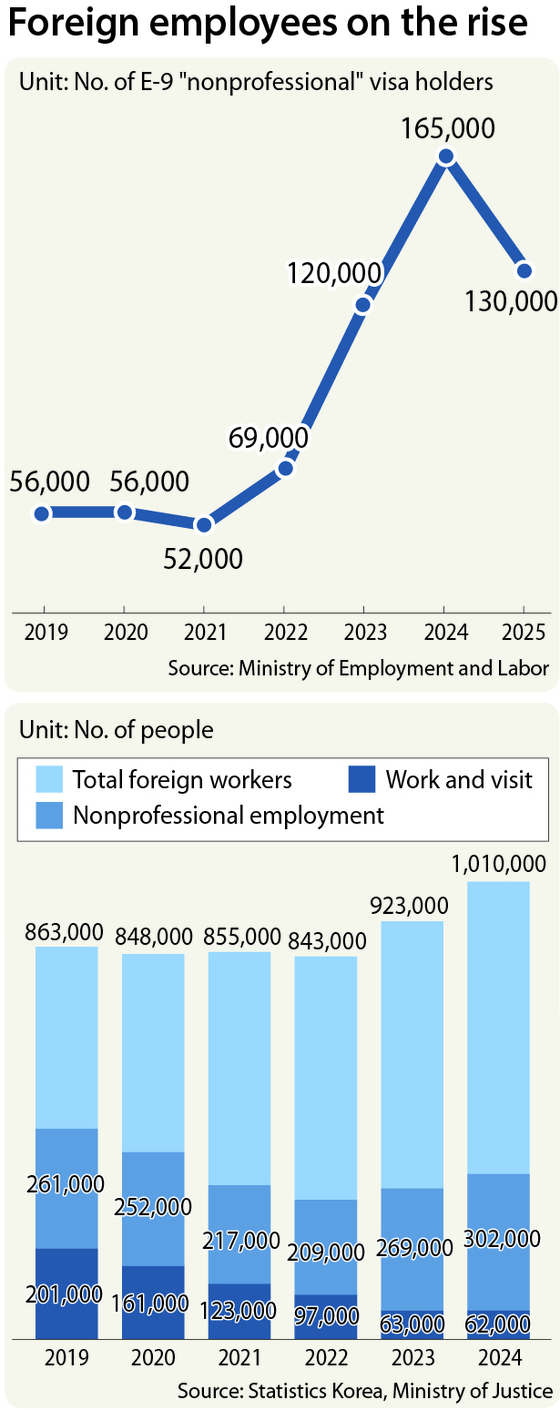
Rou and his friends are foreign workers. They arrived on E‑9 visas for “nonprofessional employment” under Korea’s Employment Permit System (EPS). More than 300,000 foreign workers hold E‑9 visas, and total foreign employment recently surpassed 1 million.
This month marks 22 years since the Act on the Employment of Foreign Workers was enacted, and 21 years since the EPS began. In unfortunate timing, a recent revelation that a Sri Lankan worker at a site in Naju, South Jeolla, was abused by his superiors, who tied the worker to a forklift and insulted him, has reignited scrutiny. That worker also held an E‑9 visa.
![Migrant workers arrive at the Incheon International Airport on July 13, 2022. [NEWS1]](https://koreaseafood.online/data/photo/2025/08/12/7d45b4e2-4457-4e0d-a3f0-5c88635fb4d5.jpg)
Migrant workers arrive at the Incheon International Airport on July 13, 2022. [NEWS1]
The JoongAng Sunday, an affiliate of the Korea JoongAng Daily, met more than 20 foreign workers and their employers. What is happening to them? What do they have to say?
'The Korean dream'
“It took me one year and six months to prepare for this. Competition for E‑9 visas is extremely fierce,” said Tai from Vietnam, who recently took a Korean language proficiency test in Vietnam.
After passing the Korean-language test, Tai waited a year before getting a job at a manufacturing firm in Gyeonggi. But the workload was intense.
“The company gave me loads of work at once to avoid paying overtime and exposed me to dangerous machinery,” Tai said. In response to a request to transfer to another workplace, the employer replied, “If that’s how you feel, go back to Vietnam. If you don’t do your job, I can discipline you. I have that authority,” and refused.
Korea visa foreign worker graph
The E‑9 visa is issued to foreign workers under the EPS. The number of E-9 visa holders was capped at 56,000 before the Covid-19 pandemic, before jumping to 160,000 last year. The system covers sectors like manufacturing, construction, agriculture, fishing and service.
Transfers to a different sector require employer consent. If not permitted, workers must stay at their assigned jobs. Or they may be fired for “incompetence or poor performance.” That label can follow them, blocking reemployment and forcing them back home or into undocumented status. Critics say the system — intended to resolve domestic labor shortages through foreign labor support — has become a modern form of slavery.
“From the day after I asked for a transfer, my in‑and‑out attendance stopped being recorded,” Tai continued, recalling how they were technically there but became a ghost. Tai was placed on forced leave for poor compliance.
“They assigned me work when busy but made me idle to cut costs,” Tai said. Naturally, his pay dropped. In July of last year, he earned only 670,000 won ($483) — not even one‑third of the monthly minimum wage of 2,060,000 won.
Tai was punished and eventually fired last month, but still could not report the company to the labor office. Concerned about unexcused absences affecting his visa, Tai continued showing up. The employer told Tai to leave and called the police. When the employer claimed that Tai refused to vacate, it was Tai who the police put in handcuffs, not the employer.
Tai urgently contacted Won Ok‑kum, the head of Migrant Center Donghaeng. Following her explanation that he had to attend work on legal grounds, the police removed the handcuffs and apologized.
“We appealed Tai’s case at the labor office, but they kept saying there was no clear evidence of discrimination based on nationality or religion,” Won said. With no support forthcoming, Tai negotiated with the employer via a labor consultant. The agreement allowed Tai to be transferred to a different workplace — but the company was relieved of paying unpaid wages and annual leave compensation. Tai lost 12 kilograms (26 pounds) over two years at the company.
![The multicultural food street in Danwon District, Ansan, Gyeonggi, is filled with pedestrians on July 29. [JOONGANG SUNDAY]](https://koreaseafood.online/data/photo/2025/08/12/b0a7daec-bd08-4724-b889-f9fe88756edf.jpg)
The multicultural food street in Danwon District, Ansan, Gyeonggi, is filled with pedestrians on July 29. [JOONGANG SUNDAY]
The cruel lifeline
For E-9 visa holders, the only option they're given is often to “just suck it up.”
“Even after working 12 hours a day and deductions, I earn less than 1,800,000 won,” said Aung from Myanmar, who has been working at a farm in North Gyeongsang for three years. “Even in the dormitory in this heat, there’s only one fan, and we eat kimchi and fried eggs for every meal. It’s torture. I’m not living, just surviving.
“If the boss gets mad because I don’t understand Korean, he shouts and curses […] but I just endure, afraid of losing my E‑9 visa,” Aung said.
Getting sick isn't an option, either.
“When I’m sick, I hesitate to go to the hospital,” said Le Thi Ha from Vietnam, who works at a food manufacturing company in North Jeolla. “I don’t speak Korean well, so I have no one to rely on. I endure by thinking of my family back in Vietnam.”
The E‑9 visa is a lifeline for a foreign worker. Tai waited a year and a half for it because working in Korea meant supporting the family back home.
![Migrant workers work at a potato field in Gangneung, Gangwon, wearing traditional Vietnamese hats, on July 23. [YONHAP]](https://koreaseafood.online/data/photo/2025/08/12/647a3141-8c14-4872-bad2-e1f7e2c6cca8.jpg)
Migrant workers work at a potato field in Gangneung, Gangwon, wearing traditional Vietnamese hats, on July 23. [YONHAP]
“Becoming a foreign worker in Korea requires significant costs and luck,” said Won. “They can't easily choose to return home or become an illegal worker, so they bear suffering and keep working.”
But becoming illegal is easier — and oftentimes inevitable.
One foreign worker called Donghaeng on July 30 in a panicked voice, saying that their three-month job-seeking timeline is about to finish. E‑9 visa holders must depart after three months of unemployment. Otherwise, they become undocumented.
As of June, about 377,000 foreign workers were undocumented. Over the past three years, an average of 50,000 E‑9 visa holders became undocumented annually. The E‑9 visa duration is three years, extendable by one year and 10 months — up to four years and 10 months total.
“E‑9 visa holders are banned from day labor, but some request it and I refuse. Our day‑labor foreign workers reject hard or dangerous jobs, so it’s hard to tell who’s the employer or laborer. Still, I can’t hire someone undocumented,” said a business owner whose company handles construction waste in Gyeonggi.
![A Sri Lankan worker is tied to bricks and moved by a forklift at a brick factory in Naju, South Jeolla on July 23. [SCREEN CAPTURE]](https://koreaseafood.online/data/photo/2025/08/12/4f797c51-a4aa-462a-9d7d-1cf635bc4a74.jpg)
A Sri Lankan worker is tied to bricks and moved by a forklift at a brick factory in Naju, South Jeolla on July 23. [SCREEN CAPTURE]
“During peak season, employment agencies contact me first,” said an owner of a manufacturing company. “They seem desperate and hard-working.”
Experts warn that the current E-9 system requires legal adjustments to properly reflect the realities of the labor market.
“The strict conditions for extending E‑9 visas — such as requiring annual income above 26 million won — are producing many undocumented workers,” said Kim Sung-hee, a professor at Korea University's Graduate School of Labor Studies. “For resolving domestic labor shortages, the expansion of professional E‑7 visas is increasingly seen as necessary.”
Institutional overhaul needed on humanitarian grounds
Not all employers are the villains, but generosity is definitely needed at both the personal and institutional level, laborers say.
“I wanted to work,” said Kim Russell, who had entered Korea in 2002 on a tourist visa and stayed illegally.
After working in sewing factories in Seoul and painting shops in Incheon, Kim knocked on the door of Koryo Pleating in Jongno District, central Seoul. Seven anxious years followed as an illegal worker. When a massive crackdown on undocumented workers began, owner Kim Bok‑hwan said, “Russell is too good to let go.”
![Bangladesh-born Kim Russell, who became a Korean citizen, shows off the materials he made at a factory in central Seoul. Behind him is his boss, Kim Bok-hwan. [KIM SANG-SEON]](https://koreaseafood.online/data/photo/2025/08/12/8391395d-164d-404c-9f91-fdc56fbc6d67.jpg)
Bangladesh-born Kim Russell, who became a Korean citizen, shows off the materials he made at a factory in central Seoul. Behind him is his boss, Kim Bok-hwan. [KIM SANG-SEON]
So, to make himself legal, Kim Russell voluntarily reported his status to authorities. He paid a fine of several million won and received a visa immediately — but this time an F‑6 marriage visa because his wife is Korean. He rejoined his boss and passed the naturalization exam to become “Kim.”
The two Kims both called the forklift abuse case “an act that harms the national interest.”
“If this gets known abroad, how would people view our export‑oriented country?” they said in unison. Kim Russell added, “At the places where my friends and I worked, employers were not so villainous. Though none were angels like my boss, vicious employers are extremely rare — they simply get more attention.”
“On my first day of work, my boss asked, ‘Is this your first time? It’s our first too,’ and said, ‘When it comes to meat, it's all about the flip.’ Looking back now, a year later, it feels like a gesture to calm me when I was nervous,” said Ariana, a worker from Uzbekistan.
“They're all like us once you get to know them,” Ariana's boss said, from afar.
“For foreigners to be recognized as neighbors, colleagues, citizens, the system must change first,” said Prof. Kim. “A humanitarian paradigm shift in policy design is needed to ensure diverse and sustainable immigration.”
![Migrant workers from Indonesia, including 25-year-old Rou at center, pose for photos after an interview with the JoongAng Sunday on July 29 in Ansan, Gyeonggi. [JOONGANG SUNDAY]](https://koreaseafood.online/data/photo/2025/08/12/b7b44dfc-0934-4fe3-a105-baa68bf3b5cd.jpg)
Migrant workers from Indonesia, including 25-year-old Rou at center, pose for photos after an interview with the JoongAng Sunday on July 29 in Ansan, Gyeonggi. [JOONGANG SUNDAY]
Last year, 2.65 million foreigners stayed in Korea. Rou is among them. He headed to a second‑floor restaurant carrying his heavy suitcase. Which employer will let him unpack those belongings?
Our Korean ancestors were once foreign workers too — working on Hawaiian sugarcane plantations more than 120 years ago and in German coal mines about 60 years ago. Foreign workers in Korea today may well leave their own mark on history.
* Yan Bingbing (China) runs a beauty salon in Ansan — “My son in his 20s is getting along with his boss, so I’m relieved,” she said.
* Akhmad (Malaysia) works three shifts at an auto parts plant in Anseong — “I hold a G‑1 visa.” It is also known as a refugee visa. When asked, “Are you a refugee?” he answered, “No. It’s complicated, not easy to explain.” Then he quietly walked away.
* Dani (Liberia) was waiting for a bus in front of Ansan Station before night delivery work for a courier company — “I work from 5 p.m. to midnight. Oh, here comes bus No. 98. Goodbye!” The interview ended abruptly.
* Doni (Indonesia) came right after Dani departed. A youth living in Korea who was on leave — “Thinking about going to work next Monday makes me depressed. Do you feel it too? You know, Monday blues.” Doni spoke good Korean — even knew “Monday blues.”
* Anonymous (Uzbekistan) declined to be identified among interviewees encountered by the reporter — “The boss grilled meat for us during holidays and took me to the hospital when I was sick. Small things, huge impact.”
* Jeong Tae‑yeong runs a livestock company in Cheongju, North Chungcheong — “I was initially reluctant about foreign workers, but their work ethic changed my mind. Even if you don’t speak the language, hearts connect.”
* Kim Hwan‑young operates a distribution firm in Suwon, Gyeonggi — “The government needs to support more. Workers need education and employers must learn about foreign workers’ human rights. Life comes first. If you treat them kindly, they will smile.”
This article was originally written in Korean and translated by a bilingual reporter with the help of generative AI tools. It was then edited by a native English-speaking editor. All AI-assisted translations are reviewed and refined by our newsroom staff.
BY KIM HONG-JOON,WON DONG-WOOK [[email protected]]


with the Korea JoongAng Daily
To write comments, please log in to one of the accounts.
Standards Board Policy (0/250자)