

How to read America’s early-voting numbers
Published: 28 Oct. 2024, 07:00
![Former U.S. President and Republican presidential candidate Donald Trump, left, is seen in Oaks, Pennsylvania, on Oct. 14, and U.S. Vice President and Democratic presidential candidate Kamala Harris is in Kalamazoo, Michigan, on Oct. 26. [AFP/YONHAP]](https://koreaseafood.online/data/photo/2024/10/28/6f33ab40-5486-4a22-b910-45a002a7c676.jpg)
Former U.S. President and Republican presidential candidate Donald Trump, left, is seen in Oaks, Pennsylvania, on Oct. 14, and U.S. Vice President and Democratic presidential candidate Kamala Harris is in Kalamazoo, Michigan, on Oct. 26. [AFP/YONHAP]
Clues to what will happen on Nov. 5 are not only to be found in polls. Millions of Americans have already voted. Nobody knows whom they voted for, but it is possible to compare turnout with previous cycles and draw inferences from that.
Both parties are putting their energy into turning out their bases. Elon Musk’s legally murky scheme to give away $1 million a day to registered voters in swing states — apparently to spur voting by supporters of Mr. Trump — has lately drawn a spotlight. Yet many other less profligate attempts to lift turnout are shaping the final, frenzied days of the race between Mr. Trump and Ms. Harris. One group is distributing 100,000 copies of a “Liberty Knights” comic book in Philadelphia to inspire young adults to turn out. Central Votes, which targets students at Central Michigan University, has offered inducements such as “walking tacos” (smashed-up bags of crisps mixed with ground meat), pickles on a stick (“voting is a big dill”) and even a petting zoo with goats.
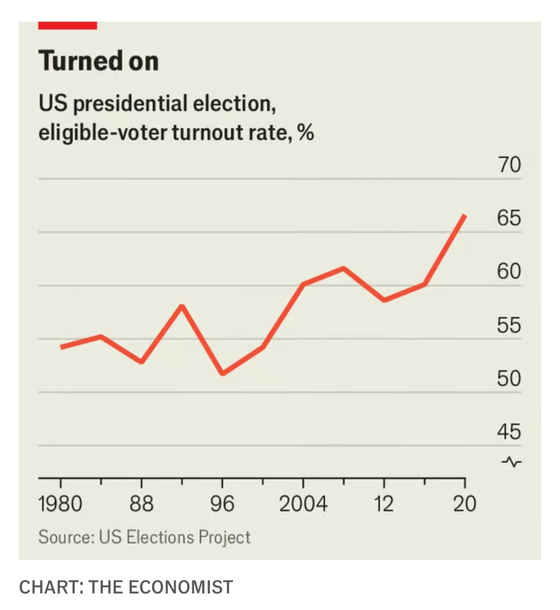
Turnout in 2020 was the highest in an American election since 1900. Mr. Trump’s polarizing presidency was one big factor. Covid-19 was another, as it led to emergency measures to make voting by mail easier. This time, Covid-19 restrictions have vanished, but Mr. Trump decidedly has not. One critical question is whether voter participation in 2024 will remain so elevated, and if not, who might benefit. Analysts are also scouring early-vote numbers for clues about who might ultimately win; some detect warning signs for the Harris campaign.
Provisional evidence suggests that voter enthusiasm remains high. Early in-person voters in Georgia have shattered records, with 1.5 million turning up in the first eight days, compared with just 1 million in 2020. North Carolina, another swing state, has also exceeded 2020’s comparable figures, but more modestly. Officials in Maricopa County, Arizona, the most populous jurisdiction in that swing state, project turnout similar to 2020.
Turnout may yet falter. If so, would this favor Mr. Trump or Ms. Harris? For decades, political science research found that Republicans benefited from lower turnout caused by factors such as bad weather, while Democrats benefited from higher turnout. But Mr. Trump’s takeover of the Republican Party has changed the equation. His Republican coalition now draws more from working-class voters, whereas the Democratic coalition has shifted to draw heavily on those with college degrees. This means old beliefs about turnout and partisan advantage must be reconsidered. “We can no longer make the assumption that high-turnout elections are universally good for Democrats,” says Elliot Fullmer, a political scientist at Randolph-Macon College. Mr. Trump’s victory in 2016, amid relatively high turnout, offers evidence for this view.
America’s higher voting rates may not endure beyond the Trump era, but the stunning rise of early voting almost certainly will. Between mail ballots and early in-person voting, 64 percent of Americans cast their ballots before election day in 2020, up from 42 percent in 2016. Covid-19 accelerated this, but early voting had grown steadily since the 1990s, as “convenience voting” spread to the great majority of states. The total early vote may fall back this year in the absence of Covid-19, but for campaign managers, “Tuesday’s Gone,” as the title of a book about early voting by Mr. Fullmer puts it.
This year, more than 26 million voters have already returned mail-in ballots or cast in-person early votes. Divining insights from these about how the election will ultimately turn out is difficult. Yet some of the early numbers are feeding Democratic anxieties. The Republican share of early returned mail ballots has risen from 27 million last time to 32 million so far in 2024, while the share enjoyed by Democrats has held at just under 48 million. Mr. Trump’s supporters find this encouraging, but “there’s still debate as to whether early voting is just cannibalizing election-day vote, or if you actually get new voters in the mix,” notes Jacob Neiheisel of the University at Buffalo.
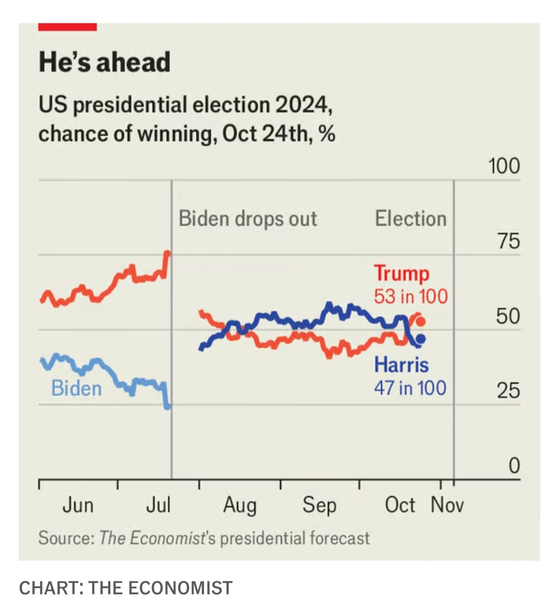
Early voting has given rise to a new subtribe of statistics geeks and scholars who interrogate the initial returns for insights. John Ralston, a veteran journalist in Nevada, has attracted a devoted following in his swing state. Our model has the state as a tossup. Mr. Ralston sees “serious danger” for the Harris campaign in early-vote figures showing that Republicans had returned more ballots than Democrats. Yet the margins remain tight in polls and in other early-vote figures. In North Carolina, by Oct. 23, Democrats had lodged just 10,000 more votes than Republicans out of more than 1 million early votes cast.
As in Nevada, The Economist’s forecast shows a dead heat in Michigan. High participation among working-class voters in western Michigan, a key Trump constituency, could tip the election toward Republicans. A surge of voting among young, black and Hispanic voters could benefit Ms. Harris. The polling could be wrong, but neither campaign wants to take that chance. Both are aggressively working to encourage their likely voters.
Team Harris has 52 campaign offices and more than 375 staff in Michigan and has signed up 100,000 volunteers since Ms. Harris’s late entry into the race. Republicans heavily rely on a constellation of efforts between outside groups, down ballot campaigns and the Trump operation itself. Victoria LaCivita, communications director for the Trump campaign in Michigan, says the former president is seeing growing “support from people and states that Democrats have taken for granted.”
Elissa Slotkin, a Democratic Senate candidate, recently made a campaign stop at Central Michigan University. She closed her expertly delivered stump speech by joking that those who had come to hear her were either “deep political nerds” or “engaged citizens.” She implored them to “please bother your friends” and make sure they vote. One student said he was certainly going to vote early: at least, then, “the text messages [will] stop.”
© The Economist Newspaper Limited, London (October 12th 2024 edition)


with the Korea JoongAng Daily
To write comments, please log in to one of the accounts.
Standards Board Policy (0/250자)