

'Politics abandoned us': Young Koreans blame older politicians for neglecting their concerns
Published: 17 Apr. 2026, 07:00
-
- MICHAEL LEE
- [email protected]
Audio report: written by reporters, read by AI
![Students at Seoul National University in Gwanak District, western Seoul, hold up placards opposing then-Justice Minister Cho Kuk's appointment on Sept. 9, 2019. [NEWS1]](https://koreaseafood.online/data/photo/2026/04/17/ade0c759-2a5d-4eb4-a938-84bfcda9b57a.jpg)
Students at Seoul National University in Gwanak District, western Seoul, hold up placards opposing then-Justice Minister Cho Kuk's appointment on Sept. 9, 2019. [NEWS1]
For 27-year-old Joo Yeong-ji, who joined protests calling for Yoon Suk Yeol's ouster after his brief declaration of martial law on Dec. 3, 2024, the political crisis gave way to disillusionment.
“After two impeachments, all I have left is skepticism toward those in power. I’ll stay engaged in politics — but I won’t support any party,” she said, referring to the removal of Yoon last year and that of former President Park Geun-hye in 2017.
Her remarks reflect a broad shift toward disappointment in the country’s main political parties among young adults in their 20s who once filled the streets in defense of democracy.
Interviews with 35 people in their 20s conducted by the JoongAng Ilbo between April 6 and 11 — including university students, job seekers and office workers — share a common grievance: that their participation has not improved the country’s political culture. Instead, interviewees said their fatigue with polarization and frustration with Korea’s two-party system have only deepened with time.
For many, the turning point was not a single event, but the accumulation of them.
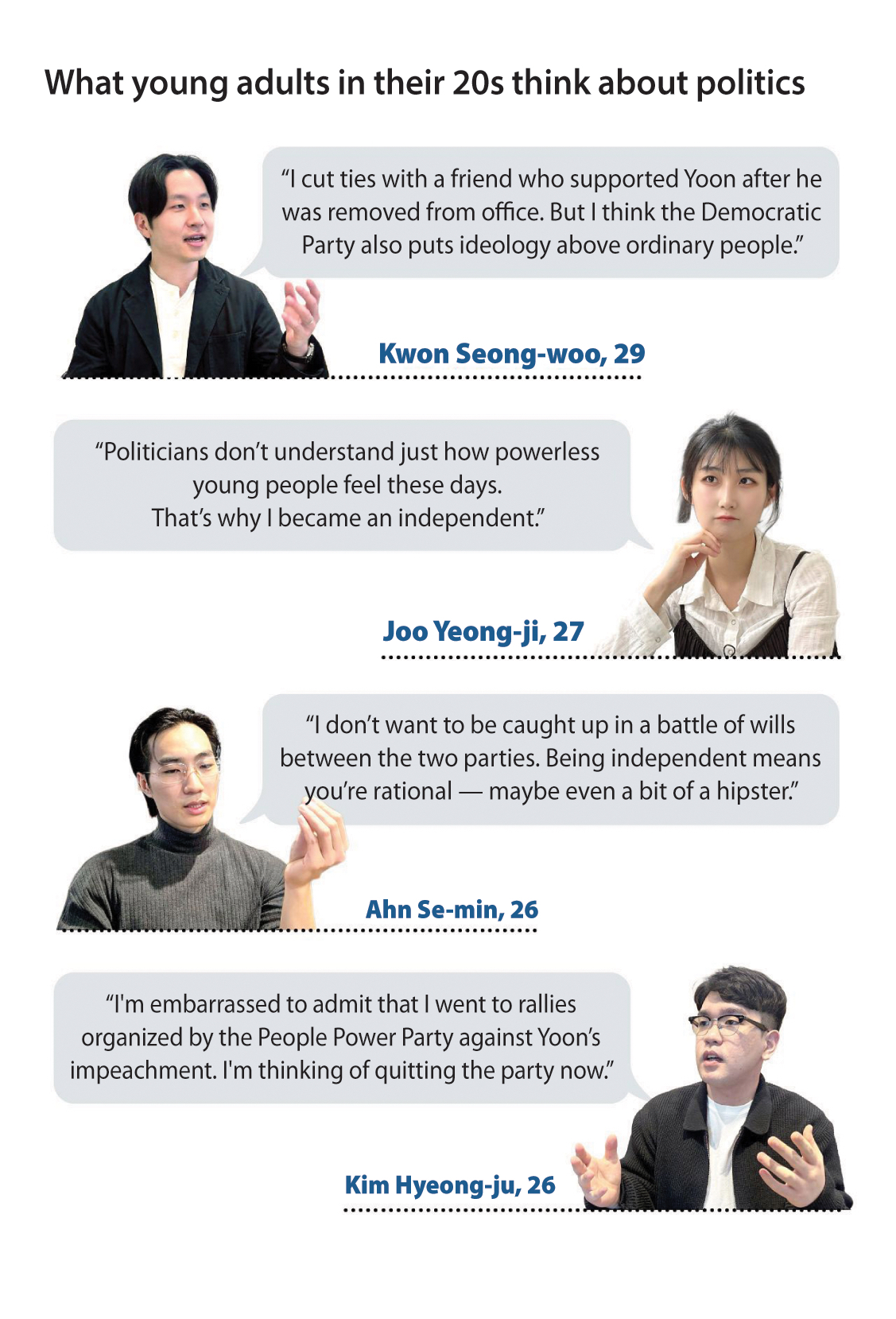
Kwon Seong-woo, 29, said he expected a change to come after he began supporting the liberal Democratic Party (DP) in light of Park’s impeachment.
“But what came back instead was soaring housing prices,” he said. “Even after the martial law episode, both parties appear obsessed with fighting each other. Voting didn’t seem to make a difference.”
He said the blame lay “not with people in their 20s abandoning politics, but rather with politics abandoning us.”
Hopes that the country’s fractious political culture would improve after Park’s impeachment crisis faded soon afterward, according to one 25-year-old office worker who spoke on condition of anonymity.
“Right now, the DP is focused on power struggles, while the People Power Party [PPP] is mired in internal conflicts,” she said. “It’s hard not to feel disillusioned.”
A 28-year-old interviewee said both parties had contributed to the erosion of popular trust.
“The PPP damaged the conservative cause with martial law, while the DP appears only intent on reshaping power structures to its liking,” he said. “I’m tired of retaliatory politics. I don’t even consider lending my support to either side.”
For many in their 20s, it is not just the parties themselves, but also polarization that has pushed them away from politics.
Ahn Se-min, 27, said he had once joined rallies in 2019 to support then-Justice Minister nominee Cho Kuk. Now, he regrets that choice.
“When you get caught up in a particular faction’s interests, the resulting harm to the public can outweigh possible benefits,” he reflected, adding that the experience led him “to become an active independent.”
Several interviewees said differences in political affiliation affected their personal relationships.
Kwon said a close friend cut ties with him after disagreements following the martial law episode. Others described avoiding political discussions altogether.
“If you talk about politics among friends, you get labeled,” said 26-year-old Kim Hyung-ju, adding that such categorizations “only breed cynicism.”
Another student said conversations among politically engaged peers often devolve into mutual contempt, with accusations and insults exchanged behind closed doors.
“In Germany, my friends can talk about politics freely,” said one 26-year-old university student who asked to stay anonymous. “But here, because polarization is so extreme, speaking up can feel like social suicide.”
Underlying the disillusionment is a sense that neither of the country’s dominant parties is willing — or able — to represent younger voters.
Joo said her expectations that politics could improve her life had faded over time.
“Since entering the work force and experiencing fraud in the housing market, I no longer believe politics can change my life for the better,” she said, adding that the country’s politicians “don’t understand just how powerless young people feel.”
Issues such as pension reform and rising national debt are seen as examples of policy decisions made by older politicians with little input from younger people who will bear the long-term costs.
“Pension reform always feels like something decided by older politicians and handed down to us,” said a 23-year-old university student. “With rising government debt, shouldn’t spending be more carefully considered?”
A 25-year-old office worker voiced similar concerns. “If the country’s debt keeps growing, won’t our generation have to repay it all?” she said.
This article was originally written in Korean and translated by a bilingual reporter with the help of generative AI tools. It was then edited by a native English-speaking editor. All AI-assisted translations are reviewed and refined by our newsroom.
BY HAN YEONG-IK, OH SO-YEONG, RYU HYO-RIM, MICHAEL LEE [[email protected]]


with the Korea JoongAng Daily
To write comments, please log in to one of the accounts.
Standards Board Policy (0/250자)