

Feeling like pawns, voters in 20s move away from dynastic parties
Published: 17 Apr. 2026, 07:00
Updated: 17 Apr. 2026, 13:13
-
- MICHAEL LEE
- [email protected]
![Protesters call for then-President Yoon Suk Yeol's impeachment in front of the National Assembly in Yeouido, western Seoul, on Dec. 11, 2024. [YONHAP]](https://koreaseafood.online/data/photo/2026/04/17/244cdadd-5626-4d11-b9ae-314b24bffec5.jpg)
Protesters call for then-President Yoon Suk Yeol's impeachment in front of the National Assembly in Yeouido, western Seoul, on Dec. 11, 2024. [YONHAP]
As of late, a 20-year-old university student surnamed Na has begun describing himself as politically unaffiliated — a label that would have seemed unlikely just a couple of years ago.
In the 2022 presidential election, he had cast his ballot for then-conservative candidate Yoon Suk Yeol. But less than three years later, after Yoon’s brief declaration of martial law, Na found himself in the streets alongside thousands of others, calling for the president’s removal.
Now, under the liberal government of President Lee Jae Myung, Na describes himself as politically unaffiliated.
“Mainstream politics just uses young people as window dressing ahead of elections,” said Na, who asked to be identified only by his surname in a phone interview. “It’s hard to support any party.”
He is not alone. A growing number of voters in their 20s are identifying as independents, reflecting a shift among younger Koreans from disengagement to active participation without party loyalty.
Nearly half of voters in their 20s do not identify with a political party, according to a March survey by Gallup Korea. Such self-identification climbed sharply over the past year to 46 percent of the age bracket, up from 33 percent a year earlier and well above the average of 27 percent across all age groups.
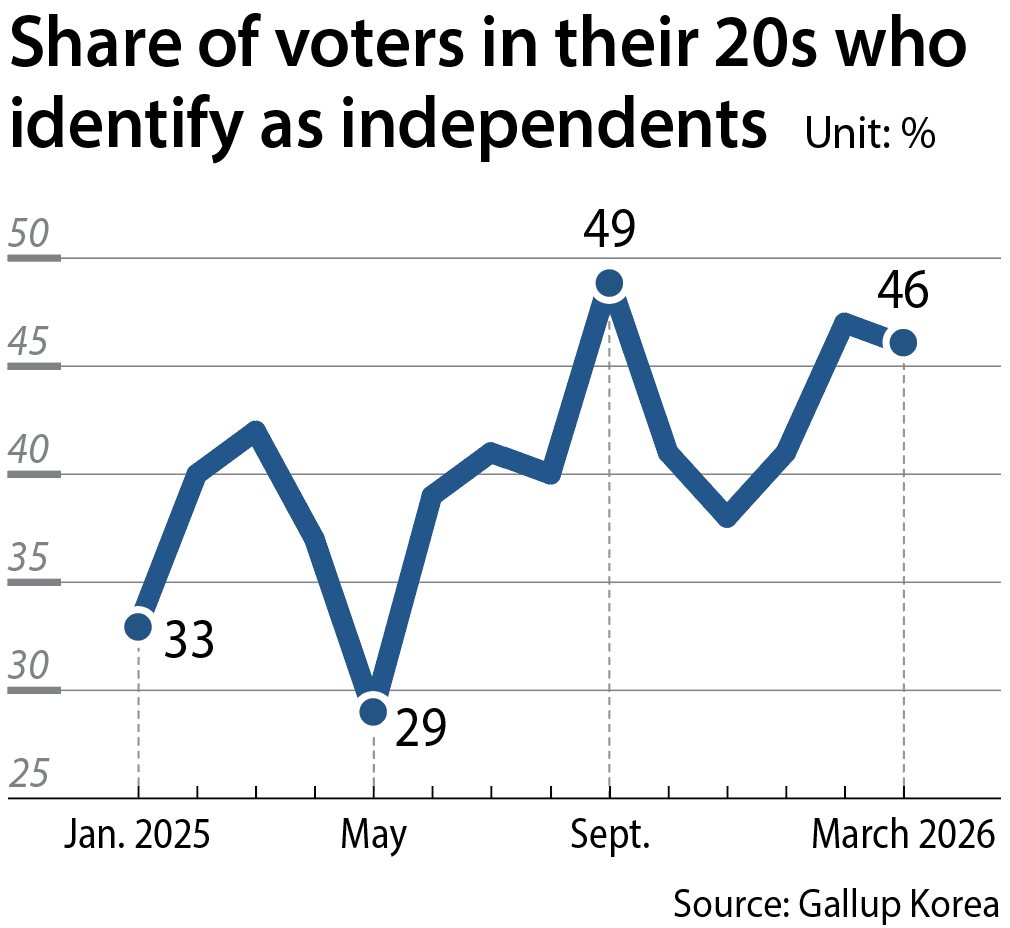
The rise in independent young voters paradoxically follows a period of intense political mobilization in the wake of the 2024 martial law crisis.
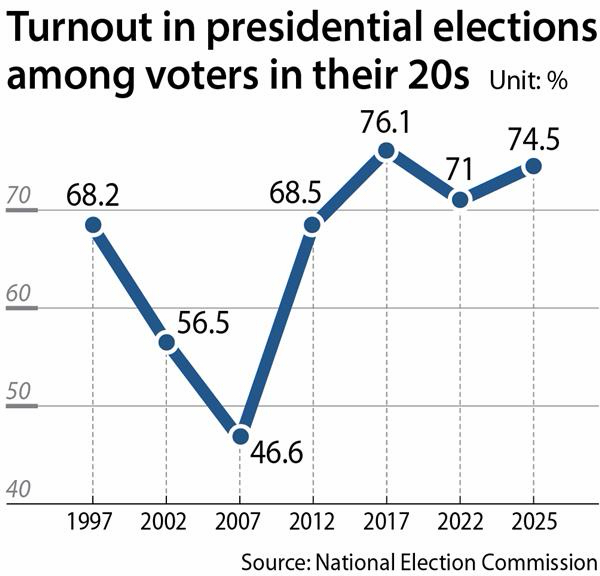
Turnout among voters in their 20s has steadily increased over the past two decades, approaching national averages in elections shaped by upheaval, such as the impeachments of Yoon and former President Park Geun-hye in 2017.
Yet that engagement has not translated into party loyalty.
Support for both parties remains weak among this group. Among voters in their 20s, backing for the Democratic Party stands at 30 percent, compared with 17 percent for the People Power Party — the lowest levels across all age groups.
Scholars say this shift reflects not apathy, but a different kind of political engagement.
“These are not apolitical voters,” said Lee Jae-mook, a professor of political science at Hankuk University of Foreign Studies. “They are closer to what we call ‘cognitively mobilized independents’ — actively engaged, but not aligned with parties.”
Many came of age politically during a period of repeated upheaval, including two presidential impeachments and early elections. That experience, analysts say, has heightened their interest in politics — even as it has deepened their skepticism.
“People in their 20s reacted strongly and mobilized during the martial law and impeachment period, but have since cooled in everyday politics,” said Lee Jun-han, a political science professor at Incheon National University.
.
Part of the disconnect may lie with the parties themselves.
“The two dominant parties have failed to address the demands of voters in their 20s,” said Lee Sun-woo, a political scientist at Jeonbuk National University, describing the phenomenon as a “lag in party responsiveness.”
Unlike members of earlier generations, who formed lasting party loyalties through defining moments such as the 1980 pro-democracy uprising in Gwangju or the death of former President Roh Moo-hyun in 2009, younger voters have come of age in a more fragmented political landscape.
Many say they are put off by what they see as parties focused more on attacking each other than addressing issues more central to their concerns, such as jobs and housing.
“I don’t want to be caught up in a battle of wills between the two parties,” said Ahn Se-min, a job seeker in his 20s. “Being independent means you’re rational — maybe even a bit of a hipster.”
The age gap between younger voters and representatives, and the country’s aging electorate, may also be reinforcing this disconnect.
.
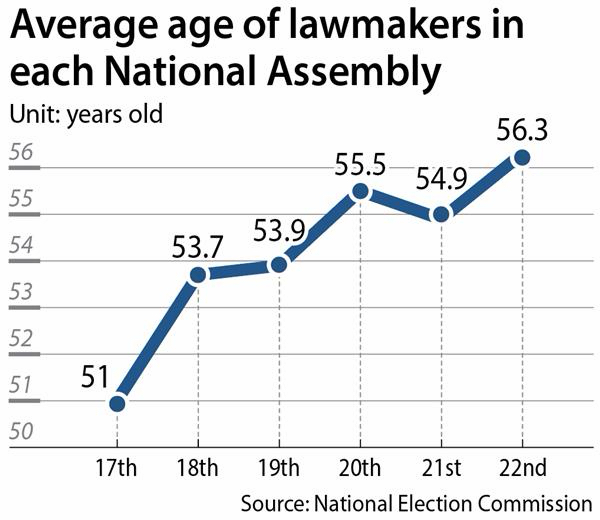
The National Assembly is older than ever, with the average age of lawmakers currently 56.3 years old. Those under 40 account for just 5.7 percent of the body, placing Korea near the bottom globally, according to the Inter-Parliamentary Union.
“Young voters are not in the majority, so it’s not surprising that policies tend to reflect the priorities of older lawmakers,” said a 29-year-old finance worker who asked not to be named.
The country’s first-past-the-post electoral system, in which a candidate wins a race by winning a simple plurality of votes, leaves little room for alternatives.
In this system, voters are often effectively forced to choose between the two main parties, limiting the space for consensus-building or the emergence of new political voices.
“Electoral reform that broadens political competition and allows power-sharing by multiple parties could elevate the demands of younger generations and other minority voices,” said Cho Won-bin, a professor at Sungkyunkwan University.
This article was originally written in Korean and translated by a bilingual reporter with the help of generative AI tools. It was then edited by a native English-speaking editor. All AI-assisted translations are reviewed and refined by our newsroom.
BY HAN YEONG-IK, OH SO-YEONG, RYU HYO-RIM, MICHAEL LEE [[email protected]]


with the Korea JoongAng Daily
To write comments, please log in to one of the accounts.
Standards Board Policy (0/250자)