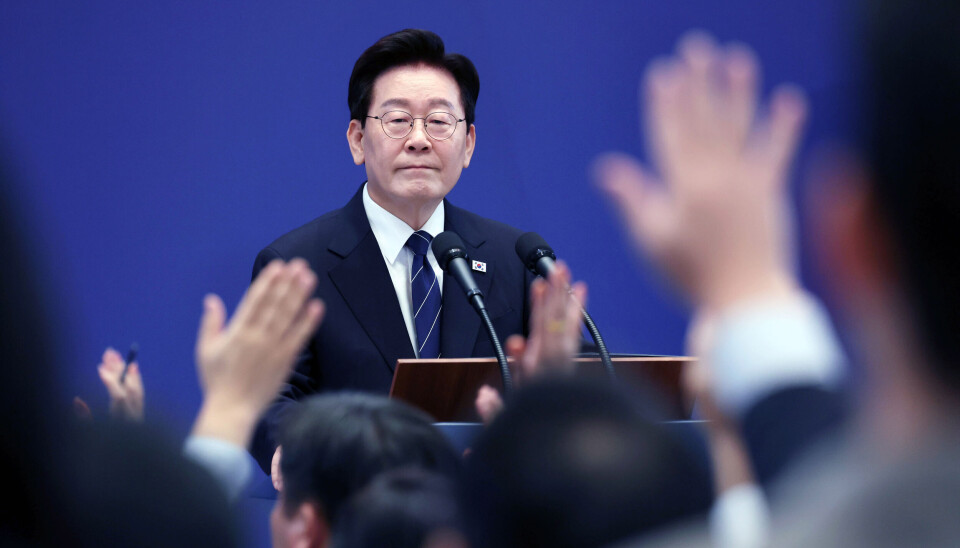
President Lee Jae Myung takes questions from reporters during a press conference at the Blue House guesthouse on Sept. 18.JOINT PRESS CORPS
Lee Ha-kyung
The author is a senior columnist at the JoongAng Ilbo.
In September 1993, President Kim Young-sam’s first year in office, Chief Justice Kim Deok-ju resigned. As head of the Seoul Civil District Court, Kim had ordered the suspension of Kim Young-sam as New Democratic Party leader. The final blow was allegations of real estate speculation exposed through a public disclosure of officials’ assets. My junior reporters had just secured decisive facts when the president moved first. Our scoop evaporated.
Kim Young-sam's justice minister, an acquaintance from high school, and the Seoul mayor, a former human rights lawyer, also resigned soon after taking office. When the press raised suspicions, the president acted swiftly. His approval rating soared.
Kim Young-sam put public duty before private interest. Two days after taking office, he disclosed his family’s assets, saying “the water must be clean from the top,” then mandated asset disclosure for public officials. Along with dismantling the Hanahoe military clique that put his predecessors in power and introducing real-name financial transactions, it became emblematic of his reforms. Those forced out protested, but Kim Young-sam did not flinch. His approval rating topped 90 percent. The southwestern region, which had voted for his rival Kim Dae-jung, was especially enthusiastic.
President Lee Jae Myung’s press conference last week centered on reflection: The people are always right, and I fell short. His usual confident smile, jokes and punchy remarks disappeared. He spoke with restraint. On a constitutional revision allowing consecutive terms, which had fueled suspicion, he said, “I have absolutely no intention of seeking another term.” He also asked the Democratic Party (DP) to remove a provision giving a special counsel authority to withdraw indictments.
But Lee still has far to go. Unlike Kim Young-sam, he has not fully separated public duty from private interest. Although he asked the ruling party to drop the special counsel’s power to withdraw indictments, he said cases involving investigations suspected of being maliciously fabricated should be examined by a special counsel. The DP recommends candidates and Lee appoints the counsel. If the counsel reaches a predetermined conclusion and prosecutors then withdraw charges, how is that materially different?
Lee said he would carefully consider public expectations in deciding whether to appoint Justice Minister nominee Kim Seung-won. Yet DP lawmakers on the Legislation and Judiciary Committee unilaterally adopted his confirmation report, while the presidential office appeared inclined to appoint him. The nominee abruptly withdrew the next day. Had his former aides not submitted a petition to the presidential office alleging sexual harassment, he might have been appointed. Kim Seung-won had co-chaired a group advocating withdrawal of indictments against Lee when the president led the DP. His nomination itself was problematic.
The possibility of an amendment enabling Lee to seek consecutive terms is gone. Yet the National Assembly speaker’s remark that “ultimately, it is for the people to decide” left political poison behind. The opposition floor leader responded that there would be “absolutely no constitutional revision under this administration.”
During a state visit to France, asked about such an amendment, Lee said his term was clearly limited by the Constitution. Such evasiveness invited speculation. Any debate over another term inevitably became entangled with questions about Lee’s pending criminal cases. The setting was ironic. In France, former presidents Jacques Chirac and Nicolas Sarkozy faced criminal trials after leaving office, despite protections while serving. Both were convicted, and Sarkozy served time in prison. It showed no one is above the law.
Lee had long avoided saying plainly that he had no intention of seeking another term. His lawyerly phrasing exhausted and angered the public. Even after the press conference, the People Power Party said it would believe him if he truly renounced another term.
Confusion remains over withdrawing indictments. Lee speaks of a “great common world” that restrains the strong and supports the weak. Seeking a privilege for himself would contradict that principle. He should say clearly: “Do not withdraw the indictments in my cases. I will stand trial when my term ends.” That could help restore trust lost through ambiguous words and actions.
Lee should also acknowledge the damage done to constitutional reform as a national agenda. The 1987 Constitution is an outdated garment for the 21st century. Decentralization, responses to a low birthrate and the climate crisis and dispersing presidential power are pressing tasks.
Yet constitutional reform became tainted by suspicions that it could serve the private goal of extending political power. It has become a politically suspect term. The question is how to revive an agenda that has been left politically lifeless.
This article was originally written in Korean and translated by a bilingual reporter with the help of generative AI tools. It was then edited by a native English-speaking editor. All AI-assisted translations are reviewed and refined by our newsroom.