Korea considers backdating new child benefits for all 2027 births
The government is considering retroactive child-rearing benefits for babies born in early 2027, addressing a potential gap of up to 34.28 million won ($25,550) under the new subsidy system.
A child arrives at a workplace day care center in Seoul on Oct. 12 as the government considers paying its new child-rearing benefits to every child born in 2027.NEWS1
The government is considering backdating its overhaul of child-rearing benefits, due to take effect in July next year, to cover every child born in 2027.
Under the current plan, a child born on June 30, 2027, could receive up to 34.3 million won ($25,550) less than one born a day later.
The Ministry of Health and Welfare budgeted for the new system to cover children born from July next year to leave time for preparations, according to a report it submitted to the National Assembly’s Health and Welfare Committee. The ministry said Wednesday that it is now considering paying the benefits retroactively to children born from January, to address fairness concerns for those born in the first half of the year.
The overhaul merges three existing benefits — the first-meeting voucher, the parental allowance and the child allowance — into two new ones: a newborn grant and a basic child allowance.
The newborn grant pays 10 million won for a first child, 12 million won for a second and 15 million won for a third or later child, in four quarterly installments over the first year. Families in areas the government designates for preferential support, mainly regions with shrinking populations, receive an extra 5 million won.
The basic child allowance pays 200,000 won a month from birth through age 12, or 300,000 won a month in the preferential areas.
The July 1, 2027, start date puts children born a day earlier under the old rules, which pay far less.
Visitors look at baby products at the 50th Befe Baby Fair at Coex in Gangnam District, southern Seoul, on Sept. 10.NEWS1
Take a first child raised at home in the greater Seoul area, for example. A baby born on June 30 would receive 35.6 million won under the existing system: a 2 million won first-meeting voucher, 18 million won in parental allowance and 15.6 million won in child allowance through age 12.
A baby born on July 1 would receive 48.4 million won under the new system: the 10 million won newborn grant, 31.2 million won in basic child allowance and a 7.2 million won supplement for caring for an infant at home.
The difference comes to 12.8 million won.
The gap is wider for a third or later child in one of the preferential areas. Under the new system, that child could receive up to 74 million won by age 12, made up of a 20 million won newborn grant, 46.8 million won in basic child allowance and the 7.2 million won home-care supplement.
Visitors look over strollers at the Cobe Baby Fair at Kintex in Goyang, Gyeonggi, on Aug. 6.YONHAP
Under the existing system, a third child raised at home in the same area and born on June 30 would receive 39.72 million won, made up of a 3 million won first-meeting voucher, 18 million won in parental allowance and 18.72 million won in child allowance at the preferential rate. The difference is 34.28 million won.
“If children born on June 30 and July 1 are treated differently for administrative convenience, there could be complaints,” President Lee Jae Myung said at a Cabinet meeting on Sept. 1.
Lee proposed applying the new system from Jan. 1 instead.
“Shouldn’t children born in the same year be treated the same?” Lee said.
Health Minister Jeong Eun-kyeong said at the same meeting that an addendum to the bill could make the system apply to all children born in the same year. Jeong said the ministry would review the option as the National Assembly deliberates the bill.
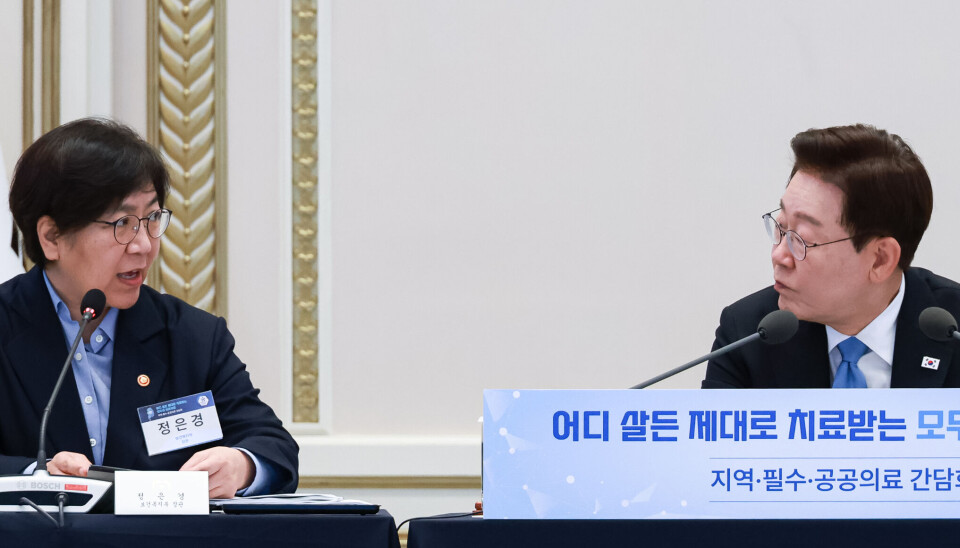
Health Minister Jeong Eun-kyeong, who has said the new benefits could be applied retroactively by birth year, speaks at a meeting on regional, essential and public health care at the Blue House on July 22.NEWS1
The government is leaning toward keeping the July 2027 start, given the time needed to build the computer system and for local governments to prepare. Benefits would then be paid retroactively to children born between January and June.
Backdating would also cost more. Covering children born from January would require about 250 billion won more in next year’s budget, Jeong told the Cabinet meeting.
The ministry plans to work with lawmakers through December on revising the Child Allowance Act and on the Assembly’s review of next year’s budget. It then aims to finish building the computer system and revising enforcement decrees in the first half of next year.
This article was originally written in Korean and translated by a bilingual reporter with the help of generative AI tools. It was then edited by a native English-speaking editor. All AI-assisted translations are reviewed and refined by our newsroom.