

From factories to data centers: Korea's heavy industries pivot to meet surging AI demand
Published: 24 Apr. 2026, 10:45
Updated: 24 Apr. 2026, 17:03
Audio report: written by reporters, read by AI
![An Amazon data center in Ashburn, Virginia [REUTERS/YONHAP]](https://koreaseafood.online/data/photo/2026/04/24/fc1fa006-0deb-43d7-9980-58eb0aa0cb1e.jpg)
An Amazon data center in Ashburn, Virginia [REUTERS/YONHAP]
Korea's heavy industries are slowly wading into the business of building AI data centers by repurposing factory sites and core technologies to meet surging demand for their power-hungry infrastructure.
Steelmakers and shipbuilders, whose operations are already energy-intensive, are now leveraging their access to power grids and industrial land — assets that have become critical as data center developers struggle to secure adequate sites and sources of electricity.
Those in Korea’s heavy industries are confident they can rise to meet the challenge.
“Whether it’s retail or services, we’re confident competing with anyone. Once we step in, we can change the game,” a source inside the industry told the JoongAng Ilbo on condition of anonymity.
One of the biggest bottlenecks in building data centers in Korea is securing approval for power usage. Under the Distributed Energy Act, projects that consume more than 10 megawatts of electricity must undergo a grid impact assessment — a process that evaluates not only power availability but also broader social, economic and policy implications.
That has made approvals particularly difficult in the Seoul metropolitan region. According to the Korea Electric Power Corporation, 53 applications have been submitted for data center-related projects since the law took effect, but only one has been approved in the capital — and that was for backup power at an existing facility.
As a result, companies are increasingly seeking idle industrial sites that already have established access to power.
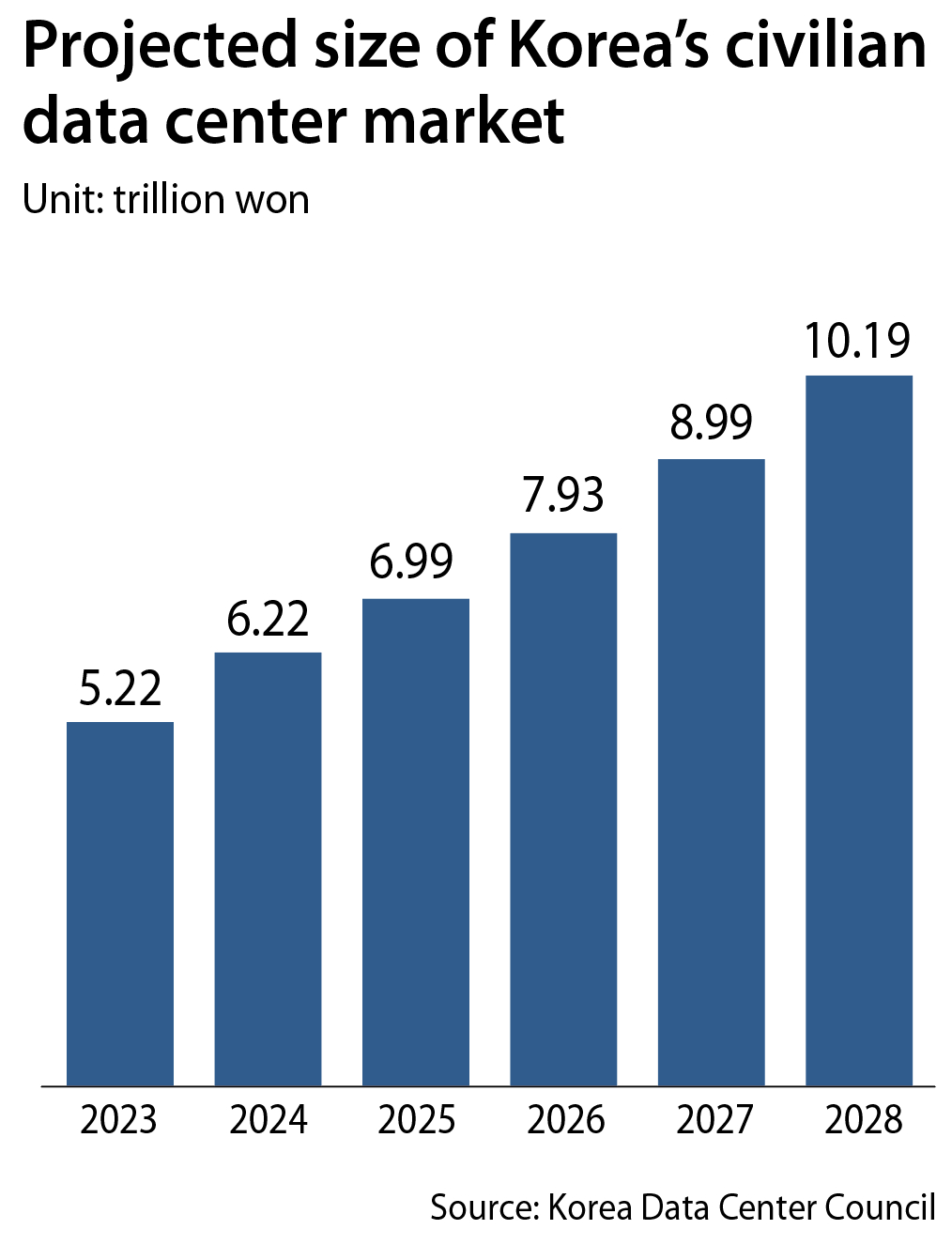
Dongkuk Steel said in February that it is reviewing investments in AI data centers and expects to make tangible progress within the year, citing its industrial sites in Incheon and Pohang as potential bases.
Hyundai Steel, which decided in January to shut down a rebar plant and a small rolling mill in Incheon, is also considering how to repurpose the land, with data centers among its options. In Pohang, a ferroalloy plant that shut down due to high electricity costs has already secured approval to be converted into a data center and is set to break ground in June.
“There is a growing consensus within companies that land with access to power has become a core asset,” said a steel industry official.
Some companies are going further, expanding their business portfolios to supply equipment for data centers.
HD Hyundai Heavy Industries (HD HHI) said Tuesday it had signed a deal with U.S.-based energy infrastructure developer Aperion Energy Group (AEG) to supply power generation equipment based on its 20-megawatt HiMSEN engines, which were originally designed for marine use.
The deal, which would increase AEG’s energy generation capacity by 684 megawatts and is worth 627 billion won ($424 million), marks the largest order for power generation engines in HD HHI’s history.
![Han Ju-seok, head of HD Hyundai Heavy Industries' engine and machinery division, left, and Aaron Wheeler, CEO of Aperion Energy Group, pose for a photo after signing a contract for the supply of power generation systems. [HD HYUNDAI HEAVY INDUSTRIES]](https://koreaseafood.online/data/photo/2026/04/24/dd5f47be-b07c-44ff-b535-e06e3e881c76.jpg)
Han Ju-seok, head of HD Hyundai Heavy Industries' engine and machinery division, left, and Aaron Wheeler, CEO of Aperion Energy Group, pose for a photo after signing a contract for the supply of power generation systems. [HD HYUNDAI HEAVY INDUSTRIES]
Export prospects are also seen as strong. In countries like the United States, where power grids are less uniformly distributed than in Korea, data centers often require on-site generation capacity.
The International Energy Agency estimates that data centers will account for half the growth in U.S. electricity demand through 2030.
“With the rapid increase in data centers, demand for gas turbine power generation is rising, but supply is constrained and prices are high, creating an opening for ship engine makers,” said an industry source.
Data centers also generate large amounts of heat, creating demand for structures that can handle heavy loads and support efficient cooling — which offers steelmakers increased opportunities to sell specialized materials and construction methods.
Dongkuk Steel’s sales strategy highlights its ability to produce H-beams up to 3 meters (9.8 feet) wide, while Hyundai Steel is targeting not only data center structures but also related infrastructure such as transmission towers and energy storage systems.
“About 3 percent of our long steel product sales currently come from data centers, and we expect that share to rise to around 6 percent,” said a Hyundai Steel representative. “We are in discussions with construction companies on deeper cooperation.”
This article was originally written in Korean and translated by a bilingual reporter with the help of generative AI tools. It was then edited by a native English-speaking editor. All AI-assisted translations are reviewed and refined by our newsroom.
BY LEE SU-JEONG [[email protected]]


with the Korea JoongAng Daily
To write comments, please log in to one of the accounts.
Standards Board Policy (0/250자)