

GDP grows 1.7% in Q1, nearly double February forecast: BOK
Published: 23 Apr. 2026, 18:12
Updated: 23 Apr. 2026, 19:57
![Export-bound containers are shown at the Pyeongtaek port in Gyeonggi on April 23. [NEWS1]](https://koreaseafood.online/data/photo/2026/04/23/87068205-43d7-4cdd-a10c-ce48240c4281.jpg)
Export-bound containers are shown at the Pyeongtaek port in Gyeonggi on April 23. [NEWS1]
Korea’s economy grew 1.7 percent in the first quarter, rebounding far more sharply than expected on strong semiconductor exports and recovering investment, the Bank of Korea (BOK) said Thursday. The gain was the strongest quarterly reading since the third quarter of 2020, while real gross domestic income rose 7.5 percent from the previous quarter, a record only second to the first quarter of 1988, when it rose 8 percent from the previous quarter.
The GDP rebound nearly doubled the central bank’s February forecast of 0.9 percent and followed a 0.2 percent contraction in the fourth quarter of 2025.
Still, economists caution that it might be too early to turn optimistic about the rest of the year because the impact of the Iran war was only partly reflected in the data and the recovery remained heavily concentrated in semiconductors.
The BOK pointed to private consumption, semiconductor-led exports and stronger facility investment as the main drivers of growth.
Private consumption rose 0.5 percent on increased spending on goods such as clothing. Facility investment gained 4.8 percent, led by machinery and transport equipment, while construction investment rose 2.8 percent as both building construction and civil engineering work increased.
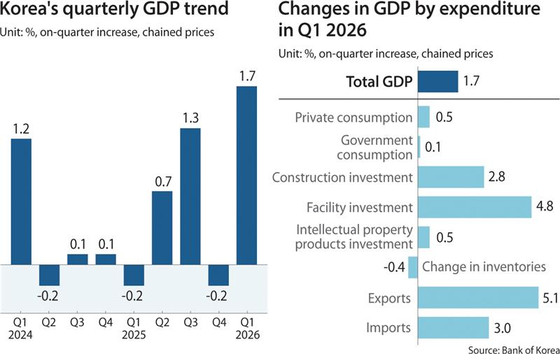
Korea's GDP trend Q1 2026
Exports, especially semiconductors and other information technology products, were the biggest engine. First-quarter exports rose 5.1 percent, the fastest pace since the third quarter of 2020, while net exports contributed 1.1 percentage points to growth, well above domestic demand’s 0.6 percentage point contribution.
The chip boom was also reflected in corporate earnings. Samsung Electronics reported a preliminary first-quarter revenue of 133 trillion won ($89 billion) with an operating profit of about 57.2 trillion won. SK hynix said Thursday that first-quarter revenue reached 52.6 trillion won and operating profit 37.6 trillion won, both record highs.
"Semiconductors accounted for about 55 percent of the total growth," The director general at the BOK's Economic Statistics Department, Lee Dong-won, said. "Without the sector, the growth rate could have been more than halved."
Manufacturing output rose 3.9 percent in the first quarter, the fastest increase since the fourth quarter of 2020, but service-sector growth was just 0.4 percent, underscoring the uneven pace of recovery.
![A customer shops at a supermarket in Seoul on April 15. [NEWS1]](https://koreaseafood.online/data/photo/2026/04/23/7d46f849-7b88-4391-86f5-75442c1f79fa.jpg)
A customer shops at a supermarket in Seoul on April 15. [NEWS1]
However, experts noted that the quarter’s strength also needs to be read with caution because only part of the Middle East war risk that erupted at the end of February appears to have been captured in the data.
Ships passing through the Strait of Hormuz were still arriving in Korea through late March, and the BOK said consumption indicators such as credit card spending had not yet shown a clear contraction.
The broader outlook is still highly uncertain. The war in the Middle East is increasing upside risks to inflation and downside risks to growth, the BOK warned, while the Organisation for Economic Cooperation and Development (OECD) said in March that disrupted shipments through the Strait of Hormuz and damage to energy infrastructure were driving up costs, weakening demand and adding inflation pressure.
![A customer looks at phones at a supermarket in Seoul on April 15. [NEWS1]](https://koreaseafood.online/data/photo/2026/04/23/8258e365-dee6-405b-a450-e4ca28f3e982.jpg)
A customer looks at phones at a supermarket in Seoul on April 15. [NEWS1]
In fact, that uncertainty has already started to weigh on forecasts.
The OECD cut its 2026 growth forecast for Korea to 1.7 percent from 2.1 percent, and major private forecasters have also trimmed their projections.
At the same time, there is still upside from semiconductors: If rising chip prices lift export prices further, that could boost corporate earnings and investment. Real gross domestic income surged 7.5 percent in the first quarter, the highest since 1988, helped by improved terms of trade that lifted both corporate profitability and real purchasing power.
The central bank had projected 2 percent growth for this year in February. Whether that target is met will depend on the balance between growth drivers, particularly the boost from the semiconductor boom.
“It is true that negative factors have grown stronger, but there are also expectations for semiconductor exports and policy effects,” the BOK's Lee said. “Second-quarter and full-year growth will be determined by the relative size of each factor.”
This article was originally written in Korean and translated by a bilingual reporter with the help of generative AI tools. It was then edited by a native English-speaking editor. All AI-assisted translations are reviewed and refined by our newsroom.
BY KIM WON [[email protected]]


with the Korea JoongAng Daily
To write comments, please log in to one of the accounts.
Standards Board Policy (0/250자)