

Small K-beauty firms ditch Korea as saturated market forces new approach
Published: 16 Apr. 2026, 17:16
Updated: 16 Apr. 2026, 17:52
![A person shops inside a retail store of cosmetic products in central Seoul in December 2025. [YONHAP]](https://koreaseafood.online/data/photo/2026/04/16/5174442d-4918-4e8b-859d-20e242539995.jpg)
A person shops inside a retail store of cosmetic products in central Seoul in December 2025. [YONHAP]
As the Korean cosmetics wave shows no signs of breaking, smaller retailers are wading into new waters — and leaving their home port behind entirely.
Small- and medium-sized enterprises (SME) in the cosmetics industry are scaling by focusing on exports and cross-border direct sales to consumers ordering directly from Korean online retailers and brands.
Eqqualberry is one such brand, nowhere to be found on the shelves of Olive Young or Daiso. The entirety of the brand's sales comes from overseas, with its products available only on global e-commerce channels such as Amazon, TikTok Shop and Shopify.
“Sales in the first quarter of this year increased more than 6.4 times compared to the same period last year," a representative from Boosters, Eqqualberry’s operator, said. “The brand had targeted overseas expansion from its launch, based on the belief that entering global markets first would deliver faster results rather than focusing on the Korean market."
![Global e-commerce channel Amazon's event about beauty and cosmetic held in southern Seoul in September 2025 [YONHAP]](https://koreaseafood.online/data/photo/2026/04/16/5ad9e1d0-30f3-446f-927d-7a2f4dc64572.jpg)
Global e-commerce channel Amazon's event about beauty and cosmetic held in southern Seoul in September 2025 [YONHAP]
While the domestic market is saturated with an ever-increasing number of brands courting a limited pool of consumers, global demand has untapped potential, prompting more Korean cosmetics firms to go global first, departing from the conventional norm of a domestic launch first.
Yearly cosmetic exports by Korean SMEs came to $8.32 billion last year, nearly double the $4.47 billion posted in 2022, according to the Ministry of SMEs and Startups on Wednesday. SMEs also gained ground in total beauty product exports, rising from 56.2 percent in 2022 to 72.8 percent last year.
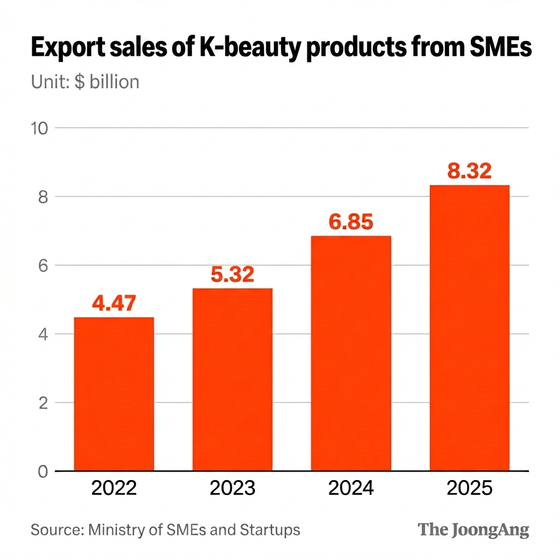
Among all cross-border direct sales items last year, cosmetics ranked second with a 20.4 percent share, following food and beverage products at 49.2 percent.
With little room left in the domestic K-beauty market, small and midsize brands are going overseas. In Korea, 27,932 companies are registered as sellers of manufactured cosmetics, according to the Ministry of Food and Drug Safety, nearly twice the figure in 2019 at 15,707.
Competition among SMEs is increasingly intensifying. The cosmetics industry had the highest number of new businesses pursuing exports over the past three years, with the number of exported SME K-beauty products rising from 8,041 in 2022 to 10,158 last year, according to the SMEs Ministry.
![Korean beauty and cosmetic products are put on display at an exposition held in Coex, southern Seoul, on Nov. 26, 2025. [NEWS1]](https://koreaseafood.online/data/photo/2026/04/16/4d6406f7-eca8-47fd-a890-a8a3ff625a9e.jpg)
Korean beauty and cosmetic products are put on display at an exposition held in Coex, southern Seoul, on Nov. 26, 2025. [NEWS1]
“Competition among brands to secure a sales path on both online and offline channels in the domestic beauty market is extremely fierce, making the process of securing distribution channels itself a barrier,” said a representative from the Korean beauty brand Some By Mi. The brand first launched on Amazon in the United States in 2017, only later hitting Olive Young shelves in Korea.
“Establishing brand credibility and finding success in global markets first can help companies secure traction among consumers in Korea without additional investment,” the representative said.
Experts say that the expansion of channels through which companies can communicate directly with consumers and the development of e-commerce platforms have made it easier for cosmetics SMEs to enter overseas markets.
“It has become easier for individual companies to generate cross-border sales using social media and through global e-commerce without relying on overseas marketing agencies,” said Prof. Shim Jong-won, a faculty member of the cosmetic science major at Dongduk Women's University.
“In the past, the concepts that were popular in Korea used to be recognized as fresh in overseas markets, which had greater room for growth,” Shim said. “However, it is a bit concerning as competition among K-beauty companies abroad intensifies. Rather than going global, differentiation strategies and securing competitiveness are what matter.”
This article was originally written in Korean and translated by a bilingual reporter with the help of generative AI tools. It was then edited by a native English-speaking editor. All AI-assisted translations are reviewed and refined by our newsroom.
BY NOH YU-RIM [[email protected]]


with the Korea JoongAng Daily
To write comments, please log in to one of the accounts.
Standards Board Policy (0/250자)