

Will Samsung become more profitable than Nvidia?
Published: 15 Apr. 2026, 18:52
Updated: 15 Apr. 2026, 19:56
-
- LEE JAE-LIM
- [email protected]
Audio report: written by reporters, read by AI
![Logo of Samsung Electronics, left, and Nvidia [YONHAP, REUTERS/YONHAP]](https://koreaseafood.online/data/photo/2026/04/15/9cf7664d-69f4-46fa-8cf9-4bf6df29fcec.jpg)
Logo of Samsung Electronics, left, and Nvidia [YONHAP, REUTERS/YONHAP]
[NEWS ANALYSIS]
An unprecedented memory boom has lifted Samsung Electronics to record operating profit in a preliminary first quarter report — surpassing the entirety of last year — with some analysts saying its earnings could rival or even overtake Nvidia’s in the coming years.
The bullish forecast points to an ongoing power shift in the chip industry, where high-end memory supply has become a decisive factor in the global race to build AI data centers amid shortages.
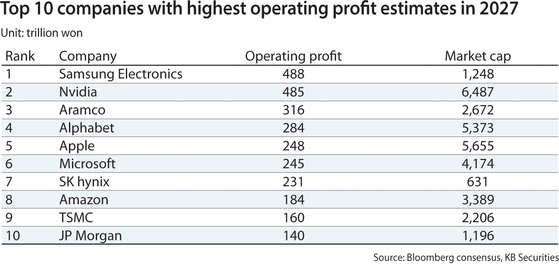
KB Securities estimates the Suwon, Gyeonggi-based chipmaker will post an operating profit of 488 trillion won ($331 billion) in 2027, surpassing Nvidia’s estimated 485 trillion won.
“The trend of increasing memory content required for AI inference is expected to persist in the coming years,” said Kim Dong-won, the head of research at KB Securities. “Accordingly, Samsung is expected to generate operating profit of 327 trillion won in 2026 and 488 trillion won in 2027, making it the global No. 1 by operating profit.”
The report suggests Samsung could narrow the gap with Nvidia in operating profit by 30 trillion won this year , although the Korean firm's market cap is just 18 percent of Nvidia’s $4.8 trillion.
Kim’s projection is far above the market consensus for Samsung Electronics' 2027 profit at 360.7 trillion won, but it is not even the highest estimate.
IBK Securities’ estimate was the highest at 515.7 trillion won, while Meritz Securities and Hanwha Securities are close with forecasts in the 463 trillion won range.
The rosy forecast is driven by Samsung’s first quarter earnings surprise, when its preliminary results — operating profit of 57.2 trillion won and revenue of 133 trillion won — outperformed market expectations that were already at record highs earlier in the month. Since then, consensus forecasts have been revised upward for each quarter this year, lifting the annual operating profit estimate to 297.6 trillion won.
The chipmaker's first quarter operating profit estimate is on par with U.S. Big Tech from the latest quarter including Alphabet, Amazon, Meta and Microsoft.
Several indicators point to memory supply constraints continuing into next year. Samsung and SK hynix are reportedly in discussions with major tech firms such as Google and Microsoft about long-term supply agreements lasting up to five years — an unprecedented shift, as the typical contract term is capped at one year.
In January, both Samsung and SK hynix signed low-power double data rate supply deals for Apple’s iPhones, but sources cited in multiple reports said chip prices were raised by more than 80 percent from the preceding quarter. Conventional dynamic random-access memory (DRAM) and NAND flash prices have also surged as supply tightened, with demand rising for high bandwidth memory (HBM) chips needed to build out AI infrastructure that Big Tech is expanding aggressively.
![Samsung Electronics' Suwon headquarters in Gyeonggi [YONHAP]](https://koreaseafood.online/data/photo/2026/04/15/075fcab8-2757-4773-b40c-8216effd5418.jpg)
Samsung Electronics' Suwon headquarters in Gyeonggi [YONHAP]
The favorable macro backdrop for AI investment is expected to hold. As competition in AI intensifies, Big Tech firms are bringing forward their 2027 server purchasing budgets into this year’s capital spending, according to a report by LS Securities. The report cautions, however, that if there is no budget top-up, the pull-forward effect could limit next year’s growth.
Another key point of debate is how long memory price increases will last, since higher prices have been boosting earnings.
“To sustain elevated conventional DRAM prices for longer, chipmakers may need to maintain an HBM-first investment strategy despite relatively lower margins and expand NAND capacity to gain more share in that segment, where margins appear higher than HBM,” said Jung Woo-sung, an analyst at LS Securities.
BY LEE JAE-LIM [[email protected]]


with the Korea JoongAng Daily
To write comments, please log in to one of the accounts.
Standards Board Policy (0/250자)