

Why 'English kindergartens' remain popular in Korea despite rising costs and government crackdowns
Published: 14 Apr. 2026, 07:00
Updated: 14 Apr. 2026, 09:03
-
- PAIK JI-HWAN
- [email protected]
![A banner hangs at an English kindergarten in Songpa District, southern Seoul on April 1. [YONHAP]](https://koreaseafood.online/data/photo/2026/04/14/1d5e5423-adf6-4d0c-8e2d-de84d376ea9f.jpg)
A banner hangs at an English kindergarten in Songpa District, southern Seoul on April 1. [YONHAP]
[EXPLAINER]
When a mother of two in Korea had to choose between a regular kindergarten and a full-day English immersion program, she opted for a so-called English kindergarten so that her children could become bilingual before starting elementary school.
“I thought it would be smart to prepare my kids to be bilingual from a young age,” the mother who asked to remain anonymous, told the Korea JoongAng Daily on Friday. “I sent them to the English kindergarten because I thought it was an easy way for them to be bilingual in Korea.”
She sent her kids to an English kindergarten in Yongin, Gyeonggi, where the private education market remains sizable, though not as large as in the three southern Seoul districts — Gangnam, Seocho and Songpa — areas considered the most affluent and prestigious in the capital.
English kindergartens are in essence private cram schools that teach kindergartners English for around 1.3 million won ($880) per month.
The core purpose of an English kindergarten is giving a child a head start, which can be an advantage in Korea’s competitive education system, where students are graded based on their rank in class rather than their absolute scores.
English kindergartens, however, have been the targets of recent government crackdowns due to concerns that these private institutions place excessive academic pressure on young children. A group of lawmakers last year even proposed a bill to limit English lessons for kindergartners to a maximum of 40 minutes per day.
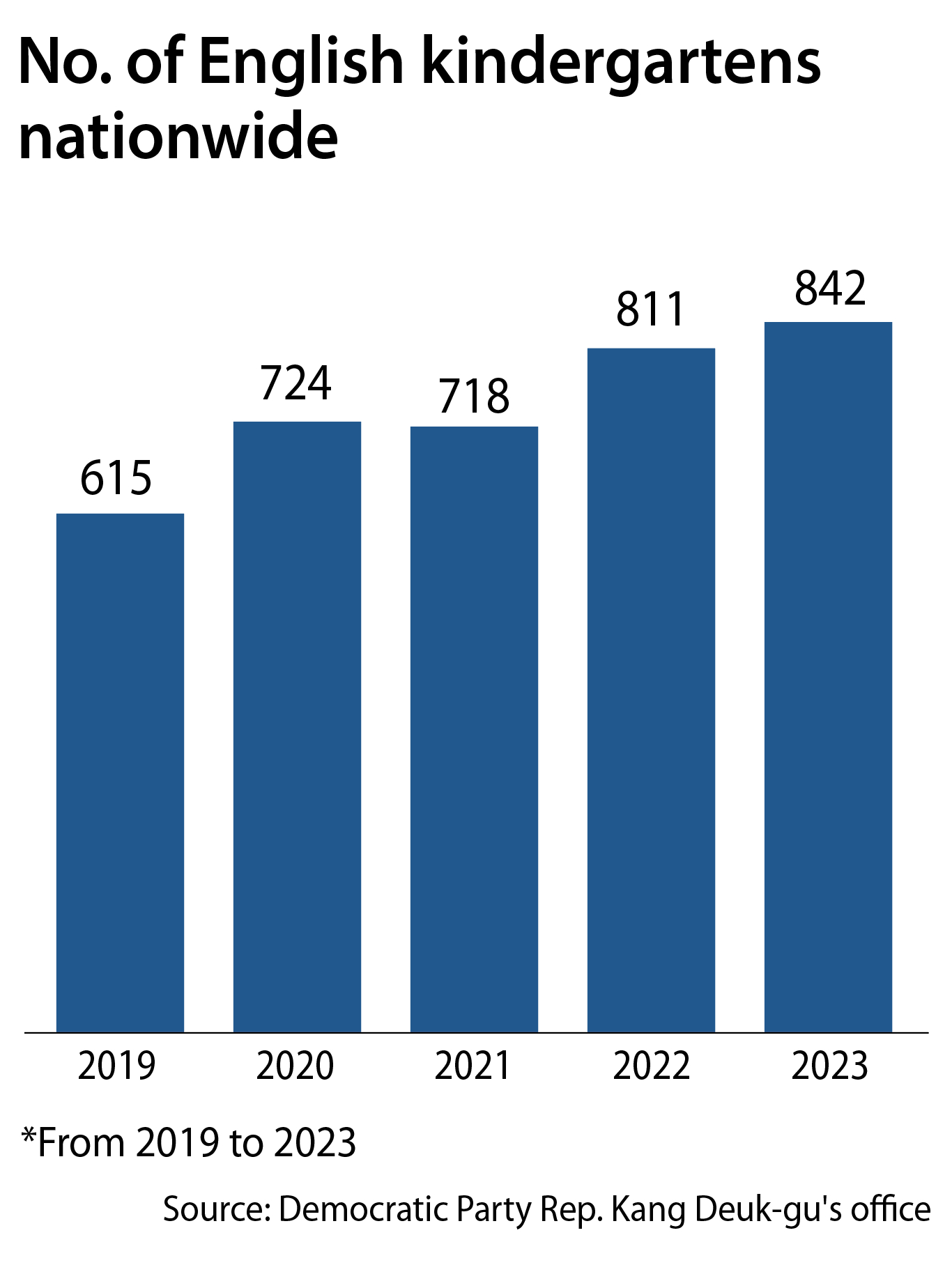
Even so, the number of English kindergartens across Korea has continued to rise in recent years, increasing from 615 in 2018 to 842 in 2023, according to data released in 2024, despite government efforts to mitigate the issue.
But to what extent do kindergartners learn English in such establishments and what do their curricula entail?
What do these 'English kindergartens' actually offer?
Those with English kindergarten backgrounds start public education on the back of basics they had learned earlier, creating a circumstance in which they can read, write and speak in English on the first day of school, whilst those without the pre-education background are only beginning to learn the alphabet.
The English kindergarten for the most part is not about playing, but offers a systematic curriculum for all three age groups: 4-, 5- and 6-years-old.
Kids aged 4 learn the alphabet and basic words first, but 5- and-6-year-olds do a great deal of reading and writing, all while practicing and listening to English conversations with teachers who are native speakers.
![An English kindergarten is seen in Gangnam District, southern Seoul on March 13, 2025. [YONHAP]](https://koreaseafood.online/data/photo/2026/04/14/0e693f4e-d777-4243-8038-9004ed5d0dd1.jpg)
An English kindergarten is seen in Gangnam District, southern Seoul on March 13, 2025. [YONHAP]
“Kids in class use English about 30 to 40 percent of the time at age 4, increase it to around 60 to 70 percent at age 5, and by age 6, they use English almost 100 percent of the time,” a former head of an English kindergarten in Yongsan District, central Seoul, who asked to remain anonymous, told the Korea JoongAng Daily on Friday. “Children from affluent families reach a reading and writing level equivalent to that of second- or third-grade students in the United States after completing English kindergarten.”
English kindergartens also use textbooks used in the United States, giving kids insight into how native speakers structure sentences.
English kindergartens not only offer language education, but also provide extra curricular courses.
“The curriculum also includes courses like art, physical education and music, because kids that age cannot sit all day long,” the former head of the English kindergarten said. “The program includes physical education so children can relax, and sessions where they watch English-language dramas. It’s not just about sitting down to read and write — there are various types of classes. That said, compared to regular kindergartens, there is far less playtime.”
Despite cost, and government crackdowns, why do parents still choose English kindergartens?
To kids, learning English in school can feel like merely studying a subject rather than picking up a new language naturally. That is where the English kindergarten comes in — to provide a more friendly setting to expose the kindergartners to the target language.
![Cars are parked at an English kindergarten in Gangnam District, southern Seoul on March 13, 2025. [YONHAP]](https://koreaseafood.online/data/photo/2026/04/14/08d0381c-0b5d-4c78-95fb-c9a2b2f7bd6f.jpg)
Cars are parked at an English kindergarten in Gangnam District, southern Seoul on March 13, 2025. [YONHAP]
“Even if you learn English later, there is still a difference between those who learned the language at a really young age and those who did so when they were older,” the mother of two kids said, talking about why she chose the English kindergarten. “The difference is visible when it comes to how they pronounce words or how they think, so I wanted my kids to naturally accept English rather than treating it as studies.”
Her case alone does not account for every parent, but it illustrates why some continue to choose English kindergartens despite the costs and concerns.
The necessity for learning English before school becomes more critical when parents want to send their kids to an international school in Korea, where all classes are taught in English.
Children with dual citizenships can legally attend an international school, but the schools usually require the applicants to pass an English language test before giving them admission.
“I did not have specific goals for my kids, but I wanted them to at least reach the level that is enough for them to be admitted to an international school,” the mother said.
The English kindergarten and international school route can also be a leverage to go overseas for college or other goals, as the international schools prepare the students to be able to study, think and do everything in English.
What are the teachers' credentials?
While the English kindergartens hire Korean teachers that are bilingual in order to help kindergartners communicate better, teachers from seven English speaking countries — Britain, Canada, the United States, South Africa, Australia, New Zealand and Ireland — are mostly involved in the teaching process.
Only those from the seven countries with an associate degree or higher are eligible to obtain the E-2 visa required for teaching English in Korea. The major does not matter when applying for the visa.
“We prefer teachers with a background in education; However, given the limited pool, many come from a range of other majors,” the former head of the English kindergarten said. “As for Korean teachers, we also prefer those that majored in education.”
How much are parents willing to pay — and what comes next?
The English kindergarten is a premium education option, with the average price in Seoul per child at 1.3 million won monthly as of 2024, according to government data.
“I think the average price is around 20 million won yearly,” the mother said. “The price did not really increase when my first kid went to the English kindergarten, but it definitely did when my second child did.”
![A banner hangs at an English kindergarten in Gangnam District, southern Seoul on March 13, 2025. [YONHAP]](https://koreaseafood.online/data/photo/2026/04/14/3e3e1008-11b8-4dbc-bf84-96e4450c206d.jpg)
A banner hangs at an English kindergarten in Gangnam District, southern Seoul on March 13, 2025. [YONHAP]
For comparison, the average price of college tuition in Korea is about 7 million won per year.
“Since it is costly, I think many people who send their kids to the English kindergarten are doctors or accountants,” the mother said. “Both parents need to have jobs in order to consider sending their kids to an English kindergarten.”
Her comments highlight the costs of attending, as well as other concerns influencing parents’ choices. Research findings shared by the Ministry of Education earlier this month also suggest that preschool education can increase children's anxiety and stress, thus some parents are opting to choose other subjects over English.
They paid an average of 127,000 won monthly for physical education and 122,000 won for music in 2024, according to the Education Ministry, as they aimed to help their children “develop their interests, build emotional sensitivity and improve social skills.”
For parents wanting their kids to improve their English, however, English kindergartens are only the beginning.
Numbers in recent years suggest that the majority of parents want to educate their kids further as they grow. Around 76 percent of all students across elementary, middle and high schools in Korea received private education last year, according to the Ministry of Data and Statistics.
The average spending on English private education, which includes after-school English academies and tutoring, was 281,000 won per month.
The monthly cost of English academies in Seoul districts with large education markets goes well above the average price, with one school in Gangnam District offering a high school class at 850,000 won per month. Some private English tutoring courses in Gangnam District and nearby districts also cost around 800,000 won.
These are the prices that parents will pay in order to help their kids master English and perform academically well throughout their school years, and the English kindergarten is the first step toward that journey.
BY PAIK JI-HWAN [[email protected]]


with the Korea JoongAng Daily
To write comments, please log in to one of the accounts.
Standards Board Policy (0/250자)