

Private education drives early academic gap across Seoul, survey finds
Published: 19 Mar. 2026, 09:08
Updated: 19 Mar. 2026, 14:24
![A pedestrian walks by an English kindergarten in Gangnam District, southern Seoul, on March 13, 2025. [YONHAP]](https://koreaseafood.online/data/photo/2026/03/19/90792ffa-c205-44bf-8639-44c407a40165.jpg)
A pedestrian walks by an English kindergarten in Gangnam District, southern Seoul, on March 13, 2025. [YONHAP]
In Seoul, many children begin studying English before ever setting foot in an elementary school as parents seek an edge in Korea’s fiercely competitive education system. But those early lessons can be expensive, and how soon children start often depends on where they live.
A new survey by the Seoul Metropolitan Office of Education shows how sharply those opportunities differ across the capital. More than half of parents in the affluent districts of Seocho and Gangnam said they have sent their children to English-language kindergartens. In contrast, parents in lower-income areas like Jungnang and Gangbuk responded the same at 13.7 percent and 14.7 percent, respectively.
English-language kindergartens typically cost significantly more than ordinary preschools because they operate as private language institutes and do not qualify for government subsidies.
Overall, 29 percent of parents with children from kindergarten to middle school said they currently send or previously sent their children to these programs.
“The results show that education gaps are beginning in early childhood and differ depending on region,” an official from the Seoul Metropolitan Office of Education said.
The findings come from a survey on perceptions of private education released on March 16. A total of 25,487 people participated, including 11,941 parents, 9,006 students and 4,540 teachers.
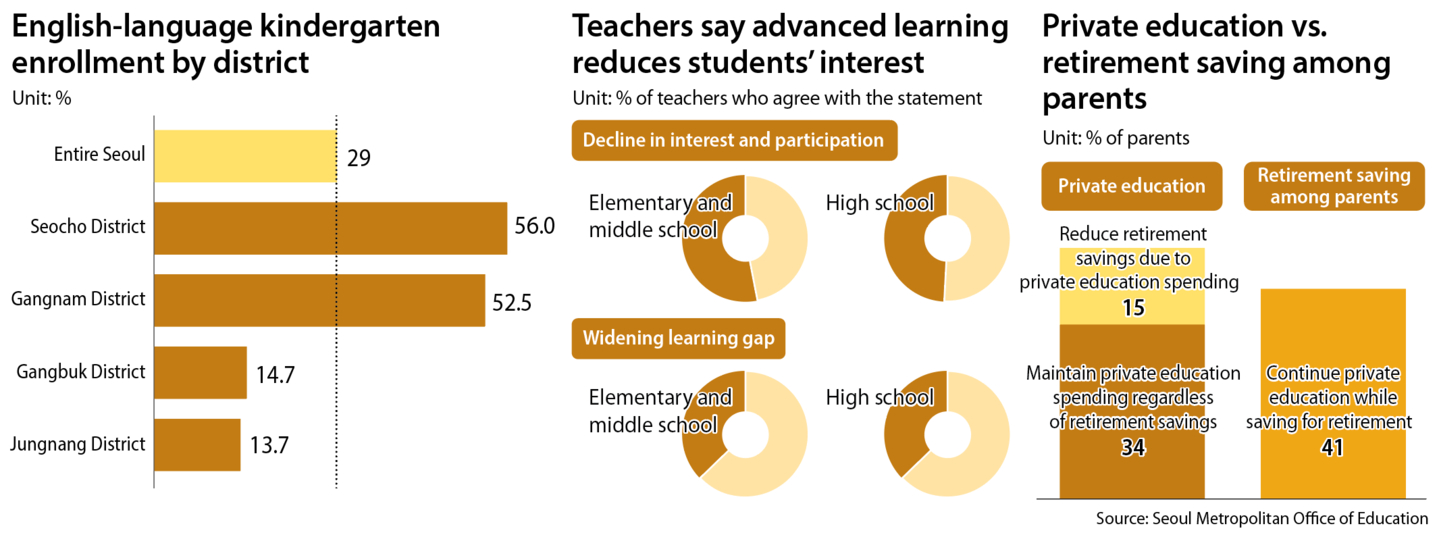
English kindergarten graphic
Private education is nearly universal in Seoul. The survey found that 82.6 percent of students participate in private education outside of school. Participation was highest among elementary school students at 90.7 percent and middle school students at 89.8 percent. Even among kindergartners, 75.4 percent were enrolled in private education programs.
District differences also appear in the extent to which students pursue advanced coursework through private academies, known as hagwon: 62 percent of respondents said private tutoring typically goes beyond what is learned at school. Among them, 45 percent said students study at least one semester ahead of the school curriculum, and 18 percent said they study more than a year ahead.
About 9 percent said students go even further, learning material from the next school level entirely, such as elementary school students studying middle school coursework.
Those practices were most common in districts known for strong school reputations. The share of students studying beyond their grade level reached 19.5 percent in Gangnam, 16.8 percent in Yangcheon and 15.8 percent in Seocho. In comparison, the figures were much lower in districts such as Jongno and Jung, which stood at 3.6 percent and 3.5 percent, respectively.
![Prospective first graders and their parents look around first-grade classrooms at Changsin Elementary School in Busan, on Jan. 6 during orientation. [YONHAP]](https://koreaseafood.online/data/photo/2026/03/19/f24352a4-4e27-422d-905c-74509e92ea01.jpg)
Prospective first graders and their parents look around first-grade classrooms at Changsin Elementary School in Busan, on Jan. 6 during orientation. [YONHAP]
Teachers said the trend can make teaching in the classroom more difficult. Fifty-three percent of elementary and middle school teachers said advanced learning through private education reduces students’ curiosity and engagement during lessons. Forty-nine percent of high school teachers reported the same concern.
Teachers also reported seeing signs of fatigue among students who juggle heavy private education schedules. The share of teachers who said they frequently observe students struggling with tiredness and difficulty concentrating rose with grade level: 34.2 percent in elementary schools, 61.4 percent in middle schools and 63 percent in high schools.
Despite those concerns, many parents said they feel unable to reduce private education spending even if it strains their finances.
![School buses are parked near an English kindergarten in Gangnam District, southern Seoul, on March 13, 2025. [YONHAP]](https://koreaseafood.online/data/photo/2026/03/19/c73b42c8-eed0-4541-8e6b-d4d25c3bc21f.jpg)
School buses are parked near an English kindergarten in Gangnam District, southern Seoul, on March 13, 2025. [YONHAP]
A parent of a kindergarten student in Seocho District, who asked to be identified only by the surname Lee, said private education often feels unavoidable.
“I can’t stop private education because public education alone makes me uneasy,” Lee said. “When you factor in private education costs and our housing loan, preparing for retirement still feels like a distant dream.”
Students in Seoul spend an average of 663,000 won ($440) per month on private education, more than 200,000 won higher than the national average of 458,000 won.
![Children and their caretakers walk down a slope near an elementary school in Seodaemun District, western Seoul, on Feb. 2. [YONHAP]](https://koreaseafood.online/data/photo/2026/03/19/9e738f0d-0608-4292-8898-42072e6e217e.jpg)
Children and their caretakers walk down a slope near an elementary school in Seodaemun District, western Seoul, on Feb. 2. [YONHAP]
The city's education officials said they plan to introduce measures to ease that burden based on the survey results. The Seoul Metropolitan Office of Education will propose revisions to the Act on the Establishment and Operation of Private Teaching Institutes and Extracurricular Lessons to ban level tests for preschool-age students at private academies.
The office also plans to provide 500,000 won per year in after-school education support for third-year elementary school students and increase the number of career and college counseling staff from 200 to 300 to reduce reliance on costly private admissions consulting.
BY LEE HOO-YEON [[email protected]]


with the Korea JoongAng Daily
To write comments, please log in to one of the accounts.
Standards Board Policy (0/250자)