

Korean Gen Z embraces freelance artists for tailored illustrations, unique storytelling experiences
Published: 09 Apr. 2026, 14:58
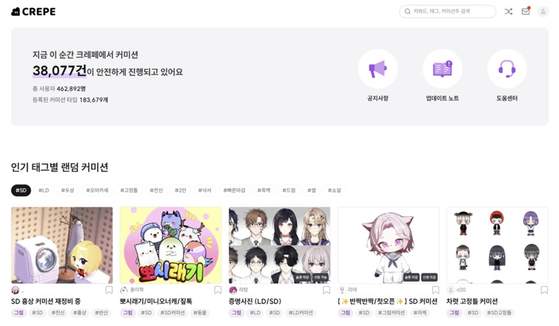
A screenshot from Crepe, an online commission marketplace [SCREEN CAPTURE[
Fans of webtoons, animation or games don't just consume content created by official artists and developers. They also pay freelance artists to create custom content just for them.
The concept, known as custom commission trading, is booming among Korean Gen Zs as they hire freelance artists and writers to sell made-to-order illustrations, writing and other works tailored to niche tastes.
"I’ll draw your favorite character in a squishy style. They’re silly, but round and squishy,” a post on Crepe, an online commission marketplace, reads.
If a client sends reference materials for a favorite character along with detailed requests, the artist returns a “round and squishy” version by the deadline.
Clients pay creators about 5,000 won ($3.4) to 10,000 won per character. “This is the best squishy commission with a high level of satisfaction," one positive reviewer wrote.
Commission trading, in this context, refers to person-to-person transactions in which people order creative works, such as illustrations and writing, through trading platforms or social media.
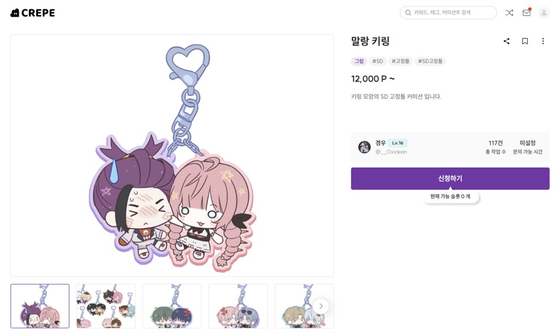
A screenshot from Crepe, an online commission marketplace [SCREEN CAPTURE[
Transactions mainly take place on social media platforms such as X or intermediary platforms such as Crepe, kmong and Artmug. Commission requests are also easy to find on general secondhand trading platforms such as Karrot and Bunjang.
Such posts range from creators' posts saying, “I draw male characters in the style of romance comics,” to clients’ posts saying, “I’m looking for someone to draw my favorite character petting me.”
As subcultures built around animation, games and virtual idols grow rapidly among young people, fans are evolving into both producers and consumers who directly order and create their own content.
In fact, Laftel, an animation-focused on-demand streaming platform whose main subscribers are in their teens and 20s, is the only Korean platform maintaining profitability while the broader domestic streaming market struggles. The share of print comic book purchases made by people in their teens and 20s has also steadily risen over the past six years, Yes24 data shows. More than one-third of all print comic book buyers last year were in those age groups.
As individual tastes become increasingly fragmented with the growth of streaming platforms, YouTube and social media, the fandom activities of younger generations, once dismissed as subculture, are creating a creative economy of their own. There are still no official figures on the size of Korea’s online commission market, but industry estimates put it at more than 500 billion won.
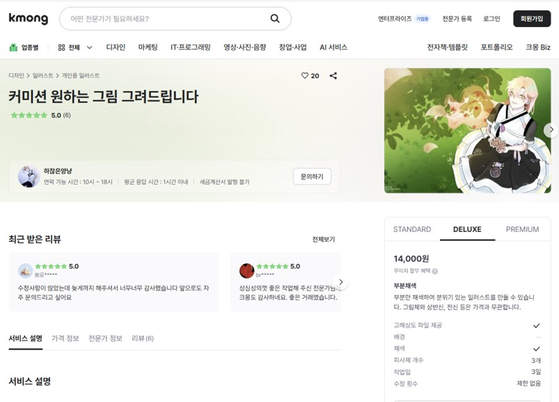
A screenshot from kmong, an online commission marketplace [SCREEN CAPTURE[
Crepe, one of the major commission trading platforms, recorded a cumulative transaction value of 43.6 billion won and 1.74 million transactions last year. Those figures were up 69 percent and 92 percent from a year earlier. The overseas transaction value also jumped 188 percent in step with the popularity of K-culture. Its main users are women in their teens and 20s.
"Consumers in their teens and 20s are very accustomed to creating or remixing content themselves," co-CEO of Cookieplace Nam Sun-woo said. Cookieplace is the firm that operates Crepe. "For them, the process of commissioning a creator to produce a one-of-a-kind result is also a form of play.”
Fans, for instance, will ask for their favorite character to wear a different outfit or for characters to be rendered at a cute miniature scale.
The commissioned works are also expanding beyond illustrations to include voices that suit characters and playlists that match fictional universes. “There are quite a few creators who make enough from commission income alone to support themselves,” a source in the industry said.
Platforms are also working to establish policies to reduce disputes arising in person-to-person transactions, including safe payment systems and guidelines for the use of generative AI.
“When a user makes a payment, the money is first held in our internal system and is paid to the seller only after the work has been checked and confirmed,” a kmong official said.
Crepe operator Cookieplace, on the other hand, launched an anti-AI project that monitors and detects the usage of generative AI without disclosing.
“We are strengthening monitoring so that creative works made with generative AI without consent are not traded on the platform,” Nam said.
This article was originally written in Korean and translated by a bilingual reporter with the help of generative AI tools. It was then edited by a native English-speaking editor. All AI-assisted translations are reviewed and refined by our newsroom.
BY HONG SANG-JI [[email protected]]


with the Korea JoongAng Daily
To write comments, please log in to one of the accounts.
Standards Board Policy (0/250자)