

Iran war threatening Hyundai’s Middle East ambitions, chipmakers’ rare gas lifeline
Published: 13 Mar. 2026, 05:00
Updated: 13 Mar. 2026, 10:50
-

- SARAH CHEA
- [email protected]
-
- LEE JAE-LIM
- [email protected]
Audio report: written by reporters, read by AI
![A render of Hyundai's factory in Saudi Arabia, which is scheduled to begin operation within the year [HYUNDAI MOTOR]](https://koreaseafood.online/data/photo/2026/03/13/52e15f68-b4ab-4b13-8dad-e3de70162bfd.jpg)
A render of Hyundai's factory in Saudi Arabia, which is scheduled to begin operation within the year [HYUNDAI MOTOR]
[NEWS ANALYSIS]
As the Iran war deepens into an indefinite standoff, exports by Korea’s automakers like Hyundai Motor have ground to a halt, abruptly clouding their endeavors in the once-promising Middle East market.
The setback is particularly acute as the Middle East has been considered a “land of opportunity” for Korean carmakers, thanks to the popularity of luxury, high-margin vehicles, making the disruption even more of a direct blow to profit stability.
For the semiconductor industry, the prolonged war could impede the supply of rare gases used in semiconductor manufacturing, with countries such as Qatar and Israel among the major producers.
Premium-heavy market hit by Hormuz closure
Until recently, Hyundai produced vehicles in India and Korea and shipped them across the Middle East, but exports have now been suspended entirely after the shutdown of the Strait of Hormuz — a vital, narrow maritime choke point connecting the Persian Gulf with the Gulf of Oman and the Arabian Sea — due to the ongoing conflict between the United States, Israel and Iran. Company expatriates in the region have all returned home.
Construction of the company’s first car factory in Saudi Arabia has also faced uncertainity, potentially impacting its scheduled completion by the end of this year.
The Middle East remains a critical market for Hyundai, particularly as car sales have surged following the lifting of restrictions allowing women to drive, and the region's purchasing patterns that favor large, high-margin vehicles such as Genesis models and SUVs.
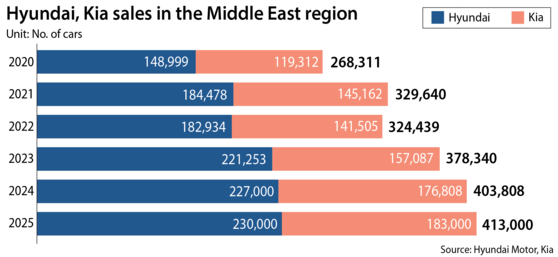
Hyundai Motor and Kia, the two largest Korean automakers, currently occupy about 15 percent of the Middle East market, second only to Toyota, while fast-rising Chinese automakers are in pursuit. Sales, which had hovered below 270,000 units in 2020, surged more than 50 percent to 413,000 as of last year, representing roughly 10 percent of the group’s global deliveries. The two carmakers aim to reach sales levels of 550,000 around 2030.
![Hyundai Motor Group Executive Chair Euisun Chung, center, inspects the company's factory in Saudi Arabia in October 2025. The factory is scheduled to begin operation within the year. [HYUNDAI MOTOR]](https://koreaseafood.online/data/photo/2026/03/13/762a1a0c-3460-4894-b4d5-db69de611e5b.jpg)
Hyundai Motor Group Executive Chair Euisun Chung, center, inspects the company's factory in Saudi Arabia in October 2025. The factory is scheduled to begin operation within the year. [HYUNDAI MOTOR]
“While there are a few alternative routes that bypass the Strait of Hormuz, the added costs and delays would significantly erode the productivity of export-driven companies,” said Yang Uk, a research fellow at the Asan Institute for Policy Studies.
“The U.S. military will probably launch a large-scale escort operation for ships passing through the Strait of Hormuz, and if that campaign succeeds, it could pave the way for a declaration ending the conflict,” Yang said. “But if it fails, the war is likely to drag on for an extended period.”
Hyundai's plant, currently under construction, is designed to operate using complete knock down assembly processes, where Hyundai Motor ships auto parts to the facilities, which are then assembled locally. The annual capacity will be about 50,000 vehicles, with both electric and internal-combustion models produced on the same line.
While Hyundai said no immediate changes to the timetable have been confirmed, a prolonged war could delay the delivery of critical equipment and restrict the deployment of specialized personnel.
If completed, the plant would mark the first production foothold in the Middle East from a major global automaker. Until now, no other carmakers outside of U.S. EV maker Lucid Motors have established a full-scale production facility in the region.
The Middle East market is also one that Korean automakers can scarcely afford to lose, particularly after Hyundai’s retreat from Russia following the outbreak of war with Ukraine. Hyundai sold off its plant in Saint Petersburg for just 10,000 rubles (about $125), and ultimately abandoned its buyback option after the conflict prolonged. Hyundai was the No. 2 carmaker in Russia, behind only local manufacturers, before being forced to walk away.
KG Mobility was also in the process of preparing to launch a semi-knockdown assembly plant in eastern Saudi Arabia with state-owned Saudi National Automobiles, with full-scale production originally slated to begin in June.
Market research firm Bernstein said in a recent report that Asian automakers — particularly those centered in China and companies such as Hyundai — could face the steepest blow if the conflict involving Iran leads to disruptions, including a closure of the Strait of Hormuz.
Potential supply chain disruption amid chip shortage
Korean chipmakers are closely monitoring the U.S.-Iran conflict as well, as Samsung Electronics and SK hynix rely heavily on imports of key semiconductor materials such as helium and bromine from Middle East suppliers. In the short term, the companies have enough inventory to continue production as planned. But if the conflict becomes prolonged, they may need to secure alternative supply sources to mitigate risks, particularly in the current sensitive market environment where memory is already experiencing tight supply and chips are in turn becoming more expensive.
Helium plays a critical role in semiconductor manufacturing. During wafer processing, helium gas is injected to help cool silicon wafers and maintain stable temperatures. Bromine itself is not directly used in chip manufacturing, but bromine-based chemicals are used in dry etching processes that remove material from wafers to create circuit patterns.
![An aerial view of Samsung Electronics' Pyeongtaek campus in Gyeonggi [SAMSUNG ELECTRONICS]](https://koreaseafood.online/data/photo/2026/03/13/ef80559b-259c-491a-b5f4-66bf104b2509.jpg)
An aerial view of Samsung Electronics' Pyeongtaek campus in Gyeonggi [SAMSUNG ELECTRONICS]
Both materials are essential for chip production. Korea relies on Qatar for 64.7 percent of its helium imports, according to the Korea International Trade Association’s 2025 data. Qatar’s liquefied natural gas (LNG) production has recently been halted following Iran’s attacks. Because helium is extracted as a byproduct during natural gas processing, disruptions to LNG production halt helium output. For bromine, Korea is even more heavily dependent on imports from Israel, which accounts for 97.5 percent of Korea's imports. Both Qatar and Israel are among the world’s major production hubs for these materials.
“We have already diversified our supply sources for raw materials and components, so at the moment there is no immediate disruption to chip production,” said an industry source who requested anonymity. “Following Japan’s export restrictions and geopolitical developments such as the Russia-Ukraine war, we worked to diversify our materials supply chain and secure safety stock.”
Still, that stock is bound to run out if the war drags on. According to Gasworld, a Britain-based gas trade outlet, helium prices could rise by as much as 50 percent due to supply disruptions, with market impacts potentially lasting several weeks or even months before conditions normalize.
![SK hynix's M16 chip plant in Icheon, Gyeonggi [SK HYNIX]](https://koreaseafood.online/data/photo/2026/03/13/04e777f8-6039-4e36-af3a-1f0b59abf454.jpg)
SK hynix's M16 chip plant in Icheon, Gyeonggi [SK HYNIX]
If imports continue to be cut off, chipmakers would then turn to the United States, which has historically been the largest global helium producer, home to companies such as ExxonMobil, Air Products and Linde.
Despite these risks, analysts say the conflict will not trigger a semiconductor downturn similar to the industry slump in 2022. That downturn followed the outbreak of the Russia–Ukraine war, which pushed up energy prices and accelerated a decline in consumer electronics demand, the key driver of memory chip demand at the time.
“Demand for memory chips is now being driven by investment in artificial intelligence infrastructure rather than consumer electronics,” Korea Investment & Securities said in a report. “Inventory levels remain relatively low, while supply expansion has yet to catch up with demand growth.”
The report also notes that rising energy prices are unlikely to significantly increase semiconductor production costs, despite the large amount of electricity required to operate chip fabrication plants.
In Korea, retail electricity prices are controlled by the government. If authorities choose not to pass higher wholesale electricity costs on to industrial users, the gap would be absorbed by the state-run Korea Electric Power.
“For companies such as Samsung Electronics and SK hynix, electricity costs account for roughly 2 to 5 percent of total production expenses,” the report said.
BY SARAH CHEA,LEE JAE-LIM [[email protected]]


with the Korea JoongAng Daily
To write comments, please log in to one of the accounts.
Standards Board Policy (0/250자)