

Most Korean men think gender equality has 'gone far enough.' Women's institute head says not quite.
Published: 08 Mar. 2026, 07:00
Updated: 09 Mar. 2026, 14:16
-

- WOO JI-WON
- [email protected]
Audio report: written by reporters, read by AI
![Male and female icons separated by a revolving equals signs on wooden cubes [GETTY IMAGES BANK]](https://koreaseafood.online/data/photo/2026/03/09/16896758-159a-4d80-890a-a0efd0b3a9af.jpg)
Male and female icons separated by a revolving equals signs on wooden cubes [GETTY IMAGES BANK]
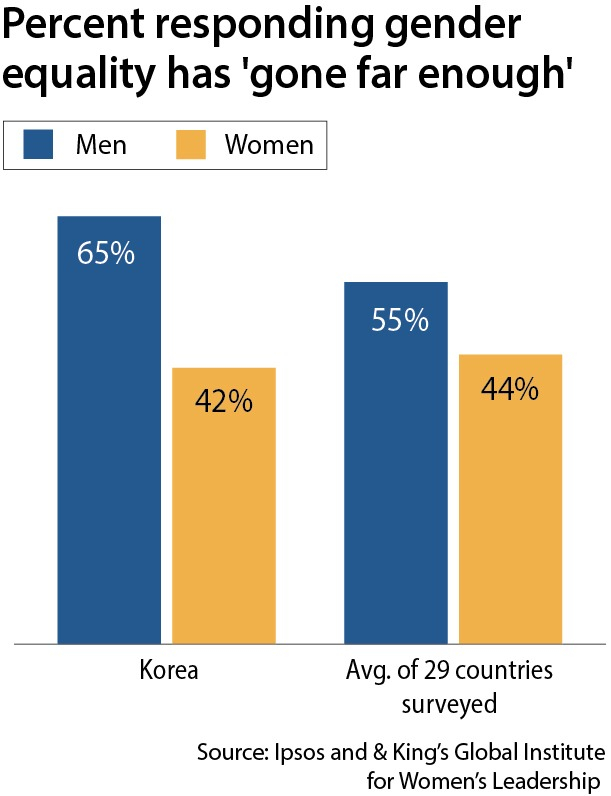
Korea recorded the largest gender divide among 29 countries on whether gender equality has "gone far enough," according to a new international survey released on Thursday ahead of International Women's Day.
Sixty-five percent of Korean men agreed that "when it comes to giving women equal rights with men, things have gone far enough in my country," compared with 42 percent of women, according to the survey conducted by market research company Ipsos and the Global Institute for Women's Leadership at King's College London, polling 23,268 adults across 29 countries.
The 23 percentage-point gap is more than double the global average gap of 11 points.
Prof. Chung Hee-jung, director of Global Institute for Women's Leadership at King's Business School who led the survey, said the wide gap reflects a combination of persistent structural inequalities in Korea along with political narratives that have resonated with young men.
"Korean women by far have not achieved gender equality, especially in the economic areas," Chung told the Korea JoongAng Daily in a phone interview, referencing the World Economic Forum's global gap report, which shows that women remain underrepresented in leadership positions in both politics and business.
![Professor Chung Hee-jung, director of the Global Institute for Women's Leadership at King's Business School [CHUNG HEE-JUNG]](https://koreaseafood.online/data/photo/2026/03/09/a8ca5788-b2a2-4aff-95e9-633980d9081c.jpg)
Professor Chung Hee-jung, director of the Global Institute for Women's Leadership at King's Business School [CHUNG HEE-JUNG]
"From the previous Yoon Suk Yeol of People Power Party and with Lee Jun-seok and the new Reform Party, there has been a huge amounts of rally of men, especially young men, into thinking that gender equality has gone too far," Chung said.
During the 2022 presidential election, former President Yoon Suk Yeol of the then–People Power Party appealed to young male voters who felt disadvantaged by gender politics. Lee Jun-seok, a conservative politician who later founded the Reform Party, has also used rhetoric critical of feminism and has drawn notable support from young male voters.
Such rhetoric has fueled sentiment among the demographic that they face gender-related disadvantages such as conscription while women receive preferential treatment.
"Because especially for young men in Korea, unemployment rates are still high, young men feel like they're not getting the same opportunities that their fathers and grandfathers had despite having worked really hard to get into universities and now get jobs," she said. The average employment rate for men in their 20s from January to October last year was 57.8 percent, while for women it was 62.9 percent — a gap of 5.1 percentage points, according to data released by the Ministry of Data and Statistics. Men in this age group have lagged behind women in employment since 2011.
"So there is huge amount of resentment among young people."
She added that politicians and media figures are using such resentment to target women and the feminist movement to get votes for themselves.
"We have seen a lot of antifeminist movements in Korea and them using that as a momentum to gain support for a political."
Although the agreement that gender equality has “gone far enough” has increased compared to 2019, when 49 percent of men and 28 percent of women agreed, Chung emphasized that structural gender inequality still remains significant in Korea, where "in many ways, women still face it very badly, especially once they are married."
Korea also ranked highest among the surveyed countries for perceived tension between men and women.
Seventy-six percent of respondents in Korea agree that there is tension between men and women in their country, compared with a global average of 51 percent, ranking highest among the surveyed countries.
The competitive nature of "every aspect of [18- to 29 year-olds'] lives" — from Korea's job market to its education system — plays some part in fueling this tension, Chung said.
"They have been through competition after competition, after competition."
![Male and female symbol on the scales [GETTY IMAGES BANK]](https://koreaseafood.online/data/photo/2026/03/09/a396dd5c-2f81-46db-95f3-c8a50cff5589.jpg)
Male and female symbol on the scales [GETTY IMAGES BANK]
The Korean average is 21 percent, below global averages of 39 percent.
Chung said negative perceptions surrounding the term "feminism" in Korea may have influenced such low proportions in both men and women.
"I think when you take the word feminism out, people are quite feminist in Korea," she said. "In Korea, the word feminism has had quite a negative image."
Referencing the #MeToo movement in Korea, she said that while it was "absolutely necessary and a very important process that we had to go through," the process in some ways alienated people by making feminism appear like "a militant, aggressive movement that is trying to police men."
"In that process, it was again driven by certain groups, certain media including social media to demonize feminists in a certain way and make them appear as an extreme group."
In countries such as the Britain, she said, feminism is often viewed as a broader movement aimed at freeing both men and women from restrictive social norms.
BY WOO JI-WON [[email protected]]


with the Korea JoongAng Daily
To write comments, please log in to one of the accounts.
Standards Board Policy (0/250자)