

BOK raises growth forecast to 2% while holding rate steady
Published: 26 Feb. 2026, 17:59
-
- JIN MIN-JI
- [email protected]
![Bank of Korea Gov. Rhee Chang-yong speaks to reporters at the central bank in central Seoul following the monetary policy board meeting on Feb. 26. [BOK]](https://koreaseafood.online/data/photo/2026/02/26/f4408031-de4e-4ed9-8e22-61044d8aa31b.jpg)
Bank of Korea Gov. Rhee Chang-yong speaks to reporters at the central bank in central Seoul following the monetary policy board meeting on Feb. 26. [BOK]
The Bank of Korea (BOK) on Thursday raised its growth forecast for this year from 1.8 percent to 2 percent, citing robust semiconductor exports, while keeping the benchmark interest rate unchanged for the sixth consecutive meeting.
“Strong semiconductor market conditions and the solid growth trajectory of the global economy are expected to drive export and facility investment growth beyond earlier projections,” said BOK Gov. Rhee Chang-yong in a press conference following the monetary policy board meeting. A recovery in consumption, driven by improved income conditions stemming from solid corporate earnings, also drove up the projection from November's forecast.
“Information technology [IT] manufacturing, including semiconductors, is expected to contribute 0.7 percentage points to this year’s economic growth, compared to 0.6 percentage points last year,” Rhee said in explaining the reason behind the upward revision. But he noted that the sector’s contribution is estimated to decline next year, which was one of the factors behind the downward revision of next year’s growth forecast from 1.9 percent to 1.8 percent.
Rhee also cautioned against polarized growth. “Considering that growth in the non-IT sector remains unchanged at 1.4 percent from the previous forecast, despite the upward revision to the overall growth outlook, the gap between the IT and non-IT sectors appears to be widening,” he said, while also noting that a delayed recovery in construction investment weighed on the growth forecast.
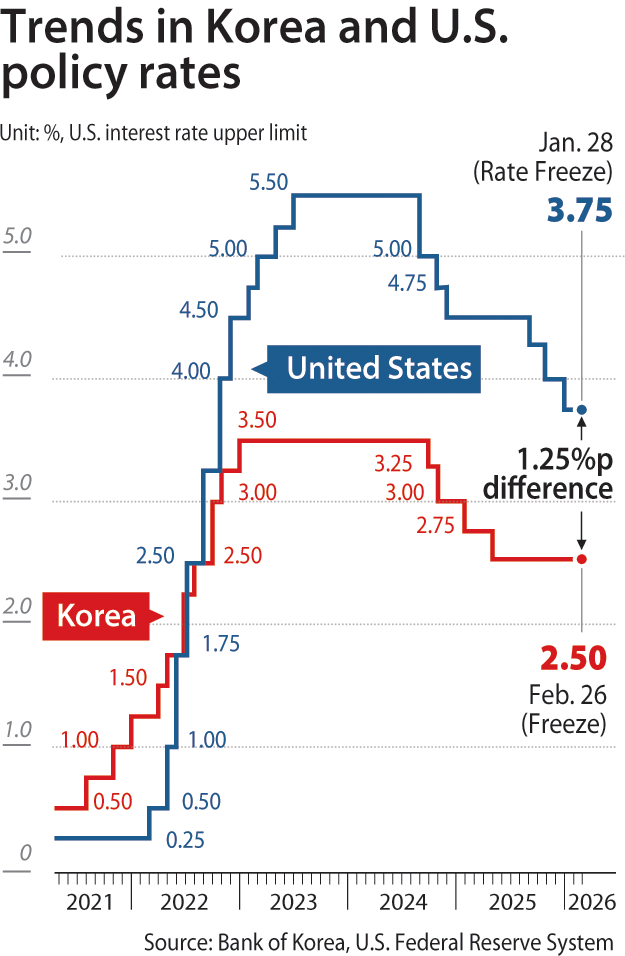
On the same day, the BOK kept the base interest rate steady at 2.5 percent in a widely anticipated move, extending the pause that started in July of last year after a four-cut streak from October 2024.
The BOK raised this year’s core inflation estimate from 2.1 percent to 2.2 percent, while keeping the forecast unchanged for next year at 2 percent.
Rhee also noted volatility in the dollar-won exchange rate as another factor behind the rate freeze. “Though the rate has declined significantly, volatility remains high. While outflows from overseas investments by the National Pension Service have significantly decreased, individual investments this January and February, including in exchange-traded funds [ETF], have increased at nearly the same rate as in October and November of last year,” he added.
The won traded at 1,425.8 against the dollar on Thursday, strengthening from the 1,470 won range logged in December of last year.
The central banker indicated that a change in policy is unlikely over the next six months, citing the newly introduced quarterly forward guidance framework with a median board rate forecast in six months of 2.5 percent. The new framework is a shift from the previous three-month forward guidance that provided the views of board members at each policy meeting.
In the central bank's dot-plot-inspired framework introduced on Thursday, 16 of the 21 dots placed by board members were at 2.5 percent, with four at 2.25 percent and one at 2.75 percent.
“Although this is a conditional outlook and possibilities cannot be ruled out, at least for now, the likelihood of raising or lowering interest rates over the next six months appears low,” Rhee said.
Below are selected excerpts from Rhee’s responses to reporters’ questions on the interest rate, growth and inflation, edited for clarity.
![Bank of Korea Gov. Rhee Chang-yong chairs a monetary policy board meeting at the central bank on Feb. 26. The board kept the rate unchanged at 2.5 percent. [BOK]](https://koreaseafood.online/data/photo/2026/02/26/a103b8d1-99ae-47e1-8eab-a1983062cf87.jpg)
Bank of Korea Gov. Rhee Chang-yong chairs a monetary policy board meeting at the central bank on Feb. 26. The board kept the rate unchanged at 2.5 percent. [BOK]
Q. Exchange rate volatility remains high. How do you assess the current exchange rate level?
A. Looking at last year’s statistics, domestic investors’ overseas investments increased roughly threefold compared to previous years. Most of this increase occurred in October and November, with individual investors showing particularly rapid growth. Including ETF investments, individual investors’ overseas investments last year even exceeded those of the National Pension Service, especially toward the end of the year.
As the volume of domestic overseas investments rose so sharply, market supply and demand factors drove expectations that the exchange rate could hit the 1,500 won level. At that time, it wasn’t fundamentals but these supply-demand factors that put pressure on the foreign exchange market.
In regards to the recent strengthening of the won, my interpretation is as follows: The National Pension Service announced a few weeks ago that it would reduce overseas investments by more than $20 billion this year, hedge its foreign exchange exposure and conduct investments flexibly. I believe this announcement significantly contributed to the strengthening won. It helped set the view that ongoing supply-demand factors would likely prevent the exchange rate from reaching 1,500 won. As a result, companies have started selling some of their dollar holdings, which is currently helping to lower the exchange rate.
It’s not a situation to be fully relaxed about yet, but I think the supply-demand-driven pressures we saw at the end of last year are gradually easing.
Concerns about the exchange rate seem somewhat lower compared to January. Which variables should we pay closest attention to when gauging the future direction of monetary policy?
I don’t think it’s yet a stage where we can be fully confident about the exchange rate. We are making significant efforts to manage domestic supply-demand factors, but the exchange rate is influenced not only by domestic factors but also by external ones.
As we’ve seen recently, factors like the impacts of U.S. AI stocks, the recent U.S. Supreme Court ruling [on tariffs] and concerns over Japan’s fiscal policy are causing high volatility, so overseas factors remain very significant.
In November and December of last year, the exchange rate was largely driven by domestic factors. But in January and February this year, it moved significantly due to both domestic and international factors. So while the exchange rate has stabilized somewhat, I think it’s still too early to be fully reassured.
How do you assess the current real estate market, which has shown a steep rally centered on houses in metropolitan areas?
The government is making substantial efforts regarding real estate. From the BOK’s perspective, we are not providing extra liquidity to fuel property prices — but this doesn’t mean the real estate market will stabilize immediately. So it’s not correct to say that concerns about financial stability have disappeared. For at least the next few months, considerations of financial stability, as well as inflation, will remain important.
Fortunately, inflation looks relatively manageable at this point, but it could still be affected by oil prices or the exchange rate. When it comes to guiding monetary policy, the most important factor will naturally be inflation. We will first monitor inflation, then consider financial stability, and finally growth, adjusting policy accordingly.
How concerned are you about Korea’s polarized growth, and how can we address the issue?
The likelihood of rising inequality in Korea has increased.
Economic growth is centered on the IT sector, while non-IT sectors are growing at just 1.4 percent, far below potential growth. This will widen the gap between IT and non-IT industries significantly.
Also, stock prices have risen sharply, but a large portion of Korean stocks is owned by high-income individuals and institutions. While everyone may benefit to some extent, the gains are uneven across income levels, which will further contribute to polarization.
Lastly, the development of AI technology has been astonishing. Over the past year, IT has advanced much faster than we anticipated. Seeing young people using AI agents extensively on computers, I often think life will be very difficult for the younger generation. The adoption of such technologies is likely to make polarization a significant social issue.
While monetary policy must be considered, addressing polarization will fundamentally require fiscal policy and structural measures. This is the approach needed to prepare for these challenges.
![Electronic display boards at Hana Bank in central Seoul show Korea's financial markets on Feb. 26. [YONHAP]](https://koreaseafood.online/data/photo/2026/02/26/8b2cc998-0b08-4ba3-80c9-f4fe6196b9b2.jpg)
Electronic display boards at Hana Bank in central Seoul show Korea's financial markets on Feb. 26. [YONHAP]
The Kospi is rapidly on the rise, and optimistic forecasts still seem to prevail. How do you assess the current stock market situation?
The recent rise in stock prices is supported not only by the government’s efforts to improve capital market regulations but also by earnings improvements across various sectors, including semiconductors, defense, nuclear power and financials. From the perspective that the domestic market is moving up from an undervalued position to a higher level, this is quite a positive development.
However, the pace of this stock price increase has been unusually fast, not just in Korea but globally. This means that volatility could spike significantly if domestic or international shocks occur. Moreover, if leverage rises sharply in the process, it can amplify vulnerability to market swings. As the central bank responsible for financial stability, we will be closely monitoring these developments.
BY JIN MIN-JI [[email protected]]


with the Korea JoongAng Daily
To write comments, please log in to one of the accounts.
Standards Board Policy (0/250자)