

South Korea weighs NATO-led weapons funding initiative, Russian retaliation as Ukraine war marks fourth anniversary
-

- MICHAEL LEE
- [email protected]
![Floodlights shine over the graves of the fallen soldiers as people gather around candles lit on the eve of the fourth anniversary of Russia’s full-scale invasion in Lviv, Ukraine, on Feb. 23. [AP/YONHAP]](https://koreaseafood.online/data/photo/2026/02/24/438089fb-5339-4a1b-9ef5-d4eb88675d0a.jpg)
Floodlights shine over the graves of the fallen soldiers as people gather around candles lit on the eve of the fourth anniversary of Russia’s full-scale invasion in Lviv, Ukraine, on Feb. 23. [AP/YONHAP]
[EXPLAINER]
South Korea finds itself once again at a crossroads over how far it can align with Western nations in supporting Ukraine without inviting Russian retaliation on the fourth anniversary of Russia’s full-scale invasion of Ukraine on Tuesday.
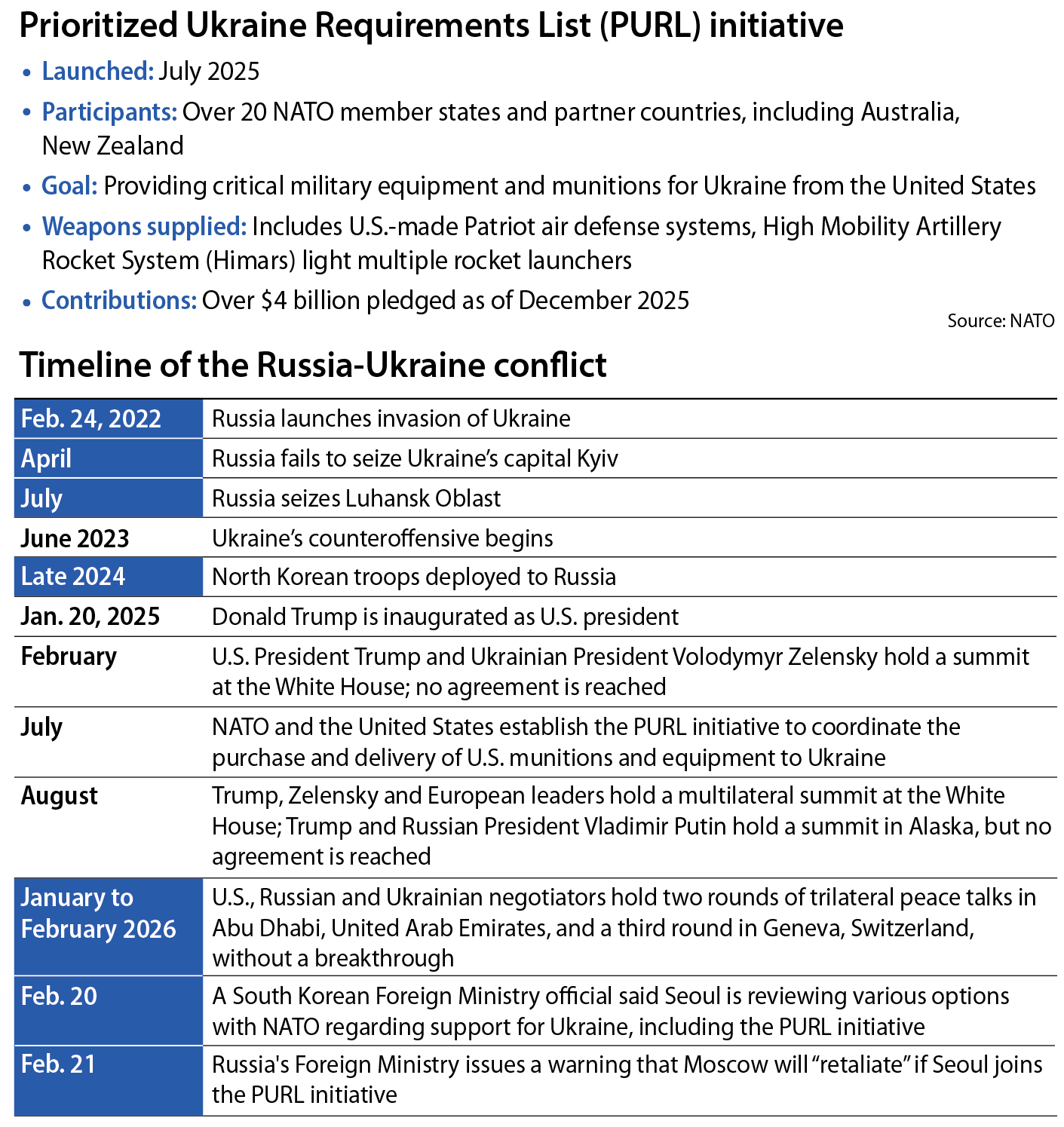
The trigger this time is Seoul’s possible participation in the Prioritized Ukraine Requirements List (PURL), a NATO-led program launched in July last year that coordinates and finances weapons and supplies for Kyiv.
Although South Korea’s Ministry of Foreign Affairs said Friday that it is only in “consultations” with NATO on measures to support Ukraine, Russian Foreign Ministry spokesperson Maria Zakharova responded by saying that Moscow could retaliate if Seoul joins the initiative.
The dispute threatens to spoil a potential thaw in relations between Russia and South Korea. As recently as January, Russian President Vladimir Putin said he hoped ties could recover after the prolonged chill that followed Seoul’s decision to join Western sanctions against Moscow.
Russia had previously designated South Korea an “unfriendly country,” and relations further deteriorated as Moscow deepened military cooperation with Pyongyang — first receiving weapons and ammunition, and later personnel to support its war effort in Ukraine.
The brewing spat over PURL raises the possibility that a tentative opening in Seoul-Moscow relations could close before it fully emerges.
![Maria Zakharova, Russia's Foreign Ministry spokesperson, gestures as she attends Russian Foreign Minister Sergey Lavrov's annual news conference in Moscow on Jan. 20. [AP/YONHAP]](https://koreaseafood.online/data/photo/2026/02/24/1d8a81a3-f236-4467-9cf9-2d01a24b7038.jpg)
Maria Zakharova, Russia's Foreign Ministry spokesperson, gestures as she attends Russian Foreign Minister Sergey Lavrov's annual news conference in Moscow on Jan. 20. [AP/YONHAP]
What is South Korea’s role in the war?
Since the start of Russia’s invasion in 2022, South Korea has supported Ukraine politically and financially. Still, it has officially withheld direct military support, in line with its longstanding policy of not sending lethal weapons to countries engaged in active conflict.
That policy is partly rooted in South Korea’s own security environment. Because of the technically still ongoing war with Pyongyang, Seoul maintains large stockpiles to preserve deterrence on the peninsula.
Ukraine has nonetheless repeatedly sought military aid from South Korea. As the conflict evolved into a war of attrition, Kyiv appealed for artillery shells, air defense systems and other weapons that South Korea is uniquely positioned to supply. For example, according to several analyses, South Korea can produce 200,000 155-millimeter shells per year, compared to the United States' annual production capacity of just 90,000 shells.
Still, Seoul resisted granting such requests, even after former President Yoon Suk Yeol suggested that policy could change if Russia’s cooperation with North Korea deepened. Domestic political caution, diplomatic calculation and fears of provoking Moscow all reinforced Seoul's refusal to arm Kyiv directly.
![North Korean soldiers are seen fighting alongside Russian forces in an undisclosed location in this footage broadcast by Pyongyang’s state-controlled Korean Central Television on Aug. 31, 2025. [YONHAP]](https://koreaseafood.online/data/photo/2026/02/24/bf9ed41f-59af-4bc1-b8da-58c398ff156d.jpg)
North Korean soldiers are seen fighting alongside Russian forces in an undisclosed location in this footage broadcast by Pyongyang’s state-controlled Korean Central Television on Aug. 31, 2025. [YONHAP]
Has Seoul not provided any weapons?
South Korea’s refusal to provide direct arms transfers did not mean it remained entirely outside the military dimension of the war. At key moments, Seoul became a quiet but significant indirect contributor to Kyiv’s war effort.
The clearest example involved 155-millimeter artillery shells. South Korea supplied hundreds of thousands of shells to the United States in 2024 under agreements stipulating that Washington would be the end user. In practice, however, such arrangements likely allowed the United States to replenish its own stocks after transferring ammunition to Ukraine.
A similar pattern emerged through defense exports to European countries such as Poland, which purchased South Korean-made systems while sending older Soviet-era equipment to Ukraine.
![South Korean President Lee Jae Myung, back right, and British Prime Minister Keir Starmer, back left, stand behind Canadian Prime Minister Mark Carney, front left, and Ukrainian President Volodymyr Zelensky during a photo session at the G7 Summit in Kananaskis, Canada, on June 17, 2025. [AP/YONHAP]](https://koreaseafood.online/data/photo/2026/02/24/f4539b49-4c7c-4453-90d9-b8f145bb6b73.jpg)
South Korean President Lee Jae Myung, back right, and British Prime Minister Keir Starmer, back left, stand behind Canadian Prime Minister Mark Carney, front left, and Ukrainian President Volodymyr Zelensky during a photo session at the G7 Summit in Kananaskis, Canada, on June 17, 2025. [AP/YONHAP]
As a result, analysts increasingly described South Korea as one of the most consequential indirect suppliers supporting Kyiv’s military sustainability, even without overt arms transfers.
Yet limits persist. Seoul has remained cautious about exporting certain categories of weapons, particularly missile systems. Some of South Korea’s ballistic missile systems were developed with Russian technical cooperation after the Cold War, making the transfer of such weapons to Ukraine particularly sensitive.
This is what makes the PURL initiative so delicate. Even if Seoul’s involvement were limited to financing or nonlethal contributions, Moscow could interpret participation as integration into Western weapons supply networks.
PURL is a system that enables NATO member states to purchase U.S. weapons and provide them to Ukraine. This means Ukraine lists an itinerary of weapons it needs, and NATO members provide the funds to procure them. The initiative was proposed by U.S. President Donald Trump to reduce Washington’s burden while expanding its allies’ contributions.
Most NATO member states are participating in PURL, while Australia and New Zealand are participating as non-NATO members. However, Japanese media earlier this month reported that Tokyo has confirmed its participation in the PURL initiative and is expected to make an official announcement soon.
South Korea, Japan, Australia and New Zealand are members of the Indo-Pacific Four (IP4), or NATO’s four partners in the region. Seoul’s participation in PURL could indirectly expand the scope of its military support.
![Russian President Vladimir Putin, left, and North Korean leader Kim Jong-un examine a launch pad of Soyuz rockets during their meeting at the Vostochny Cosmodrome in the far eastern Amur region of Russia on Sept. 13, 2023. [AP/YONHAP]](https://koreaseafood.online/data/photo/2026/02/24/efe1bb7a-933b-4ae6-80b2-466eb59adbd4.jpg)
Russian President Vladimir Putin, left, and North Korean leader Kim Jong-un examine a launch pad of Soyuz rockets during their meeting at the Vostochny Cosmodrome in the far eastern Amur region of Russia on Sept. 13, 2023. [AP/YONHAP]
How has the war affected inter-Korean tensions?
Russia’s warning that it could retaliate against South Korea is not an empty threat.
Since the summit between Putin and North Korean leader Kim Jong-un in September 2023, Moscow and Pyongyang have expanded military cooperation at an unprecedented pace. The two leaders signed what they called a “comprehensive strategic partnership treaty” at a summit in Pyongyang in 2024, after which North Korea dispatched troops and engineers to Russia. Intelligence assessments have since found that there have been expanding transfers of ammunition and military technology between the two sides. Putin and Kim also appeared alongside Chinese President Xi Jinping at a military parade in Beijing in September last year.
For Seoul, this evolution has transformed the Ukraine war into a direct security issue rather than a distant European conflict. South Korean officials have increasingly warned that Russia’s cooperation with North Korea risks undermining security on the Korean Peninsula.
South Korean President Lee Jae Myung, who has called for a more “pragmatic” foreign policy approach than his predecessor, has called for maintaining diplomatic space with Russia, China and North Korea through dialogue and trade. Yet the growing convergence of Moscow and Pyongyang’s interests suggests limited incentives for either side to reverse course.
![A banner that reads ″victory will be ours″ in Russian hangs over the Russian Embassy in central Seoul on Feb. 22. Seoul expressed its concerns to the embassy, saying that the banner could create unnecessary tensions with South Koreans and other countries. The Russian Embassy said Monday it plans to remove the banner. [YONHAP]](https://koreaseafood.online/data/photo/2026/02/24/e530166b-736a-4aa8-87ea-7224399d8899.jpg)
A banner that reads ″victory will be ours″ in Russian hangs over the Russian Embassy in central Seoul on Feb. 22. Seoul expressed its concerns to the embassy, saying that the banner could create unnecessary tensions with South Koreans and other countries. The Russian Embassy said Monday it plans to remove the banner. [YONHAP]
North Korea’s involvement in the war has also brought economic gains and battlefield experience — factors that analysts say could strengthen its military capabilities over time.
That reality narrows Seoul’s options. A hard-line stance risks accelerating Russia-North Korea cooperation, while a softer approach may produce only rhetorical goodwill without altering underlying strategic dynamics.
Both Moscow and Pyongyang have openly admitted the involvement of North Korean troops in Russia’s war effort, which indicates both sides’ comfort with acknowledging the depth of their cooperation after months of obfuscation.
In this context, Russian warnings about “asymmetrical” retaliation carry weight. Such measures could include deeper military coordination with North Korea, greater obstruction against North Korea-related proposals at the United Nations Security Council, or cyber and misinformation operations targeting South Korea.
![From right: Russian President Vladimir Putin, South Korean Ambassador to Russia Lee Seok-bae, and Russian Foreign Minister Sergei Lavrov pose during a ceremony where foreign ambassadors presented their credentials to Putin at the Kremlin in Moscow on Jan. 15. [TASS/YONHAP]](https://koreaseafood.online/data/photo/2026/02/24/4c112cec-a9bb-42e1-bd47-ff29f5fc6f0a.jpg)
From right: Russian President Vladimir Putin, South Korean Ambassador to Russia Lee Seok-bae, and Russian Foreign Minister Sergei Lavrov pose during a ceremony where foreign ambassadors presented their credentials to Putin at the Kremlin in Moscow on Jan. 15. [TASS/YONHAP]
What lies ahead for Seoul?
The controversy over PURL underscores a broader strategic dilemma facing Seoul. South Korea is simultaneously a U.S. treaty ally, an emerging global defense exporter and a front-line state confronting an immediate security threat from North Korea. The war in Ukraine has begun to compress those roles in uncomfortable ways.
Putin’s recent remarks suggesting openness to restoring relations with South Korea appeared to create space for cautious reengagement. But Russian officials have also signaled that Seoul’s restraint on direct arms shipments remains a key reason that possibility exists.
Participation in PURL — even if limited — risks being interpreted in Moscow as a departure from that restraint.
For Seoul, the challenge is no longer simply how to respond to a war in Europe, but how to manage the ripple effects of that war on the Korean Peninsula itself.
As the war enters its fifth year, South Korea’s carefully maintained middle path appears increasingly narrow. Initiatives originating in Brussels or Washington continue to carry clear risks for Seoul as it tries to support Ukraine while avoiding the perception that it has crossed the line into direct military involvement.
BY MICHAEL LEE [[email protected]]


with the Korea JoongAng Daily
To write comments, please log in to one of the accounts.
Standards Board Policy (0/250자)