

A K-beauty patient's best friend: Medical tourism agencies help clients with flights, feelings and more
Published: 09 Jan. 2026, 07:00
Updated: 09 Jan. 2026, 11:14
-

- WOO JI-WON
- [email protected]
Audio report: written by reporters, read by AI
![Docfinderkorea General Manager Eugenia Hwang assists a patient during a consultation. [EUGENIA HWANG]](https://koreaseafood.online/data/photo/2026/01/09/dfb95ccf-cfeb-4b61-ba84-bee2d628cbfc.jpg)
Docfinderkorea General Manager Eugenia Hwang assists a patient during a consultation. [EUGENIA HWANG]
In recent years, Korea has become an increasingly popular choice for overseas patients seeking cosmetic and other medical treatments thanks to its advanced techniques and widely available medical services.
What many find confusing, however, is where to begin that journey: which clinic to choose, which surgeon to approach for a procedure or even how to book an appointment — particularly in a country with roughly 1,200 plastic surgery clinics.
That's when medical tourism agencies come in. From flight arrangements to clinic bookings and post-procedure care, these agencies make sure patients receive the treatments they want, and even more, often within a tight schedule.
"For our company, even shopping or light sightseeing are standard for surgery patients," said Eugenia Hwang, a general manager at a medical tourism agency Docfinderkorea. The agency even assists with much smaller tasks, including food delivery during a patient's stay in Korea. "Sometimes, this means finding halal meals, suitable options for vegetarians or vegans or simply foods that feel familiar and comforting during recovery."
.
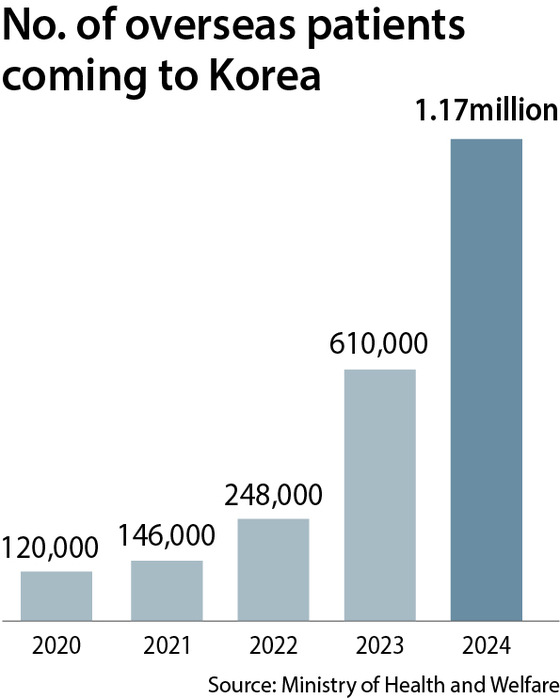
The industry's rapid growth has even resulted in the coining of the term "medical tourism," referring to foreign travelers coming to Korea for beauty and other treatments and has been on the government agenda for years as a means to spur growth in tourism sector.
Many K-beauty followers come on tightly scheduled trips, opting for bundled packages that compress multiple procedures into just a few days — from treatments that take only minutes, such as Botox injections or skin boosters, to more involved operations like eyelid surgery or rhinoplasty.
During these short-term visits, it is often agency managers, as well as consultants and translators, who ensure the experience runs smoothly.
![A TikToker introduced a “Korea Glow Up List,” recommending beauty treatments — including chin InMode — for a glow-up in Korea. [SCREEN CAPTURE]](https://koreaseafood.online/data/photo/2026/01/09/43e4c92b-b235-49c9-ae3f-a128c9c1249b.jpg)
A TikToker introduced a “Korea Glow Up List,” recommending beauty treatments — including chin InMode — for a glow-up in Korea. [SCREEN CAPTURE]
K-beauty's invisible brokers
Korean patients usually book directly with clinics, hopping from one to another in search of the right surgeon at a reasonable price. Many international visitors, however, first turn to medical tourism agencies, easily searchable online.
![A dense cluster of plastic surgery clinics in Seoul [YONHAP]](https://koreaseafood.online/data/photo/2026/01/09/b8d11e4b-f2d1-42b8-a9f5-2f4db90b3530.jpg)
A dense cluster of plastic surgery clinics in Seoul [YONHAP]
Medical tourism agencies help foreign patients plan and manage medical treatment abroad and are run by government-backed centers, such as the Medical Korea Info Center or private companies.
As of 2024, there were 1,195 plastic surgery clinics in Korea, up 20.6 percent from 991 in 2019, according to data by Rep. Kim Mi-ae from the Health Insurance Review and Assessment Service. The number of dermatology clinics also rose by 11.8 percent over the same period.
![Foreign tourists in Myeongdong, central Seoul, on Dec. 21, 2025 [NEWS1]](https://koreaseafood.online/data/photo/2026/01/09/e7d212f7-a47e-4d86-bff4-8220a021222f.jpg)
Foreign tourists in Myeongdong, central Seoul, on Dec. 21, 2025 [NEWS1]
For most overseas patients using the agencies, the process begins online.
Initial contact typically takes place through messaging platforms or email, where online consultations allow agency managers to identify patient's concerns, help in finding suitable clinics for desired procedures and gather recommendations and pricing quotes.
Once a patient decides to move forward, the manager schedules consultations and surgeries, explains recovery timelines and helps with travel preparation, including hotel bookings and visa-related guidance.
"They are not living in Korea, so they need to plan to their whole journey," said Maiya Kogay, who has spent seven years working across K-beauty industry both at agencies and clinics. "That's why the online consultation is an important part."
When the patient arrives in Korea, "the role becomes much more hands-on," said Hwang.
Managers typically meet patients at the airport and, from that point on, become inseparable companions, accompanying them to every clinic visit. "During consultations, the manager ensures that both the doctor and the patient fully understand each other, particularly when discussing expectations, limitations and surgical plans."
Support continues after surgery, with managers soothing post-op worries, delivering care kits and medications and escorting patients to every follow-up visit. "This level of support can be especially reassuring for patients who do not speak Korean and are recovering in an unfamiliar environment," said Hwang.
![Eugenia Hwang assists a patient during a post-operative checkup. [EUGENIA HWANG]](https://koreaseafood.online/data/photo/2026/01/09/3ce1b028-1c81-48fd-b2bd-1b3f4e6b0e79.jpg)
Eugenia Hwang assists a patient during a post-operative checkup. [EUGENIA HWANG]
The role does not stop at medical care. "Beyond medical care, the manager's role often becomes deeply personal," said Hwang.
"We help patients with small, everyday tasks — ordering food when they're too tired to think clearly, navigating public transportation, running errands or shopping for daily necessities." Hwang added. "These moments are rarely part of any official service list, but they matter deeply when someone is recovering far from home."
Kogay described the whole serve as "like a concierge." "They assist you almost like your assistant and support you 24/7 while you are in Korea."
Peace of mind
Agency managers like Hwang, who oversee patients' care from start to finish, often kick off their K-beauty career with simpler, but crucial roles, such as translators.
"When I first started, I worked mostly as a translator during my first year, which is where my hands-on experience with consultations and patient communication began," Hwang said. Kogay, who now works as a marketing manager at a clinic, also began her career as a translator at an agency for about two years and still does English translations at her clinic.
Both overseas Koreans, they translated consultations for English-speaking patients. From the consultation to post-procedure follow-ups, they help overseas clients navigate an unfamiliar medical system.
![Vietnamese patients consults with medical staff at a dermatology clinic in Seomyeon, Busan. [JOONGANGILBO]](https://koreaseafood.online/data/photo/2026/01/09/bbb59f50-a7ad-49eb-b038-25c5df8fc0c1.jpg)
Vietnamese patients consults with medical staff at a dermatology clinic in Seomyeon, Busan. [JOONGANGILBO]
"I would say around 50 percent of a patient's final decision is influenced by the manager or translator assisting them," Hwang said, adding that they help patients in understanding "why a certain procedure is recommended or why it may not be necessary, and what kind of results they can realistically expect."
"A lot of doctors use medical terms that are very hard to understand if you are not in the medical field," said Kogay. "That's why a translator is very important."
"Even if the doctors are very skilled, if you cannot communicate very well, that is a problem especially in the beauty industry. It's also very crucial to deliver the patient concerns very clearly."
Their role goes beyond word-for-word translation.
Hwang had fronted patients who arrived with very strong expectations shaped by online information or social media, only to hear during consultations by doctors that those results are not realistic or safe.
"In moments like these, my role becomes especially important," said Hwang. "Not just translating words, but helping the patient emotionally process what they are hearing and understand that a more conservative approach can often lead to better and safer long-term results. I've seen patients feel disappointed or anxious at first, only to later express gratitude because they felt truly listened to and protected from making a rushed decision they might have regretted."
There is no formal certification required to work as a translator in Korean agencies and clinics, though it's important to be able to "speak at least two languages fluently," said Hwang. Most companies provide two to three weeks of training, but Hwang said "training alone is not enough" and emphasized the importance of empathy, communication skills and judgment as a key skills of a translator.
Entry-level salaries typically start at around 30 million won ($20,720) a year, with performance-based raises possible annually.
![A tourist receives a cosmetic surgery consultation at an experience booth during Seomyeon Medical Street Festival held in Seomyeon, Busan, in 2017. [JOONGANG ILBO]](https://koreaseafood.online/data/photo/2026/01/09/1aa33090-9661-46f9-918b-6899dfb381b0.jpg)
A tourist receives a cosmetic surgery consultation at an experience booth during Seomyeon Medical Street Festival held in Seomyeon, Busan, in 2017. [JOONGANG ILBO]
There are challenges as well.
Kogay has handled complicated cases requiring interpretation for multiple people, such as families or groups traveling together. "I go in with all of them, even four of them, and just translate for each of them. Of course, you are exhausted by the end of the day."
"But I think one of the hardest part of the translator work is people," she said. Kogay had met few patients who had "a lot of the concerns and mental issues." "Those people can be a little bit tough to work with because they might be very, not understanding. If they're not satisfied with the result, they might get very aggressive. It is hard."
Still, the role can be deeply meaningful, with translators often taking on an emotional support role as well — particularly during recovery, when patients may feel anxious about the results. "You are their moral support," she said. "You keep listening to them and help them get through it, explaining, like, 'Hey, it' s okay.'"
For Hwang, the rewards from managing and assisting patients remain clear.
"In the end, the most meaningful part of my work is seeing patients go home happy and relieved, feeling more confident, more comfortable in their own skin and genuinely excited about a fresh start. Those moments are what make this job truly rewarding for me."
BY WOO JI-WON [[email protected]]


with the Korea JoongAng Daily
To write comments, please log in to one of the accounts.
Standards Board Policy (0/250자)