

Pension fund's currency interventions could heighten U.S. scrutiny on Korea, says former NPS chief
Published: 18 Dec. 2025, 18:21
Updated: 18 Dec. 2025, 18:48
-

- JIN MIN-JI
- [email protected]
![Electronic display boards at a foreign exchange booth shows the rate in Seoul on Dec. 18. [NEWS1]](https://koreaseafood.online/data/photo/2025/12/18/53621ddc-56d2-463a-a3a8-ffe281acc226.jpg)
Electronic display boards at a foreign exchange booth shows the rate in Seoul on Dec. 18. [NEWS1]
The National Pension Service’s (NPS) expanding role in stabilizing the won against the dollar could spark friction with the United States over currency intervention and provide a pretext for a prolonged designation as a currency-monitoring country, a former head of the world's third-largest pension fund warned.
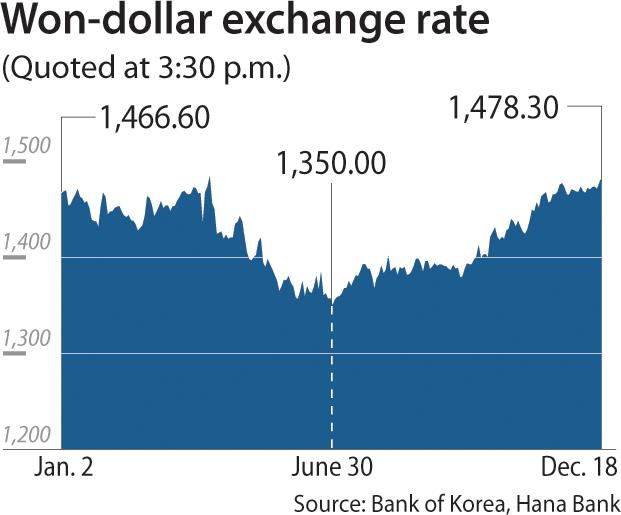
The NPS has emerged as Seoul’s key lever in defending the won, which has largely remained above the psychological threshold of 1,400 won this year. It was quoted at 1,478.3 at 3:30 p.m. on Thursday after breaking past 1,480 the previous day — the weakest in eight months.
The pension fund recently extended its strategic foreign exchange hedging program and the $65 billion swap agreement with the Bank of Korea through the end of next year, amid the government’s will to strengthen the won against the dollar.
“Korea’s measures to stabilize the foreign exchange market, especially the involvement of the NPS and pressuring export companies to convert their dollar earnings, could be interpreted as currency manipulation,” said Jun Kwang-woo, the Chairman of the Institute for Global Economics and the former Chairman of the NPS and the Financial Services Commission.
![Jun Kwang-woo, chairman of the Institute for Global Economics and the former chairman of the NPS and the Financial Services Commission, speaks at a forum held in central Seoul on March 4. [NEWS1]](https://koreaseafood.online/data/photo/2025/12/18/db5af8bf-bcca-480e-ab70-a52eed09eb18.jpg)
Jun Kwang-woo, chairman of the Institute for Global Economics and the former chairman of the NPS and the Financial Services Commission, speaks at a forum held in central Seoul on March 4. [NEWS1]
“If such measures meet the U.S. criteria, they could become a source of tension in Korea-U.S. financial and trade relations. Repeated or large-scale interventions could also potentially undermine Korea’s external credibility and have negative implications in international financial markets,” Jun added, explaining that the U.S. Department of the Treasury emphasizes any direct or indirect government intervention in the market is subject to “close scrutiny.”
The United States evaluates cases based on three criteria: bilateral trade surpluses with the United States, material current account surpluses and persistent, one-sided interventions in the foreign exchange market.
In the Treasury’s June report, the United States kept Korea on the Monitoring List of major trading partners for the second consecutive time, noting that its “currency practices and macroeconomic policies merit close attention.”
The report mentioned the NPS’s tripled advance foreign exchange purchase limit and expanded swap agreement with the BOK, signaling the United States’ growing attention to the pension fund’s rising role in the foreign exchange market.
The Treasury mentioned the pension fund’s increase in total foreign asset holdings in its November 2024 report, but did not comment on any strategies that might influence the foreign exchange market.
The NPS has become a force to be reckoned with due to its sizable overseas investments. It had invested 604.8 trillion won ($410 billion) in overseas stocks and bonds as of the end of September, accounting for 44.4 percent of its 1,361 trillion won in assets under management. Its overseas holdings in equities and bonds are roughly on par with Korea’s total foreign reserves, which stood at $430.66 billion at the end of November.
“We don’t expect any countries to be removed from the list, which would then include China, Germany, Ireland, Japan, Korea, Singapore, Switzerland, Taiwan, Thailand and Vietnam,” said Francesco Pesole, a foreign exchange strategist at the ING Bank NV, in a report in November. He noted that the Treasury “intensified focus” on foreign exchange practices through the lens of tackling the large U.S. trade deficit.
To address concerns about foreign exchange manipulation, Seoul in September agreed to refrain from currency manipulation and to intervene only in cases of excessive volatility or market disorder, while committing to monthly disclosure of interventions, reserves, and forward positions.
Despite the concerns, some believe that the foreign exchange authorities’ growing efforts to strengthen the won will have only a limited impact on the Seoul-Washington relationship.
“The Korean government is currently focused on correcting excessive weakness in the exchange rate, which runs in the opposite direction of what the United States is concerned about,” said Jee Man-soo, a senior research fellow at the Korea Institute of Finance. “So it is unlikely to become a point of friction with the United States. If anything, it could have the effect of easing U.S. concerns related to the exchange rate.”
He downplayed the significance of the Treasury’s mention of the NPS in its monitoring list report.
“The view is simply that the authorities are monitoring important institutional changes related to the exchange rate. The reference reflects an awareness of these policy changes, rather than signaling concern,” Jee added.
“At its core, the U.S. objective is to prevent other countries from excessively devaluing their currencies — particularly cases where China, for example, offsets the impact of higher U.S. tariffs through exchange rate movements, or weakens the yuan to boost the price competitiveness of its exports relative to U.S. firms even in the absence of tariffs,” said Min Gyeong-won, a foreign exchange economist at Woori Bank. “The currency report is focused on such practices and does not take issue with currency appreciation.”
BY JIN MIN-JI [[email protected]]


with the Korea JoongAng Daily
To write comments, please log in to one of the accounts.
Standards Board Policy (0/250자)