

Korea tops robot charts. But why can't it keep the lead?
Published: 10 Dec. 2025, 07:00
-

- SARAH CHEA
- [email protected]
Audio report: written by reporters, read by AI
![A Korean-made humanoid robot holds Korean flags at a robotics exhibition held at Kintex in Goyang, Gyeonggi, on Nov. 5. [NEWS1]](https://koreaseafood.online/data/photo/2025/12/10/ca6c26a5-26d8-41a1-ad37-228d7498f4dc.jpg)
A Korean-made humanoid robot holds Korean flags at a robotics exhibition held at Kintex in Goyang, Gyeonggi, on Nov. 5. [NEWS1]
[NEWS ANALYSIS]
At Hyundai Motor’s flagship plant in Ulsan, the entire process on the assembly line for car bodies — where the very backbone of a vehicle is manufactured — is handled entirely by robots, without a single human in sight.
While such full automation has become a common sight, a closer look reveals a stark reality: Amid the global boom in "physical AI," Korea may top the charts in robot density — a measurement of robots to human workers — but high-performing, productivity-driving robots, the kind that signal true technological prowess, are notably absent.
China aims to secure primacy by 2027, with major players such as Ubitech and Unitree rolling out new models at a breakneck pace, buoyed by an aggressive wave of state-level support.
![Humanoid robots from Korean startups AeiROBOT, Rainbow Robotics, Robros and Blue Robin stand at a ceremony marking the launch of the ″K-Humanoid Alliance″ in central Seoul on April 10. [NEWS1]](https://koreaseafood.online/data/photo/2025/12/10/f2849405-c17a-4eeb-9a0c-d5bb6c0be13e.jpg)
Humanoid robots from Korean startups AeiROBOT, Rainbow Robotics, Robros and Blue Robin stand at a ceremony marking the launch of the ″K-Humanoid Alliance″ in central Seoul on April 10. [NEWS1]
Density isn’t development
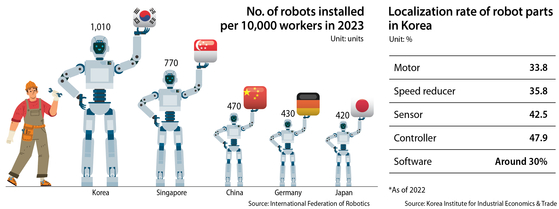
In terms of robot deployment, Korea stands unrivaled. The country had 1,012 industrial robots per 10,000 employees in 2023, the highest figure ever recorded and far above the global average of 162, according to a report by the International Federation of Robotics. The gap with other nations is staggering: Singapore, the second-highest, is at 770 units, followed by China at 470 and Germany at 430.
But a critical caveat lies in Korea’s robotics capability, which remains largely confined to traditional industrial systems, rather than the autonomous, cognitively capable platforms that define the cutting edge of humanoid and physical AI development.
Morgan Stanley’s Humanoid 100 report shows that between 2022 and February of this year, 40 Chinese companies, or 61 percent of all firms globally, unveiled new humanoid robot models. North American companies accounted for 24 percent, while Korea had just one — Rainbow Robotics, a Samsung-affiliated robotics subsidiary.
The gap is equally stark in patent activity. Between 2018 and 2023, China filed 5,688 humanoid robot–related patents, far outpacing the United States’ 1,483 and Japan’s 1,195, while and Korea registered just 368.
![An industrial robot, Diden, developed by KAIST to be deployed in the harsh conditions of a manufacturing plant [YONHAP]](https://koreaseafood.online/data/photo/2025/12/10/33132e6b-32b4-4082-9c10-3d7e2dc8de3c.jpg)
An industrial robot, Diden, developed by KAIST to be deployed in the harsh conditions of a manufacturing plant [YONHAP]
“From a technological standpoint, if the United States stands at 100, Korea falls somewhere between zero and one,” said Park Chul-wan, a professor of automotive engineering at Seojeong University.
“Korea’s extensive use of robots simply makes it a convenient test bed, an attractive place for global companies to trial their products because many industrial robots are already deployed,” Park added. “In reality, Korea produces none of the high-end industrial robots that drive the frontier of the field.”
In practice, even Hyundai Motor Group’s roughly 88 percent stake in Boston Dynamics does not grant it meaningful control over the Massachusetts-based robot maker’s core technologies.
Large corporations, despite their capacity for significant investment, have been notably hesitant to enter the robotics market. As of 2023, Korea was home to 2,524 robotics companies, of which more than 98 percent were small- and medium-sized enterprises. Large firms account for just 0.5 percent, or 12 companies, while mid-sized firms represent 1.3 percent, according to data from the Korea Institute for Robot Industry Advancement.
Among the total, roughly half, or 1,296 firms, operate affiliated research laboratories, yet only 53.8 percent of them are dedicated to robotics-related research.
Susanne Bieller, the general secretary of the International Federation of Robotics, also pointed out that Korea’s powerful labor unions, which she noted have often constrained productivity gains.
“Labor unions are quite strong in Korea; it's good to have them on board and make them understand it's not against them, but it's rather supporting their members to introduce automation,” Bieller said during a recent interview with the Korea JoongAng Daily.
“If you have the staff embracing the technology and not fighting against it, it could be one of the factors increasing productivity.”
![Atlas, Boston Dynamics’ bipedal humanoid robot [BOSTON DYNAMICS]](https://koreaseafood.online/data/photo/2025/12/10/634a9707-68ea-4d0b-8cd0-1f035bba9afd.jpg)
Atlas, Boston Dynamics’ bipedal humanoid robot [BOSTON DYNAMICS]
Chained to China’s lead
While Korea, which became the world’s second nation to develop the bipedal humanoid robot, Hubo, in 2004, hesitated, the United States and China seized the opportunity, surging ahead and rapidly closing the gap.
Of particular concern is Korea’s pronounced dependence on China for essential robotic components, casting doubts on the nation’s ability to bridge the technological gap and remain competitive in the global development race.
Domestic production rates for key robotic parts remain low, around 35.8 percent for reducers, 38.8 percent for motors, 42.5 percent for sensors and 47.9 percent for controllers, according to the Korea Institute for Industrial Economics and Trade.
![Korean-made humanoid robots work at a robotics exhibition held at Kintex in Goyang, Gyeonggi, on Nov. 5. [NEWS1]](https://koreaseafood.online/data/photo/2025/12/10/6081085e-2159-4c26-bee9-e1651c58a126.jpg)
Korean-made humanoid robots work at a robotics exhibition held at Kintex in Goyang, Gyeonggi, on Nov. 5. [NEWS1]
Reducers — a type of gearbox — alone are overwhelmingly supplied by Japanese manufacturers, which hold roughly 70 percent of the market, while more than half of the servomotors and controllers — essential for precise robotic movements — are imported from China and Japan.
China, meanwhile, has moved swiftly to localize and vertically integrate its robotic supply chains, which climbed from 27.3 percent in 2018 to 47.2 percent in 2023. The domestic rate for servo drivers surged from 40 percent to 90 percent, with 70 percent for actuation components.
Government-level investment further underscores the widening gap. While China has established funds totaling roughly 1 trillion yuan ($141 billion) for the robotics sector, Korea allocated around 1 trillion won ($681 million) for the so-called K-Humanoid Alliance by 2030.
“Chinese robots are estimated to cost roughly 50 percent less than competing alternatives,” said Lee Sang-su, a researcher at iM Securities, adding that they have enabled “several domestic firms to purchase Chinese robots, install proprietary software and resell or even export them, effectively allowing Chinese manufacturers to penetrate overseas markets indirectly through local intermediaries.”
![WIRobotics executives pose with its humanoid robot, Allex, in Cheonan, South Chungcheong, on Aug. 19. [KIM SUNG-TAE]](https://koreaseafood.online/data/photo/2025/12/10/f985f710-b1e8-42d2-a3c3-70252014acad.jpg)
WIRobotics executives pose with its humanoid robot, Allex, in Cheonan, South Chungcheong, on Aug. 19. [KIM SUNG-TAE]
BY SARAH CHEA [[email protected]]


with the Korea JoongAng Daily
To write comments, please log in to one of the accounts.
Standards Board Policy (0/250자)