

Approaching the Northern Sea route through the lens of energy security
Published: 05 Dec. 2025, 00:04
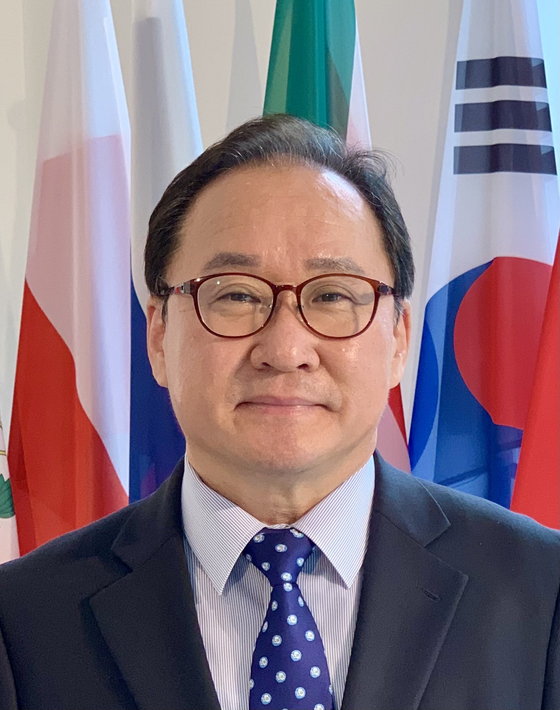
The author is a chairperson of the Korea Polar Research Committee
Arctic warming is progressing more than four times faster than the global average. As temperatures rise, sea ice in the central Arctic Ocean has thinned by more than 30 percent since the early 1970s. The total extent of Arctic sea ice is shrinking by about four percent each decade. If current trends continue, some researchers warn that summer sea ice in the Arctic Ocean may disappear entirely by around 2030.
![Hanwha Ocean's icebreaker [HANWHA OCEAN]](https://koreaseafood.online/data/photo/2025/12/05/54fd1c93-8803-47ae-8b6e-c92caf0ce9b3.jpg)
Hanwha Ocean's icebreaker [HANWHA OCEAN]
As ice retreats, interest in the Northern Sea Route has grown rapidly. Cargo volume along the route has increased tenfold over the past decade, reaching 38 million tons in 2024, and is expected to rise to 100 million tons by 2030. Although the route is mainly used in summer, expanded icebreaker fleets and improved weather services are likely to extend the navigable season. Its value lies not only in shorter distance. In a crisis such as the closure of the Suez Canal or the Strait of Malacca, the route would serve as a crucial alternative.
The Arctic is also a vast reservoir of natural resources. An estimated 13 percent of the world’s undiscovered oil and 30 percent of its undiscovered natural gas are believed to lie within the region. More than 80 percent of Russia’s natural gas is produced in western Siberia. The Yamal Peninsula alone, though only half the size of Britain, contains enough gas to supply Europe for more than 40 years. Major gas fields continue to be discovered across the Arctic continental shelf.
Until Russia’s invasion of Ukraine in 2022, gas produced in Yamal and western Siberia was supplied to Europe through pipelines. But the Arctic route offers a more economical way to deliver liquefied natural gas to East Asian markets such as Korea and Japan, which are too distant for overland transport. To develop the Yamal fields, Russia ordered 15 LNG icebreaking tankers from Daewoo Shipbuilding and Marine Engineering, now Hanwha Ocean.
Natural gas is a high-efficiency, relatively clean energy source that accounts for about 20 percent of Korea’s primary energy demand. It supplies roughly 30 percent of the fuel for power generation. Korea is gradually replacing coal with natural gas to meet greenhouse-gas reduction targets. As the country advances toward a hydrogen-based economy, demand for natural gas — half of hydrogen production currently relies on it — is expected to grow further.
Korea now imports most of its LNG from Qatar, the United States, Australia and Malaysia. The route from Russia’s Yamal Peninsula to Busan, about 12,000 kilometers (7,456 miles), is shorter than the 15,000-kilometer route from Qatar. Gas expected to be produced from future developments on Alaska’s North Slope would also move along segments of the Northern Sea Route.
Once the war in Ukraine ends, Korea will need to diversify its LNG suppliers to ensure stable energy security. Cooperation with Russia is likely to become more important. A strategic approach will be needed, similar to the former government’s New Northern Policy, to secure reliable supplies of Arctic energy resources.
Investment in Arctic infrastructure is expected to expand, including icebreaking LNG carriers, liquefaction facilities, loading terminals and onshore facilities such as storage tanks, pumps, communication systems and emergency-response equipment. Korea’s strengths in shipbuilding, civil engineering and plant construction could play a major role. Participation in such projects could secure new energy sources for Korea while opening new markets for its construction and plant industries.
![President Lee Jae Myung, who was then serving as Democratic Party leader, listens to a briefing on projected demand related to the opening of the Northern Sea Route during a visit to the Busan New Port promotion center in Gangseo District, Busan, on the morning of March 6. [YONHAP]](https://koreaseafood.online/data/photo/2025/12/05/38b8b404-6ec4-4217-8f85-280a4678e3bb.jpg)
President Lee Jae Myung, who was then serving as Democratic Party leader, listens to a briefing on projected demand related to the opening of the Northern Sea Route during a visit to the Busan New Port promotion center in Gangseo District, Busan, on the morning of March 6. [YONHAP]
Recognizing the growing importance of the Northern Sea Route, the Korean government has designated its development as a national priority. Plans include building icebreakers, training maritime professionals and expanding port facilities. The National Assembly is considering a special law to establish a Northern Sea Route Committee under the president, bringing multiple ministries together to coordinate Arctic logistics strategy.
Yet immediate use of the route for cargo between Korea and Europe remains limited because the route lacks intermediary transshipment ports. Its economic feasibility will improve only gradually. For now, the Northern Sea Route should be viewed not primarily as a logistics shortcut but as part of Korea’s long-term energy-security strategy.
Energy policy is inseparable from national security, economic competitiveness, environmental sustainability and technological capacity. As the global energy landscape shifts, securing access to Arctic natural gas through the Northern Sea Route will be an increasingly important option for Korea’s long-term stability.
This article was originally written in Korean and translated by a bilingual reporter with the help of generative AI tools. It was then edited by a native English-speaking editor. All AI-assisted translations are reviewed and refined by our newsroom.


with the Korea JoongAng Daily
To write comments, please log in to one of the accounts.
Standards Board Policy (0/250자)