

Gold rises or falls, but 'kimchi premium' sticks
Published: 15 Nov. 2025, 07:00
Updated: 16 Nov. 2025, 16:01
-

- JIN MIN-JI
- [email protected]
![Gold products are displayed at the Korea Gold Exchange in Jongno, central Seoul, on March 13. [NEWS1]](https://koreaseafood.online/data/photo/2025/11/16/99b04707-1f98-4997-9d03-7ef07ebfe001.jpg)
Gold products are displayed at the Korea Gold Exchange in Jongno, central Seoul, on March 13. [NEWS1]
[NEWS ANALYSIS]
Frenzied gold trading continues to fuel a striking price disparity between Korea and the international market, sustaining the so-called kimchi premium during both highs and lows in gold prices.
The price difference stems from thin liquidity in Korea’s gold futures market — limiting arbitrage opportunities — and a surge in demand that outstrips supply.
The price gap surged past a whopping 20 percent last month, with the Korean market trading at a premium, as investors’ rising bets on the U.S. Federal Reserve's interest rate cuts pushed the international spot gold price to a record high of $4,380 per ounce.
The disparity continued even with late October's weak gold trading.
When the international spot gold price plunged more than 4 percent on Oct. 22, its price in Korea still traded at a premium of 3.7 percent — remaining well above the 1 percent gap recommended by the Korea Exchange (KRX). As of Friday, the Korean market for the bullion traded at a premium of 2.17 percent, widening the gap as gold price bounced back above $4,200 an ounce this week after sliding below $4,000 in early November, according to the KRX data.
![An office worker tries to buy gold from a vending machine.[JOONGANG ILBO]](https://koreaseafood.online/data/photo/2025/11/16/ebf88584-1106-4ceb-a889-0a4fd2c0f24a.jpg)
An office worker tries to buy gold from a vending machine.[JOONGANG ILBO]
“The gold price disparity has occurred regularly in the past few years, in line with the rise in gold investments in Korea,” said Hong Sung-ki, a commodity analyst at LS Securities.
“Typically, such price gaps should quickly close through arbitrage. But that isn’t happening because Korea’s futures market lacks sufficient liquidity, leaving no practical way to conduct arbitrage. As a result, the premium persists,” Hong added.
Arbitrage is the simultaneous buying and selling of an asset in different markets — such as the spot and futures markets — to lock in a profit from the price difference. However, this type of arbitrage is difficult in Seoul as trades are inactive in the gold futures market, effectively leaving only spot selling as the viable option.
Korea launched the gold futures market in 1999, but trading volumes have remained weak, with daily turnover as low as 225 million won ($154,166) as of Thursday. To boost market liquidity, the KRX signed a partnership with Korea Investment & Securities in 2022, under which the firm commits to executing a certain level of trades to facilitate contract execution for other investors.
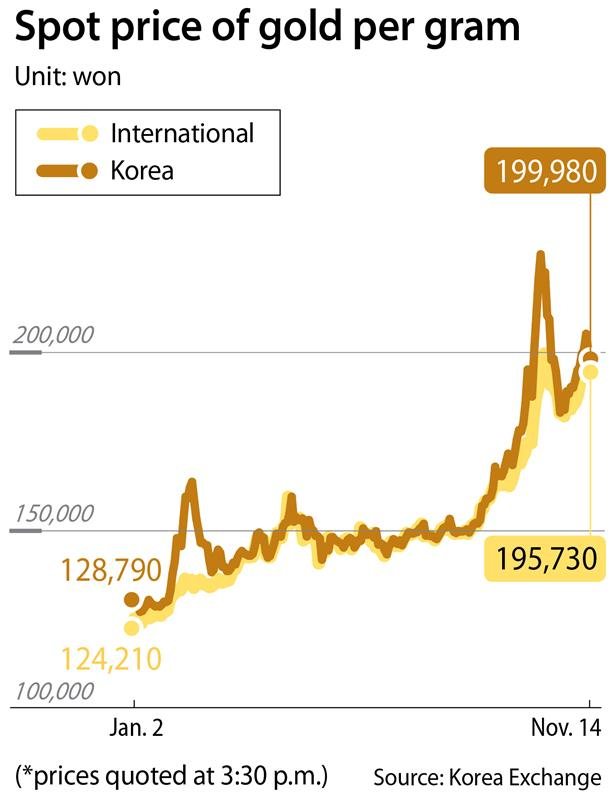
Soaring demand far outstripping supply is also fueling the kimchi premium.
The average daily gold trading volume on the KRX gold market skyrocketed from 195 kilograms (430 pounds) in January to a staggering 821 kilograms in September and jumped past 1,000 kilograms in October. Gold has been so popular recently that gold distributor Korea Gold Exchange had to suspend sales last month, citing issues with the supply of raw materials and a surge in orders.
Meeting the jump in demand takes time, as imported gold must go through quality certification and storage procedures before it can be made available for trading.
“Only designated suppliers are allowed to provide gold to our market,” said Choi Ju-yeon, head of the KRX’s commodities market department. “Even though they try to supply as much as possible, including both domestic and imported gold, demand has been overwhelmingly high.”
As demand fails to keep up with supply, the Financial Supervisory Service last month raised warnings to investors of potential losses, telling them to be cautious of gold price “as they converge to the international price.”
The KRX also issued warnings in September and October, saying that “investors are advised to exercise caution” when trading in the KRX gold market in light of the recent widening gap.
Gold prices are expected to rise further, potentially widening the price gap as supply struggles to keep up with demand.
J.P. Morgan analysts kept a bullish outlook on the bullion in late October, forecasting that it could reach an average of $5,055 per ounce by the last quarter of 2026, according to a report from Reuters. They cited demand assumptions from investors and central bank buying averaging around 566 tons a quarter next year amid the Fed’s rate-cutting cycle with overlays of stagflation anxiety as reasons for their outlook.
“We can see that net buying of gold remains relatively strong considering the major buyers – such as central banks, retail investors and exchange-traded fund inflows,” said Oh Jae-young, an analyst at KB Securities. “Also, given the rate-cutting cycle of the U.S. Federal Reserve, which is expected to cut rates at least once next year, the overall environment still appears favorable for gold prices.”
BY JIN MIN-JI [[email protected]]


with the Korea JoongAng Daily
To write comments, please log in to one of the accounts.
Standards Board Policy (0/250자)