

Korea Inc. tightens belt: Factories still and investments put on hold
Published: 04 Apr. 2025, 19:42
Updated: 09 Jul. 2025, 15:37
-

- SARAH CHEA
- [email protected]
Audio report: written by reporters, read by AI
![Samsung Electronics' manufacturing complex in Pyeongtaek, Gyeonggi [SAMSUNG ELECTRONICS]](https://koreaseafood.online/data/photo/2025/07/09/c21b3784-455a-424b-b32f-6c8ff393c60d.jpg)
Samsung Electronics' manufacturing complex in Pyeongtaek, Gyeonggi [SAMSUNG ELECTRONICS]
[NEWS ANALYSIS]
Spanning an area equivalent to 400 football stadiums, Samsung Electronics’ massive chip complex in Pyeongtaek, Gyeonggi, once symbolized Korea’s dominance in the semiconductor industry. But the area has been less active over the past months.
The construction of the new plants — dubbed P4 and P5 — have been on hold since last year due to market downturn, the country’s uncertain leadership and U.S. President Donald Trump’s tariffs and subsidies.
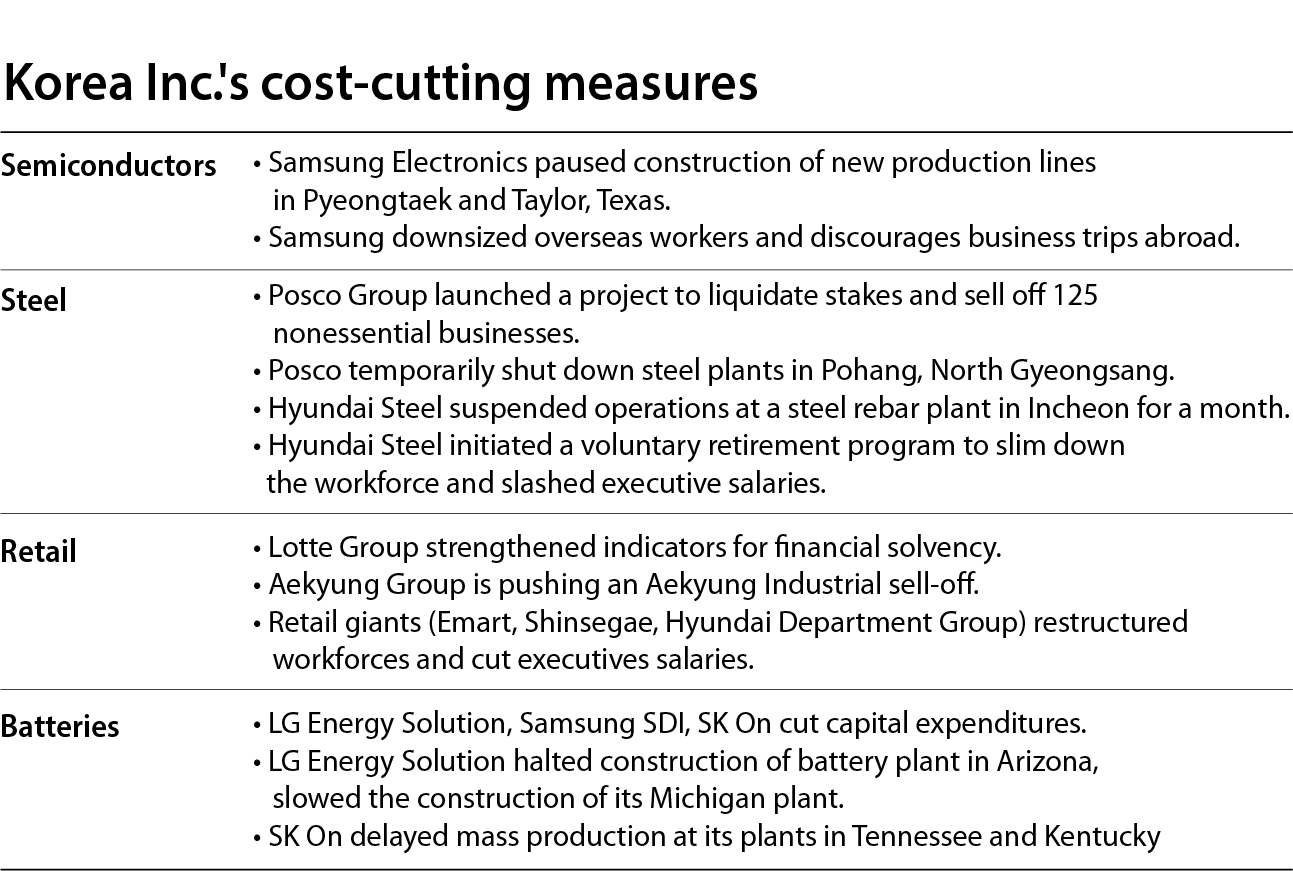
This type of freeze and a cut-down in overall expenditures have increasingly become the new normal in Korea’s major industries as they face hostile market conditions and a turbulent political landscape both internally and externally.
Silently waiting to embrace the unpredictable side effects the impeachment of President Yoon Suk Yeol and the U.S. President Donald Trump’s ongoing tariff tussle could trigger, the cost-cutting measures arrived in various forms, from the pausing of overseas and domestic plants to the massive liquidation of nonessential assets.
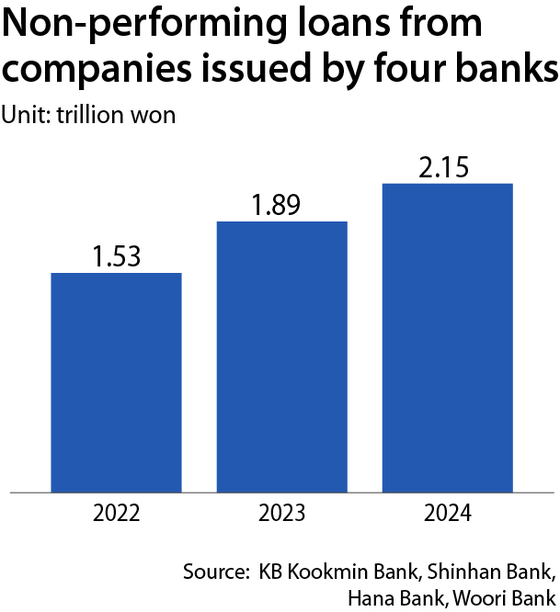
But some companies are already heavily indebted and unable to pay it back. The volume of nonperforming loans, or loans that a borrower is unlikely to repay on time or in full, held by companies operating in Korea, issued by four banks — KB Kookmin, Shinhan, Hana and Woori — had spiked to 2.15 trillion won ($1.5 billion) as of 2024, up 40 percent from 2023’s 1.53 trillion won.
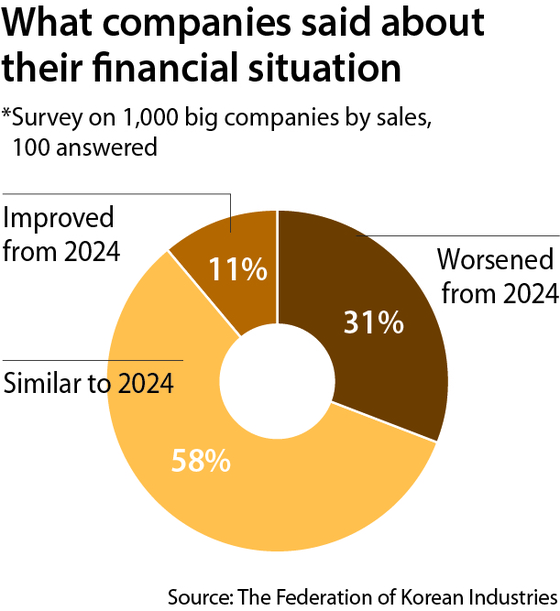
Thirty percent of Korea’s large companies said their financial situation had “worsened from 2024” while only ten percent answered that it had “improved from 2024.” The Federation of Korean Industries conducted a poll on 1,000 big companies by sales, and 100 of them answered.
Pacing the schedule
Samsung Electronics has stopped bringing in equipment and the orders for raw materials essential to producing chips at the factories under construction, a maneuver used by a chipmaker to slow down investment.
"It has been months since the construction stopped at both P4 and P5 factories," said a source at a major supplier to the Korean tech giant.
Samsung C&T, a primary builder of the Pyeongtaek facilities, pushed back the timeline of a production line at P4 to the end of this year from March 31, according to an electronic disclosure.
A spokesperson at the chipmaker declined to directly address the question about the status of P4 and P5 and said that the company was "adjusting the schedule in a flexible manner, depending on market conditions."
The chip producer also has a manufacturing site under construction in Taylor, Texas, where Samsung pledged to spend $44 billion. The U.S. factory's start of operations was rescheduled to 2026.
With the Trump administration threatening to repeal the $4.7 billion in subsidies promised under the former Joe Biden administration, the chipmaker is in a tough spot at home and abroad.
Still, the spokesperson said that Samsung is pushing ahead with the plan to operate in 2026 at the Taylor site.
![Hyundai Steel's steel reinforcement rebar plant in Incheon, which was shut down on April 1 for a month due to weak demand. [YONHAP]](https://koreaseafood.online/data/photo/2025/07/09/a0a0eb04-206b-4fd4-97f6-a779491c10db.jpg)
Hyundai Steel's steel reinforcement rebar plant in Incheon, which was shut down on April 1 for a month due to weak demand. [YONHAP]
Noncore assets up for sales
Steelmaking firms are even dumping some less-related subsidiaries to put cash in their coffers while sluggish demand lingers with the influx of China’s low-cost products.
Posco Group has set a goal to pull out from 125 businesses or assets — 55 low-profit businesses and 70 noncore assets — since last year in an attempt to improve asset efficiency.
A total of 45 projects were completed as of last year, during which Posco was able to secure 662.5 billion won in cash. It includes Posco Holdings’ offloading of its entire 0.9 percent stake in KB Financial Group for an estimated price of 190 billion won.
“The whole companywide effort is to secure funds for further situations; Posco Group plans to divest 61 more businesses or assets by this year to collect a total of 2.1 trillion won in reserves,” said a spokesperson for Posco.
“In line with this, Posco Holdings is in the process of selling off its shares of Zhangjiagang Pohang Stainless Steel, its stainless plant in China.”
Posco Holdings and Posco China hold 82.53 percent of the plant, which is approximated valued at some 500 billion won. The remainder stake is held by China's Jiangsu Shagang.
The steelmaker also decided to sell off 15.69 million shares of Nippon Steel, or 1.5 percent of its stake, for 467.8 billion won.
Hit by weak demand, Posco also shut down a wire rod plant in Pohang, North Gyeongsang, in November, just five months after the shutdown of a steelmaking facility.
Hyundai Steel on April 1 also suspended the operation of its steel rebar plant in Incheon, forcing 400 employees to stay home and receiving just 70 percent of their salaries.
After entering "emergency management mode," Hyundai Steel is currently offering early retirement packages to all employees 50 and older and has slashed the salaries of executives by 20 percent.
![This picture taken in Jan. 2023 shows the early construction phase in SK On's battery plant in Glendale, Kentucky, a joint venture with Ford Motor. The two have two plants there, with one factory that faced a delay in mass production due to the sluggish demand. [SK ON]](https://koreaseafood.online/data/photo/2025/07/09/53afbab6-6bbd-44bf-ba19-a062022e7240.jpg)
This picture taken in Jan. 2023 shows the early construction phase in SK On's battery plant in Glendale, Kentucky, a joint venture with Ford Motor. The two have two plants there, with one factory that faced a delay in mass production due to the sluggish demand. [SK ON]
Trimming investments
Korean battery companies, once aggressive investors, are cutting back on their capital expenditure and pausing some pledged investments in the United States to prevent any budget bleeding from unused but costly facilities.
LG Energy Solution, the country’s largest battery maker, has announced that it will cut capital expenditures by 3 trillion this year, or 30 percent, compared to 2024.
“LG Energy will utilize unused capacity for energy storage systems [ESS] instead of newly investing in Arizona,” said Lee Chang-sil, a chief financial officer from LG Energy Solution, at a conference call in January.
The Arizona plant was initially planned to have two production lines, cylindrical batteries and batteries for ESS, but the construction for the ESS facility was suspended in June.
The Korean battery manufacturer is also scaling down the construction of its Michigan plant, initially planned as a joint investment with General Motors, to adjust supply amid low demand.
SK On halved its capital expenditures for this year to 3.5 trillion won and decided to delay the operation of its Tennessee plant by a year, which was about to start mass production this year.
The delay came following its No. 2 Kentucky plant, on which the postponement had already been decided two years ago. SK On and Ford Motor invested $11.3 billion in the three plants, but only one Kentucky plant is slated to start production in the second quarter as scheduled.
Samsung SDI also said it is “adjusting its investment plans,” and taking a cautious approach toward its independent plant in North America, where the former CEO has said to come shortly.
Capital injection
Starting this year, Lotte Group ordered all subsidiaries to strengthen their indicators of financial solvency, expanding the scope to all divisions, including the marketing team that inevitably uses more expenses than other teams.
The affiliates now have set their own business objectives to secure financial stability such as reduction in borrowings, sell-offs of property assets and cut or hold in investment sizes.
“The company is pushing to seek internal stability rather than committing mergers or acquisitions that have vague and uncertain profitable structures,” said an executive from Lotte on the condition of anonymity. “That’s same as ordering [us] not to spend money, so we’re all reducing the expenses.”
Cash-strapped AK Holdings, the holding company of Aekyung Group, is currently in the process of disposing of its 64 percent shares of Aekyung Industrial, a cosmetics and consumer goods manufacturer.
Known as a cash cow arm, the value of the deal is estimated at some 600 billion won, which AK Holdings aims to use to cut its snowballing debt. The holding company’s accumulated debt stands at 4 trillion won as of the end of 2024.
Solely in the retail industry, two companies — Homeplus and Balaan — have already entered corporate rehabilitation due to liquidity concerns caused by credit rating downgrades. Team Fresh, a logistics company, has halted its early morning delivery service after failing to pay delivery workers.
"In a scenario where the lingering economic slump leads to more companies going bankrupt, the corporate bond market could be strained quickly from then on," said Ha Joon-kyung, economics professor at Hanyang University. "Some companies may will be blocked from funding, along with the jump of interest rates, even for firms with relatively high credit ratings."
BY SARAH CHEA, PARK EUN-JEE, CHOI HYUN-JU [[email protected]]


with the Korea JoongAng Daily
To write comments, please log in to one of the accounts.
Standards Board Policy (0/250자)