

Cheap yen under 'Takanomics' lures Korean travelers, but exporters sound alarm
Published: 14 Nov. 2025, 07:00
-

- JIN MIN-JI
- [email protected]
![People visit a shopping street near the Ise Jingu shrine complex in Ise, central Japan on May 1. [AP/ YONHAP]](https://koreaseafood.online/data/photo/2025/11/14/6097e928-3f47-4ee3-b8df-4b4235d85165.jpg)
People visit a shopping street near the Ise Jingu shrine complex in Ise, central Japan on May 1. [AP/ YONHAP]
Park, an office worker living in Gyeonggi, is an avid fan of Japan. She flies to the country three times a year, each time exploring a different city and its unique attractions: hot springs in Sapporo, cherry blossoms in Kyoto and golf resorts in Kagoshima.
She spends at least 2 million won ($1,360) per visit, but says she is ready to spend more when the yen further depreciates. “With the weak yen, I get to shop at great discounts — sometimes so much that it feels like I’ve already made up for my airfares,” said Park, who bought a wedding ring from Cartier last year and frequently buys apparel at Comme des Garçons during her trips to Japan. “Considering how much it costs to travel to other nearby destinations like Jeju Island, trips to Japan actually feel affordable.”
With yen depreciation looming under Prime Minister Sanae Takaichi — a hard-line conservative favoring fiscal expansion — Korea faces a widening travel deficit as trips to Japan become cheaper.
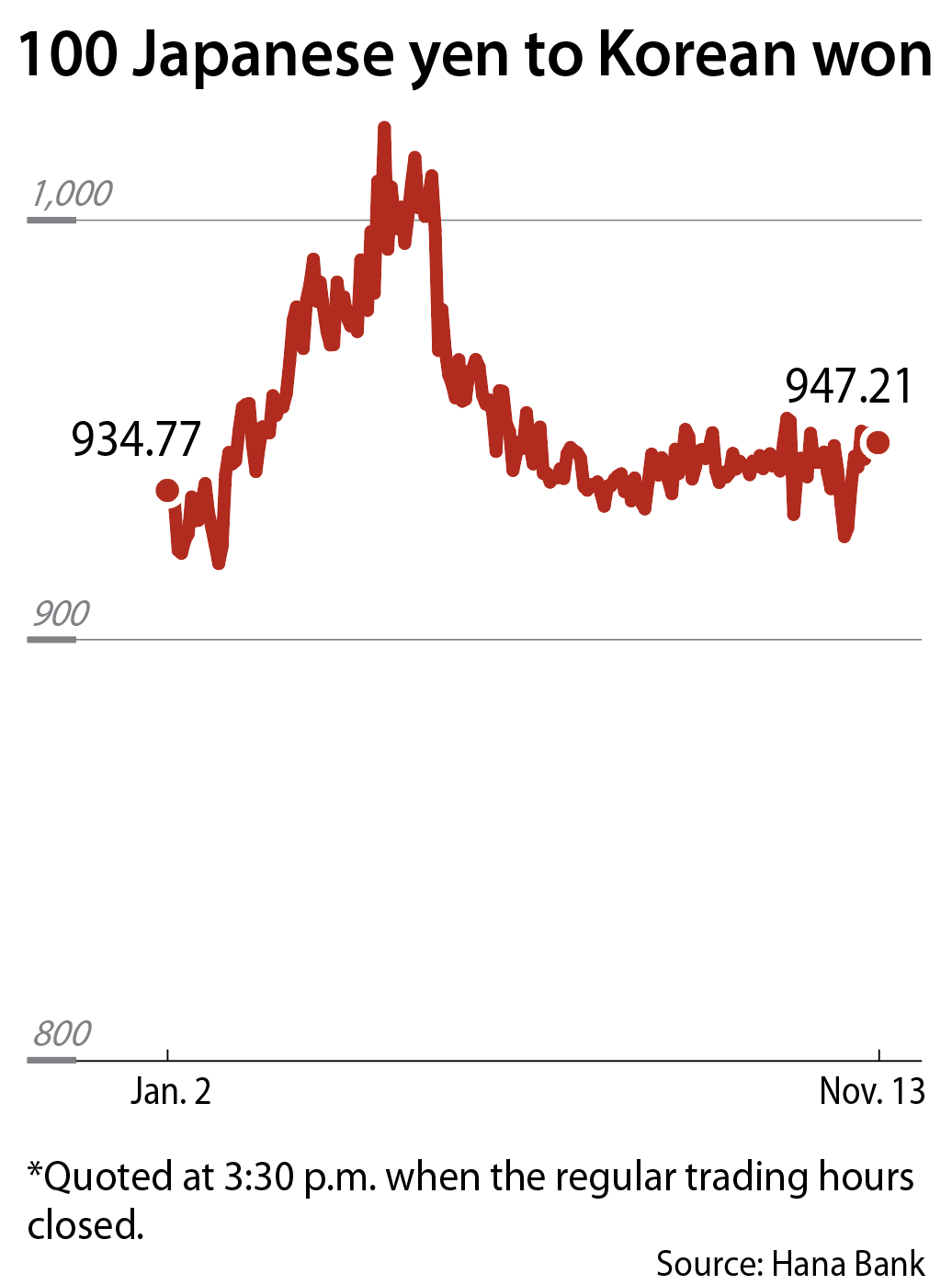
At the start of October, 100 yen ($0.65) was trading at around 950 won, a figure that had depreciated to 924.42 won by the end of the month following Takaichi's inauguration on Oct. 21. The decline even prompted U.S. Treasury Secretary Scott Bessent to issue a warning against maintaining a yen that is too weak through prolonged low interest rates.
The yen’s depreciation could reignite travel and shopping sprees in Tokyo, echoing the surge seen in 2024. Such a trend may further widen Korea’s already sizable travel deficit, which is estimated to have reached $7.31 billion through September this year. It could also dampen Seoul’s weak domestic demand and exports, which are already under strain from U.S. tariffs.
“An increase in outbound tourists could ripple across domestic industries — from hotels and restaurants to retailers such as department stores and duty-free shops — dampening local demand as more spending shifts abroad,” said Kim Gye-soo, a professor who teaches business at Semyung University. “Businesses in tourist areas, such as Jeju Island, are expected to be hit particularly hard.”
![People walk down a shopping street in a touristy section of Kyoto on October 11, 2022. [AFP/ YONHAP]](https://koreaseafood.online/data/photo/2025/11/14/dc04ee35-754e-43de-a2c5-3ef2415036bf.jpg)
People walk down a shopping street in a touristy section of Kyoto on October 11, 2022. [AFP/ YONHAP]
Cheaper yen, bigger travel bill
In line with the rising demand, airlines are increasing the number of flights. Jeju Air more than doubled its weekly flights to Osaka in October, raising them from three to seven. Similarly, Air Seoul plans to expand the number of its weekly flights to Yonago — a city in western Tottori Prefecture — from four to seven, starting next month.
In the early 2010s, Japan wasn’t considered an affordable travel destination for domestic tourists. It was an advanced economy where people went to experience highly developed industries and services. In 2010, 100 yen was trading for between 1,200 and 1,400 won, and Koreans’ personal gross disposable income was just $13,400 compared to $20,300 last year, according to the Bank of Korea.
“Japan has always been a great travel destination, though an expensive one,” said Seo Yong-gu, a professor of business at Sookmyung Women’s Univesity. “Now, it’s still a great place to visit but also an affordable one, making it one of the world’s best value-for-money destinations.”
With a weaker yen, increased income and more flights available from highly competitive budget airlines, Japan has become a viable alternative, now comparable to domestic tourist spots like Jeju Island and Namhae in South Gyeongsang.
A total of 8.82 million Koreans visited Japan last year, accounting for the largest 23.9 percent of all tourists to the country, distantly followed by China’s 18.9 percent, according to Japan National Tourism Organization.
They spent a staggering $6 billion on trips — the third highest after China ($11 billion) and Taiwan ($10 billion) — accounting for roughly 1.06 percent of Korea’s total individual credit card spending for 2024.
“If our travel deficit of roughly $10 billion was spent within Korea’s domestic industries, the impact on the domestic economy would be significant — it would create more jobs in regional businesses like hotels and local restaurants.” said Prof. Kim Nam-jo, who teaches at Hanyang University’s Graduate School of International Tourism.
Falling yen squeezes Korean exporters
In addition to domestic-oriented firms, Japanese exporters are also expected to welcome a weaker yen, as their products would become cheaper abroad and boost their profits when converting their overseas earnings back into yen.
However, it could deliver a direct blow to export-dependent Korea, with the impact expected to be particularly severe in industries that compete directly with Japan, such as the automobile sector.
![Japanese Prime Minister Sanae Takaichi speaks during a press conference after the Asia-Pacific Economic Cooperation (APEC) summit in Gyeongju, North Gyeongsang, on November 1. [REUTERS/ YONHAP]](https://koreaseafood.online/data/photo/2025/11/14/b7a5d00f-7916-4380-b455-3da2b75e3316.jpg)
Japanese Prime Minister Sanae Takaichi speaks during a press conference after the Asia-Pacific Economic Cooperation (APEC) summit in Gyeongju, North Gyeongsang, on November 1. [REUTERS/ YONHAP]
Japan — home to global carmakers such as Toyota, Honda, and Nissan — earned 21 percent of its total exports from the automotive sector last year, with most shipments bound for the U.S. market, according to Trading Economics. Cars accounted for 14 percent of Korea’s exports last year, with the United States also among its top destinations, showed industry government data.
Among Korea’s major trading partners, its export competitiveness with Japan was the highest at 46.8 in the third quarter of 2024, according to data from the Korea Trade-Investment Promotion Agency. Germany followed distantly at 39.8 and the United States at 39.1. A higher number indicates greater similarity in the countries’ exports.
Other notable competing products between the two countries include ships, petroleum products, chips and machinery.
Some analysts, however, argue that concerns over an ever-weakening yen may be overstated, expecting the yen to regain strength as political factors have already been priced in and broader economic fundamentals — including inflation and a potential U.S. rate-cut cycle — support a stronger long-term outlook.
“Political factors have already been priced into the yen’s depreciation,” said Oh Jae-young, an analyst at KB Securities, noting Takaichi’s assumption of office. “We expect the yen’s long-term trajectory to be stronger as the dollar weakens, given that the United States is in a rate-cut cycle and liquidity expansion is anticipated.”
BY JIN MIN-JI [[email protected]]


with the Korea JoongAng Daily
To write comments, please log in to one of the accounts.
Standards Board Policy (0/250자)