

Takaichi faces backlash after suggesting Japan would exercise self-defense in a Taiwan contingency
Published: 11 Nov. 2025, 20:46
![Japanese Prime Minister Sanae Takaichi responds to questions during a session of the House of Representatives' Budget Committee at the National Diet in Tokyo on Nov. 10. [AFP/YONHAP]](https://koreaseafood.online/data/photo/2025/11/11/66479ff6-7fa3-4492-bae7-ffe98e7f391c.jpg)
Japanese Prime Minister Sanae Takaichi responds to questions during a session of the House of Representatives' Budget Committee at the National Diet in Tokyo on Nov. 10. [AFP/YONHAP]
TOKYO — Concerns are growing in Japan over the foreign policy direction of Prime Minister Sanae Takaichi, the first sitting Japanese leader to publicly suggest that Japan would exercise its right to self-defense in the event of a Taiwan contingency.
Her remarks sparked strong backlash from China and raised fears domestically, as Takaichi’s comments may negatively impact Japan-China relations.
Criticism has also emerged over what some see as the limitations of “Takaichi diplomacy,” especially following the decision to cancel midair refueling for Korea’s Black Eagles flight team, allegedly over its recent flyover of Dokdo.
Takaichi made the controversial statement on Friday during a session of the House of Representatives' Budget Committee, according to Japan's Nikkei newspaper on Tuesday. When asked about a hypothetical Chinese blockade of the Taiwan Strait, she responded, “If force is used, such as warships engaging in military action, it could [...] constitute a situation that threatens Japan’s survival.”
Her comment implies that Japan's Self-Defense Forces could intervene militarily in a Taiwan contingency, triggering considerable political reverberations. When opposition lawmakers on Monday demanded she retract or revise the statement, Takaichi refused, saying, “It aligns with the government's long-held position.”
The Nikkei criticized Takaichi for abandoning “strategic ambiguity,” noting that past Japanese prime ministers intentionally left vague what circumstances would justify collective self-defense to avoid inflaming tensions with China.
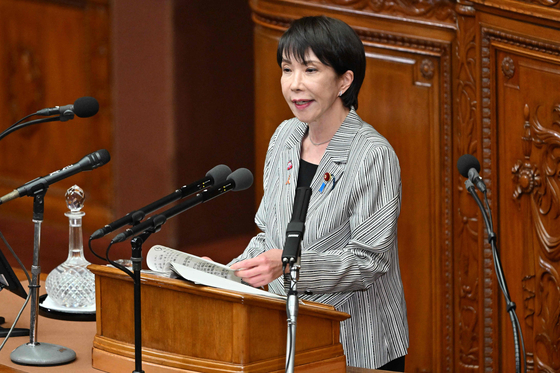
Japanese Prime Minister Sanae Takaichi answers questions from Yoshihiko Noda, the leader of the main opposition Constitutional Democratic Party of Japan, regarding her policy speech at the House of Representatives of the National Diet in Tokyo on Nov. 4.
“Governments must be prepared internally, but [their plans are] not something that should be stated outwardly,” one former prime minister reportedly said.
The Nikkei warned that such clarity may undermine deterrence, noting that citing specific scenarios in which Japan would exercise collective self-defense could actually weaken strategic positioning.
Another Japanese newspaper, the Asahi Shimbun, also warned that Takaichi’s remarks risk straining ties with China. Under Japanese law, a “situation threatening Japan’s survival” refers to an attack on a close ally, an existential threat to Japan’s security or a clear danger to the lives of its people. The paper noted that Takaichi’s interpretation appears to go beyond previous cabinet positions.
A senior Japanese Defense Ministry official told the Asahi, “Even the United States maintains ambiguity in how it would respond to a Taiwan crisis,” adding, “[Takaichi] should have used more ambiguous language like her predecessors did.”
A diplomatic spat has erupted as well, with a Chinese diplomat in Japan reportedly using phrases like “I will cut off your head” and “the road to death” in reaction to Takaichi’s remarks. Analysts suggest the timing — immediately after a summit between Chinese President Xi Jinping and Takaichi — exacerbated tensions.
![Japanese Prime Minister Sanae Takaichi speaks during a press conference after the Asia-Pacific Economic Cooperation (APEC) summit in Gyeongju, North Gyeongsang, on Nov. 1. [REUTERS/YONHAP]](https://koreaseafood.online/data/photo/2025/11/11/a89e8057-72c4-4f5f-87a6-340e9346ad47.jpg)
Japanese Prime Minister Sanae Takaichi speaks during a press conference after the Asia-Pacific Economic Cooperation (APEC) summit in Gyeongju, North Gyeongsang, on Nov. 1. [REUTERS/YONHAP]
Given Takaichi’s background as a hard-line conservative who has visited the controversial Yasukuni Shrine, which honors Class A war criminals, Xi was reportedly already wary of her leadership. Her remarks shortly after their summit could now derail efforts to thaw long-chilled China-Japan relations.
Chief Cabinet Secretary Minoru Kihara said on Tuesday that the Japanese government had explained Takaichi's intentions and reaffirmed its position to Beijing.
“Japan’s stance on Taiwan remains unchanged from the 1972 Japan-China Joint Communiqué,” Kihara said, adding that both governments had agreed to pursue a comprehensive strategic partnership and build a constructive, stable relationship.
Takaichi’s diplomatic missteps have also impacted Korea-Japan relations: A symbolic plan to provide midair refueling to Korea’s Black Eagles flight team at a Japanese Self-Defense Forces base — a first between the two countries — was scrapped.
![Korea’s Black Eagles flight team is seen during an air show over Seongnam, Gyeonggi, on Oct. 19. [YONHAP]](https://koreaseafood.online/data/photo/2025/11/11/e0d39522-38b9-4e5e-b458-375900ff5772.jpg)
Korea’s Black Eagles flight team is seen during an air show over Seongnam, Gyeonggi, on Oct. 19. [YONHAP]
The Japanese government canceled the plan on Oct. 30, just before the bilateral summit between Takaichi and President Lee Jae Myung, according to the Asahi. The move came after defense officials discovered that Korean Air Force planes, including the Black Eagles, had flown over Dokdo — a territory claimed by both Korea and Japan.
According to the newspaper, while some Japanese Defense Ministry officials argued the refueling should proceed, one official said, “If we don’t cancel it, it could be interpreted as accepting Korea’s claim to Takeshima.” Takeshima is the Japanese name for Dokdo.
The decision was reportedly made in consideration of the conservative base that supports Takaichi. The Asahi also reported that the refueling plan was originally part of a broader effort to build momentum toward signing a long-stalled Acquisition and Cross-Servicing Agreement between the two countries.
One Japanese Defense Ministry official lamented, “This only confirms that Korea and Japan aren’t even capable of doing something as basic as this.”
This article was originally written in Korean and translated by a bilingual reporter with the help of generative AI tools. It was then edited by a native English-speaking editor. All AI-assisted translations are reviewed and refined by our newsroom.
BY KIM HYUN-YE [[email protected]]


with the Korea JoongAng Daily
To write comments, please log in to one of the accounts.
Standards Board Policy (0/250자)